Amagansett sits between East Hampton Village and Montauk on the South Fork, a hamlet that has managed to preserve a character distinct from its wealthier neighbors. Known for its surfing culture, farm stands along Route 27, and a tight-knit mix of year-round residents and seasonal homeowners, Amagansett carries a laid-back authenticity that draws people who want the Hamptons experience without the formality. But like every East End community, Amagansett faces a housing crisis that threatens the very character that makes it special.
The median home price in Amagansett exceeds $2 million, putting homeownership out of reach for the workers who keep the community running. Rental prices during the summer season are astronomical, and even year-round rentals have escalated to levels that force essential workers into long commutes from communities far to the west. Accessory dwelling units — particularly the detached cottages that are part of Amagansett's architectural tradition — offer a practical, community-appropriate solution to this crisis.
Amagansett's Detached Cottage Tradition
Unlike many communities where ADUs represent a new concept, Amagansett has a long history of secondary dwellings on residential properties. The hamlet's character was shaped by fishermen, farmers, and tradespeople who built modestly and practically. Guest cottages, converted outbuildings, and secondary structures have been part of the landscape for generations. This tradition means that ADU construction in Amagansett does not feel like an intrusion — it feels like a return to how the community has always functioned.
The typical Amagansett residential lot is generous by Long Island standards, often ranging from half an acre to two or more acres in the areas north of Route 27. These lot sizes provide ample room for a detached ADU that maintains comfortable separation from the primary residence while still fitting naturally into the property's landscape. South of the highway, closer to the beach, lots tend to be smaller but many still offer conversion opportunities within existing structures.
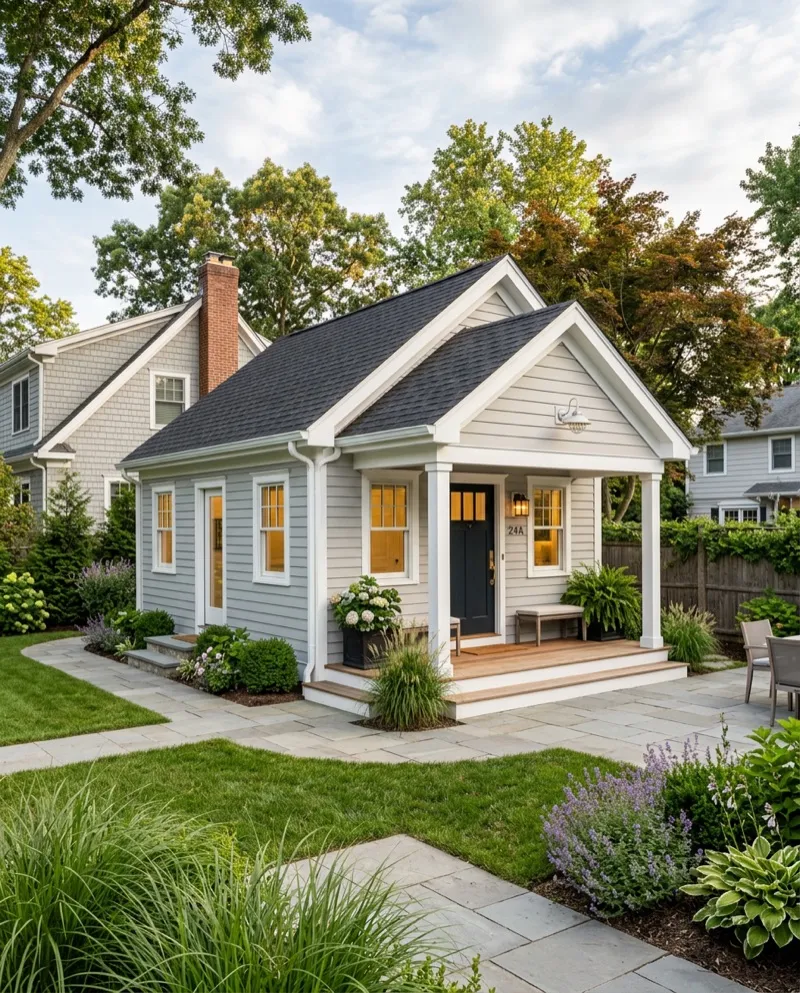
Amagansett's architectural language favors weathered cedar shingles, simple gabled forms, and honest materials. An ADU built in this vocabulary — a shingled cottage with a covered porch, operable windows to catch ocean breezes, and a garden — feels like it has always been there. This is one of Amagansett's great advantages for ADU construction: the community aesthetic naturally accommodates secondary dwellings.
The Plus One ADU Program: $125,000 Grants
The Plus One Accessory Dwelling Unit Program provides grants of up to $125,000 to homeowners who build ADUs and commit to renting them as workforce housing. For Amagansett property owners, this grant can cover a substantial portion of the cost of building or converting a secondary dwelling.
Program status — verified September 2026
Plus One ADU is a New York State program (an $85 million allocation through the Housing Trust Fund Corporation) but it is run town by town, and each town's intake opens and closes on its own schedule. As of September 2026 on Long Island: Huntington and Riverhead are accepting applications; Brookhaven, Islip and Southold are closed. Babylon, East Hampton, Shelter Island and Southampton run their programs through Community Development Long Island rather than the Long Island Housing Partnership.
The $125,000 is a cap, not an amount every applicant receives, and it is awarded as a grant. Huntington's published guidelines cap household income at 100% of Nassau/Suffolk area median income (2023 HUD limits: $109,400 for a one-person household, $156,300 for four) and require that you have owned and lived in the home for at least one year. Applications go on a first-come waitlist and are then re-ranked on priority points, including whether the unit will be affordable at or below 80% AMI and whether it can be permitted without a zoning variance. Municipal code always overrides the program guidelines. Verify your town's status before you budget around a grant: LIHP (631) 435-4710. We also check it for you on the walkthrough — see our Plus One ADU grant page for the eligibility checklist and what the build costs if your town's round is closed.
- Grant amount. Up to $125,000 toward construction costs. For many Amagansett projects, particularly conversions and modest cottage construction, this can cover 40 to 70 percent of the total budget.
- Income targeting. The ADU must be rented to tenants earning at or below 80% of the Area Median Income (AMI). This serves Amagansett's workforce: restaurant and hospitality workers, teachers, healthcare staff, tradespeople, and the service industry employees who sustain the community.
- Rental commitment. Grant recipients agree to affordable rental rates for a specified period, typically 10 years. The unit must serve as a long-term rental — short-term vacation use is not permitted under the grant.
- Eligible projects. New detached cottages, garage conversions, basement conversions, and outbuilding renovations all qualify. Amagansett's existing building stock provides numerous conversion candidates.
- Application assistance. We prepare construction estimates and project plans that strengthen Plus One applications for our Amagansett clients.
Consider the math: a 600-square-foot detached cottage in Amagansett might cost $200,000 to build. With a $125,000 Plus One grant, the net investment drops to $75,000. That cottage then generates rental income of $1,800 to $2,200 per month — a strong return on a modest investment, with the added benefit of supporting someone who works in and contributes to the community.
Interested in the $125K ADU grant?
We help Amagansett homeowners apply — free consultation.
Workforce Housing Demand in Amagansett
Amagansett's economy depends on a workforce that increasingly cannot afford to live in the community. The seasonal surge makes this particularly acute. During summer months, the population of Amagansett and surrounding communities can multiply several times over, creating enormous demand for hospitality, food service, retail, and personal service workers. But even in the off-season, the year-round community depends on teachers, healthcare workers, tradespeople, and municipal employees who face an impossible housing market.
The hospitality sector illustrates the problem most clearly. Amagansett's restaurants, from the casual spots on Main Street to the farm-to-table destinations that draw weekend visitors, struggle to recruit and retain staff because workers simply cannot find affordable housing within commuting distance. Some restaurants have reduced hours or limited menus not because of customer demand but because of staffing shortages rooted in the housing crisis.
ADUs built through the Plus One program directly address this shortage by creating year-round, affordable rental units in the community where workers are needed. A single ADU may house a restaurant line cook, a school teaching assistant, a home healthcare aide, or a landscaping crew leader — someone whose daily presence is essential to Amagansett's functioning but whose income cannot compete with the broader real estate market.
Year-Round vs. Seasonal Residents: A Community in Balance
Amagansett's character comes from its mix of year-round and seasonal residents. The year-round population — roughly 1,100 to 1,200 people — forms the community's backbone. These are the people who attend town meetings, volunteer at the fire department, coach Little League, and keep local businesses open through the winter months. But year-round residency is becoming financially untenable for all but the wealthiest or those who purchased homes decades ago.
ADUs help preserve this balance by creating housing that allows working people to remain in the community year-round. When a property owner builds an ADU and rents it to a year-round tenant, they are directly investing in the community's social fabric. The tenant becomes a neighbor, a customer at local businesses, a participant in civic life. This is the kind of housing that sustains a real community rather than a seasonal resort.
Zoning and Regulations in Amagansett
Amagansett is an unincorporated hamlet within the Town of East Hampton, which means the town's zoning code governs construction. East Hampton has been increasingly supportive of ADU development, and the regulatory environment is favorable for homeowners who want to build. Key zoning considerations include:
- Zoning districts. Amagansett includes several residential zoning districts with varying lot size minimums and building regulations. Most residential properties allow accessory structures, but specific size limits, setbacks, and coverage ratios depend on your zoning designation.
- ADU size limits. The Town of East Hampton establishes maximum sizes for accessory dwelling units based on the zoning district and lot size. Typical limits range from 600 to 1,000 square feet, which is sufficient for a comfortable one-bedroom or studio apartment.
- Setback requirements. Detached ADUs must maintain minimum distances from property lines and from the primary residence. Amagansett's larger lots generally provide ample room to meet these requirements with favorable positioning.
- Height restrictions. Accessory structures are typically limited to one or one-and-a-half stories. This keeps ADUs in proportion with the community's modest architectural scale.
- Design compatibility. While Amagansett does not have the same formal architectural review as East Hampton Village, the community has strong expectations for design quality. Cedar shingle exteriors, traditional proportions, and sensitive site placement are important.
- Environmental overlay. Properties near the beach, dunes, wetlands, or other environmentally sensitive areas may face additional review requirements from the East Hampton Trustees or other regulatory bodies.
Licensed & Insured
Full coverage on every project
36+ Cities Served
Suffolk County & Long Island
Free Walkthrough
No obligation, no pressure
Get a Free Estimate
Tell us about your project — we respond within 24 hours.
No spam. No obligation.
ADU Construction Costs in Amagansett
Construction costs in Amagansett reflect the Hamptons premium — higher labor rates, material delivery logistics to the East End, and the quality expectations of the community. However, Amagansett's more relaxed aesthetic compared to neighboring villages can keep costs somewhat more contained than in the most formal Hamptons communities. Here are realistic 2026 cost ranges:
- Garage conversion: $65,000 to $140,000. Amagansett's detached garages often have good ceiling height and square footage for conversion. Adding insulation, a bathroom, kitchenette, and finished interior creates a functional studio or one-bedroom unit.
- Basement conversion: $70,000 to $145,000. Homes with walkout basements or high ceilings below grade can convert effectively, though waterproofing and egress are key considerations.
- Detached cottage (new construction): $180,000 to $350,000. A purpose-built 500 to 800 square foot cottage with a kitchen, bathroom, living area, and bedroom. Cedar shingle exterior, quality windows, and durable finishes.
- Above-garage apartment: $110,000 to $200,000. Adding a second floor over an existing garage, with exterior stairs and independent entry.
- Outbuilding conversion: $90,000 to $220,000. Converting a shed, workshop, or other existing structure into livable space. Costs depend heavily on the condition and size of the existing building.
With the Plus One grant covering up to $125,000, a garage conversion can become essentially free out of pocket, and even a new detached cottage becomes a highly affordable investment relative to Amagansett real estate values.
Types of ADUs That Work in Amagansett
Amagansett's property mix supports several ADU approaches, each with distinct advantages:
- Backyard cottages. The most natural fit for Amagansett. A small, shingled cottage set behind the primary home, connected by a garden path. These units provide complete independence and privacy for both the homeowner and tenant. On lots of half an acre or more, the cottage can feel like its own small home.
- Garage studio conversions. Many Amagansett properties have detached garages that are underused or oversized for current needs. Converting part or all of a garage into a studio apartment is one of the most cost-effective ADU approaches available.
- Guest house renovations. Some properties already have secondary structures that were built as seasonal guest accommodations. Upgrading these to year-round standards — adding insulation, heating, a full kitchen, and modern plumbing — creates an ADU from an existing shell.
- Attached apartments. For homeowners who prefer to keep things under one roof, an interior conversion of unused space (a large basement, an underutilized wing) can create an ADU with a separate entrance while minimizing site disturbance.
The Amagansett Permit Process
Since Amagansett falls under the Town of East Hampton's jurisdiction, the permitting process follows the town's established procedures:
- Site assessment. We visit your property to evaluate the lot, existing structures, zoning classification, septic capacity, and the best approach for your ADU project.
- Design and plans. Architectural plans are developed that comply with East Hampton zoning, building code requirements, and Amagansett's community character.
- Building Department submission. Plans are submitted to the East Hampton Building Department for review. The department evaluates zoning compliance, building code conformity, and structural adequacy.
- Health Department review. Properties on septic systems must receive Suffolk County Health Department approval for the additional dwelling unit. This may require a septic assessment and possible system upgrade.
- Environmental review (if applicable). Properties near the dunes, wetlands, or other sensitive areas may require review from the East Hampton Trustees or other environmental agencies.
- Permit issuance. Once all approvals are secured, the building permit is issued and construction begins.
- Inspections and certificate of occupancy. The building department inspects at required stages throughout construction and issues a CO upon completion.
Alec's Construction manages the entire approval process for our Amagansett clients. We have experience working within East Hampton's regulatory framework and understand how to prepare applications that move efficiently through review.
House a worker. Strengthen your community.
Let us show you what is possible on your Amagansett property.
Rental Demand and Income Potential
Amagansett's rental market is among the most competitive on Long Island. Year-round rental units are scarce and command strong rents even at workforce-affordable levels. A well-built ADU in Amagansett can generate $1,800 to $2,500 per month in year-round rental income while remaining affordable for workers at 80% AMI under the Plus One program guidelines.
The rental demand is not seasonal — it is year-round. While summer brings the highest market-rate rental prices, the Plus One program focuses on 12-month leases at stable, affordable rates. This provides consistent income for the property owner rather than the feast-or-famine cycle of seasonal rentals. It also means your ADU serves the community through the quieter months when year-round residents depend most on local services and businesses.
Frequently Asked Questions
Can I build a detached cottage ADU on my Amagansett property?+
How does the Plus One grant affect what I can charge for rent?+
Will building an ADU affect my property taxes in Amagansett?+
What design style works best for an Amagansett ADU?+
Work With Alec's Construction
This guide is written by the crew that does the work. See Alec's ADUs service — accessory apartments, garage conversions and grant paperwork. Licensed and insured on Long Island, one crew start to finish, free walkthrough and a written estimate inside 48 hours.
Booking the cold months now: we also handle Additions & New Construction and Bathroom Remodeling.
We pull the permits on our own jobs — if you need the building department for your town, we keep a current directory of all 23 Long Island permit offices.
Ready to Build an ADU in Amagansett?
Contact Alec's Construction for a free consultation. We will assess your Amagansett property, explore cottage and conversion options, walk you through the Plus One grant process, and provide a detailed estimate.
Get a Free Consultation