East Hampton faces one of the most severe housing crises on Long Island. The median home price in the Town of East Hampton exceeds $1.5 million, and rental costs have pushed essential workers — teachers, nurses, restaurant staff, landscapers, tradespeople — into commutes of two hours or more each way. The result is a community that depends on a workforce that cannot afford to live there.
Accessory dwelling units have emerged as a central part of East Hampton's response to this crisis. The town actively promotes ADU construction, participates in the Plus One ADU Program with grants up to $125,000, and has created pathways for homeowners to build secondary units that serve workforce housing needs. If you own property in East Hampton and have been considering an ADU, the incentives have never been stronger.
Program status — verified September 2026
East Hampton runs its Plus One ADU program through Community Development Long Island, not the Long Island Housing Partnership, so its intake calendar is its own. As of September 2026 the LIHP-administered towns stand as follows: Huntington and Riverhead open; Brookhaven, Islip and Southold closed. Confirm the current round with Community Development Long Island before you budget around a grant.
The $125,000 is a cap, not an amount every applicant receives, and it is awarded as a grant. Huntington's published guidelines cap household income at 100% of Nassau/Suffolk area median income (2023 HUD limits: $109,400 for a one-person household, $156,300 for four) and require that you have owned and lived in the home for at least one year. Applications go on a first-come waitlist and are then re-ranked on priority points, including whether the unit will be affordable at or below 80% AMI and whether it can be permitted without a zoning variance. Municipal code always overrides the program guidelines. Verify your town's status before you budget around a grant: LIHP (631) 435-4710. We also check it for you on the walkthrough — see our Plus One ADU grant page for the eligibility checklist and what the build costs if your town's round is closed.
East Hampton's ADU Programs
Unlike many Long Island towns that merely tolerate ADUs, East Hampton has taken a proactive approach. The town recognizes that its economic vitality depends on housing the people who keep the community functioning. ADUs are a key piece of the town's affordable housing strategy because they create new units without requiring large-scale development or rezoning of open land.
East Hampton has streamlined its ADU approval process, published guidance for homeowners, and partnered with county and state programs to reduce the financial burden of construction. The town's housing authority and planning department work together to support ADU applications and connect homeowners with available funding.
The Plus One ADU Program: $125,000 Grants
The Plus One Accessory Dwelling Unit Program is a game-changer for East Hampton homeowners. Funded through a combination of state and local resources, the program provides grants of up to $125,000 to offset the cost of building a new ADU or converting existing space into an accessory apartment.
- Grant amount. Up to $125,000 toward construction costs, which can cover a significant portion of a conversion project and a meaningful share of new construction.
- Income targeting. The completed ADU must be rented to tenants earning at or below 80% of the Area Median Income (AMI). This ensures the units serve the workforce housing population that East Hampton needs most.
- Rental period commitment. Grant recipients commit to renting the ADU at affordable rates for a specified period, typically 10 years. The unit must remain a long-term rental, not a seasonal or vacation rental.
- Eligible projects. The grant covers new detached ADUs, garage conversions, basement conversions, and interior conversions. Both new construction and renovation of existing structures qualify.
- Application process. Homeowners apply through the administering housing authority. We help our clients prepare construction estimates and project plans that strengthen their applications.
A $125,000 grant can turn a $180,000 garage conversion into a $55,000 out-of-pocket project. That changes the math entirely and makes ADU construction accessible to homeowners who might not otherwise be able to afford it.
Interested in the $125K ADU grant?
We help East Hampton homeowners apply — free consultation.
Why ADUs Matter in East Hampton
The workforce housing shortage in East Hampton is not abstract. It affects every business, school, and service in the community:
- Restaurants and hospitality. East Hampton's restaurant scene and hospitality industry cannot retain staff when workers face two-hour commutes from western Suffolk or beyond. ADUs provide on-community housing that reduces turnover and improves quality of life.
- Healthcare workers. Nurses, home health aides, and medical staff serving East Hampton's aging population need affordable, year-round housing close to their patients.
- Tradespeople and contractors. The irony is not lost on us — the people who build and maintain Hamptons homes often cannot afford to live anywhere near them. ADUs help close that gap.
- Teachers and municipal employees. Schools and town services depend on employees who increasingly cannot find housing within a reasonable distance.
When a homeowner builds an ADU and rents it to a local worker, they are not just generating income. They are helping sustain the community that makes East Hampton function.
Zoning and Architectural Requirements
Building in East Hampton comes with design and regulatory considerations that do not exist in most of Suffolk County. The Hamptons have scenic preservation standards, architectural review processes, and environmental protections that shape what you can build and how it looks.
- Scenic area of special planning concern. Parts of East Hampton fall within scenic overlay districts that impose additional design standards. ADUs in these areas must be architecturally compatible with the surrounding neighborhood character.
- Setback and lot coverage. Zoning districts in East Hampton establish minimum setbacks and maximum lot coverage ratios. These determine where on your property an ADU can be placed and how large it can be.
- Height restrictions. ADUs are typically subject to lower height limits than primary residences. Most zones cap accessory structures at one or one-and-a-half stories.
- Design review. Depending on your location, your ADU design may need to go through an architectural or design review process. The goal is ensuring new construction complements the existing neighborhood aesthetic.
- Environmental protections. Proximity to wetlands, beaches, and protected habitats can trigger additional review from the Trustees of the Freeholders and Commonalty or other environmental bodies.
These requirements add time and complexity compared to building an ADU in central Suffolk County, but they are navigable with an experienced contractor who understands East Hampton's approval process.
Licensed & Insured
Full coverage on every project
36+ Cities Served
Suffolk County & Long Island
Free Walkthrough
No obligation, no pressure
Get a Free Estimate
Tell us about your project — we respond within 24 hours.
No spam. No obligation.
Building Costs in East Hampton
Construction costs in East Hampton run 20 to 30 percent higher than central Suffolk County. This Hamptons premium reflects higher labor costs, material delivery logistics, stricter design requirements, and the general cost of doing business on the East End. Here are realistic ranges for 2026:
- Garage conversion: $65,000 to $130,000. Even conversions cost more in the Hamptons due to design standards and finish expectations.
- Basement conversion: $75,000 to $150,000. Many East Hampton homes have high-quality basements that convert well, but waterproofing and egress work adds up.
- Above-garage apartment: $100,000 to $185,000. Architectural review may require design elements that increase cost compared to a utilitarian build.
- Detached new construction: $185,000 to $375,000+. A standalone cottage with Hamptons-appropriate design, materials, and finishes.
The Plus One grant can offset up to $125,000 of these costs. Even at Hamptons pricing, a garage conversion with a $125K grant becomes extremely affordable.
Types of ADUs for Hamptons Properties
East Hampton properties lend themselves to several ADU configurations, many with a distinctly Hamptons character:
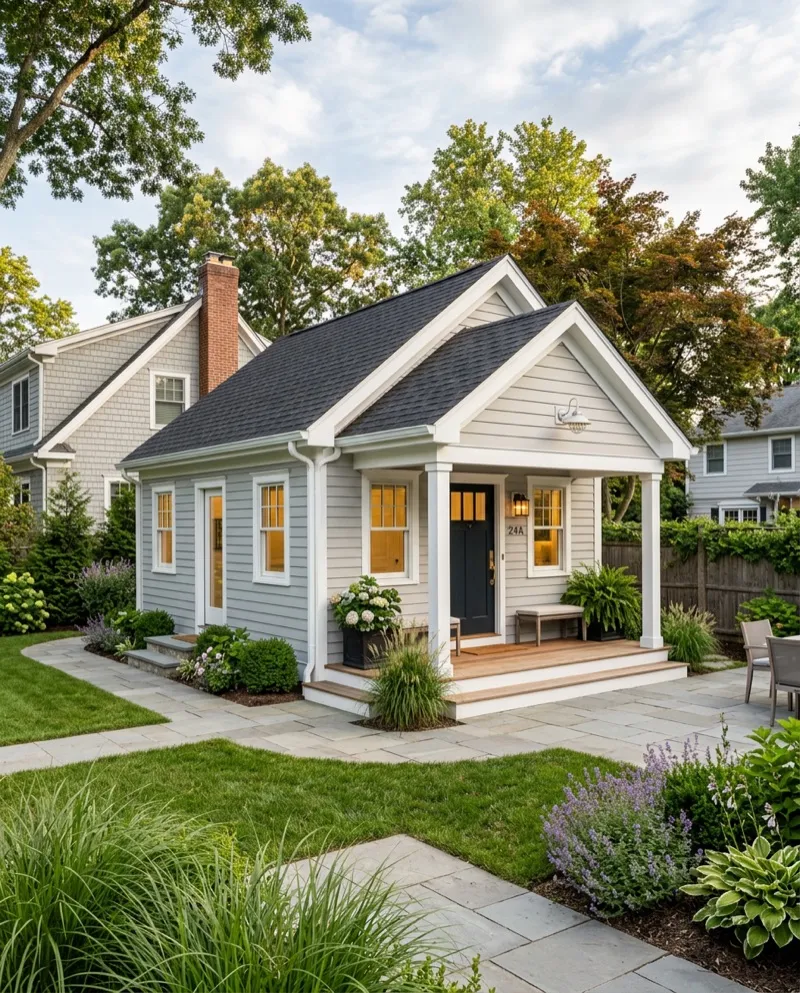
- Backyard cottages. The classic Hamptons guest cottage, reimagined as a year-round workforce housing unit. On the large lots common in East Hampton, a detached 600 to 900 square foot cottage provides complete independence.
- Carriage house conversions. Many older East Hampton properties have existing carriage houses, barns, or outbuildings that can be converted into ADUs. These conversions preserve historic character while creating modern living space.
- Pool house conversions. Properties with underused pool houses have a ready-made shell for an ADU. Adding a kitchen, bedroom, and proper insulation transforms a seasonal structure into a year-round apartment.
- Garage conversions. Converting a detached garage preserves the exterior footprint while creating a comfortable studio or one-bedroom unit inside.
- Above-garage apartments. Second-story additions over existing garages are common in East Hampton and blend naturally with the architectural vocabulary of the area.
Seasonal Property ADUs
A significant portion of East Hampton's housing stock sits vacant for much of the year. Seasonal homeowners who use their properties primarily during summer months have an opportunity to create ADUs that serve year-round workforce housing needs. A detached cottage or converted outbuilding can be rented to a local worker on a 12-month lease, providing housing stability for the tenant and reliable income for the property owner.
This model works particularly well for properties where the homeowner visits seasonally and the ADU occupant provides an added security benefit by maintaining a year-round presence on the property.
Permit Process in East Hampton
The East Hampton building permit process involves several layers depending on your property's location and the scope of your project:
- Pre-application consultation. We visit your property, evaluate the site, and determine the best ADU approach based on your zoning district, lot configuration, and goals.
- Design and architectural plans. Licensed plans are prepared that comply with East Hampton's zoning, building code, and any applicable design review standards.
- Building Department submission. Plans are submitted to the East Hampton Building Department for zoning compliance and building code review.
- Design review (if applicable). Properties in scenic overlay areas or historic districts may require additional architectural review.
- Health Department approval. For properties on septic systems, the Suffolk County Health Department must approve the additional dwelling load.
- Permit issuance and construction. Once all approvals are in place, the building permit is issued and construction begins.
- Inspections and CO. The building department inspects at key stages and issues a certificate of occupancy upon completion.
Alec's Construction has experience navigating East Hampton's approval process. We handle every submission, hearing, and inspection so you can focus on the end result rather than the paperwork.
Build workforce housing. Earn rental income.
Let us show you what is possible on your East Hampton property.
East Hampton Communities We Serve
Alec's Construction serves homeowners throughout the Town of East Hampton, including:
- East Hampton Village — historic village center with stringent architectural standards and strong ADU demand
- Montauk — year-round community with acute workforce housing needs for fishing, hospitality, and service industries
- Amagansett — residential hamlet with large lots well-suited for detached backyard ADUs
- Wainscott — quiet agricultural-residential area with ample space for accessory units
- Springs — artist community with a mix of property sizes and growing interest in ADU construction
- Sag Harbor (shared with Southampton) — historic village where carriage house and outbuilding conversions are particularly appropriate
Frequently Asked Questions
How does the Plus One $125K ADU grant work?+
Why are ADU costs higher in East Hampton?+
Can I convert a pool house into an ADU?+
Can I use my ADU as a short-term vacation rental?+
Work With Alec's Construction
This guide is written by the crew that does the work. See Alec's ADUs service — accessory apartments, garage conversions and grant paperwork. Licensed and insured on Long Island, one crew start to finish, free walkthrough and a written estimate inside 48 hours.
Booking the cold months now: we also handle Additions & New Construction and Bathroom Remodeling.
We keep a permit office directory for Nassau and Suffolk, checked against each jurisdiction's own site, because we file in these counters constantly.
Ready to Build an ADU in East Hampton?
Contact Alec's Construction for a free consultation. We will assess your East Hampton property, walk you through the Plus One grant process, and provide a detailed estimate.
Get a Free Consultation