Montauk occupies a singular position on Long Island — literally and economically. Perched at the easternmost tip of the South Fork, this community of roughly 3,500 year-round residents swells to over 30,000 during summer months. The fishing fleet docks at Montauk Harbor, surfers line the beaches at Ditch Plains, and hotels and restaurants operate at capacity from Memorial Day through Labor Day. But behind the postcard scenery lies a housing crisis that threatens the very workforce that keeps Montauk alive.
The median home price in Montauk has crossed the $1.5 million mark, and year-round rental listings are nearly nonexistent. Workers in the fishing industry, hospitality sector, and service trades face an impossible choice: pay rents that consume most of their income, endure multi-hour commutes from western Suffolk County, or leave the community entirely. Accessory dwelling units represent one of the most practical solutions to this crisis — and with the Plus One ADU Program offering grants up to $125,000, Montauk homeowners now have a powerful incentive to build.
Program status — verified September 2026
Plus One ADU is a New York State program (an $85 million allocation through the Housing Trust Fund Corporation) but it is run town by town, and each town's intake opens and closes on its own schedule. As of September 2026 on Long Island: Huntington and Riverhead are accepting applications; Brookhaven, Islip and Southold are closed. Babylon, East Hampton, Shelter Island and Southampton run their programs through Community Development Long Island rather than the Long Island Housing Partnership.
The $125,000 is a cap, not an amount every applicant receives, and it is awarded as a grant. Huntington's published guidelines cap household income at 100% of Nassau/Suffolk area median income (2023 HUD limits: $109,400 for a one-person household, $156,300 for four) and require that you have owned and lived in the home for at least one year. Applications go on a first-come waitlist and are then re-ranked on priority points, including whether the unit will be affordable at or below 80% AMI and whether it can be permitted without a zoning variance. Municipal code always overrides the program guidelines. Verify your town's status before you budget around a grant: LIHP (631) 435-4710. We also check it for you on the walkthrough — see our Plus One ADU grant page for the eligibility checklist and what the build costs if your town's round is closed.
Montauk's Workforce Housing Emergency
Montauk's economy is built on industries that require an on-the-ground, year-round labor force. The housing shortage does not just affect seasonal tourism — it undermines the community's ability to function twelve months a year:
- Commercial fishing industry. Montauk is home to the largest commercial fishing fleet in New York State. Captains, deck hands, fish cutters, and dock workers need housing within reasonable distance of the harbor. Fishing schedules are dictated by weather, tides, and fish runs — not commuter train timetables. A deck hand who lives in Riverhead and faces a 90-minute drive cannot respond to a 3 AM departure call. ADUs near the harbor directly support the fishing industry's operational needs.
- Hotels, restaurants, and bars. Montauk's hospitality industry generates the revenue that sustains the community, but it cannot retain staff without housing. Restaurants that once employed local residents now recruit from hours away, leading to chronic understaffing and high turnover. An ADU rented to a year-round hospitality worker provides the stability that both the employee and employer need.
- Surf shops, retail, and services. The small businesses along Main Street and the Montauk Highway corridor depend on employees who can show up reliably. When housing costs drive workers away, these businesses reduce hours, cut services, or close — eroding the community character that draws visitors in the first place.
- Emergency services. Montauk's volunteer fire department and ambulance service depend on residents who live close enough to respond quickly. As housing costs push people out, response times and volunteer numbers suffer.
Every ADU built in Montauk is a direct investment in the community's ability to function. It keeps a worker housed, a business staffed, and a neighborhood intact.
The Plus One ADU Program: $125,000 Grants
The Plus One Accessory Dwelling Unit Program provides grants of up to $125,000 toward ADU construction or conversion costs. For Montauk homeowners, where construction costs run high due to location and coastal building requirements, this grant makes projects financially viable that might otherwise be out of reach.
- Grant amount. Up to $125,000 toward construction costs, covering new detached ADUs, garage conversions, basement conversions, and interior apartment buildouts.
- Income targeting. The completed ADU must be rented to tenants earning at or below 80% of the Area Median Income — precisely the income bracket of Montauk's fishing, hospitality, and service workers.
- Rental commitment. Recipients commit to maintaining affordable rental rates for a specified period, typically 10 years. The unit must serve as long-term housing, not a seasonal or short-term vacation rental.
- Application support. Alec's Construction prepares construction estimates and project documentation to strengthen grant applications. We understand what the program administrators look for and help position your application for approval.
In a community where a basic garage conversion can cost $85,000 to $145,000, a $125,000 grant transforms the economics entirely. It turns an ADU from a major investment into a modest expense with strong long-term returns.
Montauk homeowner? The $125K ADU grant can work for you.
We help navigate flood zones, coastal codes, and grant paperwork — free consultation.
Flood Zone Considerations in Montauk
Montauk's geography creates building challenges that do not exist in most Long Island communities. Surrounded by water on three sides — the Atlantic Ocean to the south, Block Island Sound to the north, and Lake Montauk in between — a significant percentage of Montauk properties fall within FEMA-designated flood zones. This has direct implications for ADU construction:
- FEMA flood zone mapping. Many Montauk properties are classified as Zone AE (high-risk coastal flood zone) or Zone VE (high-risk coastal zone with wave action). ADUs built in these zones must comply with National Flood Insurance Program (NFIP) standards and local floodplain management ordinances.
- Base Flood Elevation (BFE). In flood zones, the lowest habitable floor of the ADU must be elevated to or above the Base Flood Elevation established by FEMA. For Zone VE properties, this requirement is even more stringent, and the structure must be elevated on pilings, posts, or columns with the space below left open or designed as breakaway construction.
- Elevated foundation design. Detached ADUs in flood zones typically require pier, piling, or elevated slab foundations rather than conventional concrete foundations. This adds cost — typically $15,000 to $35,000 above a standard foundation — but is non-negotiable in designated flood areas.
- Flood-resistant materials. Below the BFE, all building materials must be flood-resistant. This includes exterior cladding, insulation, structural components, and utility installations. We specify marine-grade and flood-rated materials throughout our Montauk ADU designs.
- Flood insurance implications. A properly elevated and constructed ADU can qualify for lower flood insurance premiums. Cutting corners on flood compliance results in astronomical insurance costs — or an uninsurable structure.
Alec's Construction has direct experience building in Montauk's flood zones. We design ADUs from the ground up to comply with FEMA requirements, East Hampton Town floodplain ordinances, and New York State coastal erosion hazard area regulations. Flood zone construction is not optional engineering — it is life-safety construction that protects your investment and your tenant.
Coastal Building Requirements
Beyond flood zone regulations, Montauk's coastal location imposes additional building requirements that affect ADU design, materials, and construction methods:
- Wind load design. Montauk is exposed to nor'easters, tropical storms, and hurricane-force winds. ADUs must be engineered to withstand sustained winds of 110+ mph with appropriate connections, sheathing, and roof tie-downs. Simpson Strong-Tie hardware and engineered trusses are standard on our coastal builds.
- Salt air corrosion resistance. The salt-laden marine environment accelerates corrosion of metal fasteners, flashing, hardware, and mechanical equipment. We specify stainless steel or hot-dipped galvanized fasteners, marine-grade exterior hardware, and corrosion-resistant HVAC equipment for all Montauk projects.
- Coastal Erosion Hazard Area (CEHA). Properties near the bluffs or shoreline may fall within New York State's Coastal Erosion Hazard Area, which imposes setback requirements from the erosion line. An ADU within the CEHA requires a permit from the NYS Department of Environmental Conservation in addition to local approvals.
- Trustees oversight. The Trustees of the Freeholders and Commonalty of the Town of East Hampton have jurisdiction over beaches, harbors, and certain nearshore areas. Projects that affect drainage, grading, or vegetation near the shoreline may require Trustees approval.
Licensed & Insured
Full coverage on every project
36+ Cities Served
Suffolk County & Long Island
Free Walkthrough
No obligation, no pressure
Get a Free Estimate
Tell us about your project — we respond within 24 hours.
No spam. No obligation.
ADU Types for Montauk Properties
Montauk lots tend to be smaller than those in Bridgehampton or East Hampton Village, but creative design solutions make ADUs feasible on most residential properties. The configurations we build most often in Montauk include:
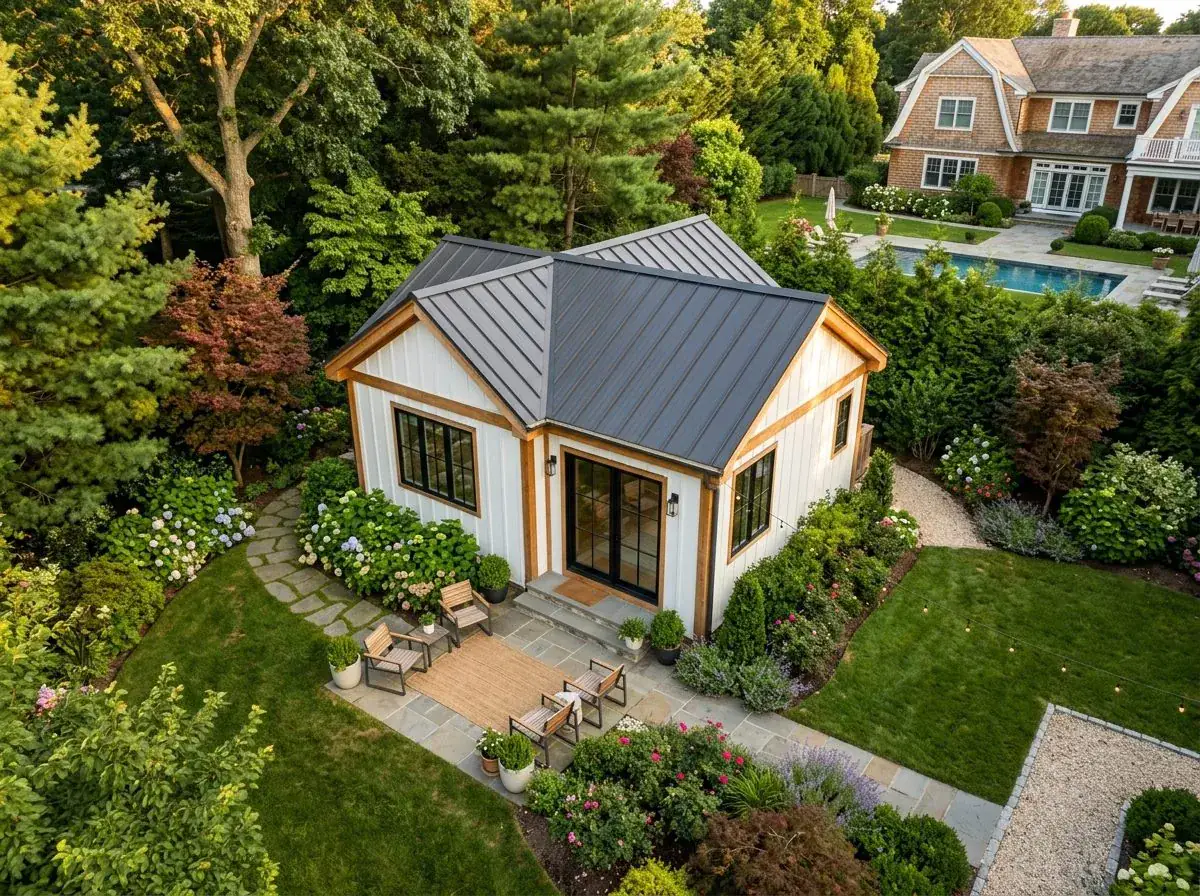
- Elevated detached cottages. A compact 500 to 750 square foot cottage raised on pilings above the BFE. The space beneath the structure can be used for parking or storage (with breakaway walls in VE zones). These cottages are efficient, resilient, and designed to handle everything the Atlantic throws at them.
- Garage conversions. Many Montauk homes have detached garages that can be converted into year-round apartments. On properties outside flood zones, a ground-level conversion is straightforward. In flood zones, the conversion may need to incorporate elevated living areas with flood-vented ground-level space.
- Above-garage apartments. Adding a second story above an existing garage creates living space while preserving the ground-level parking or storage. This approach maximizes a small lot's buildable area and, in flood zones, naturally places the living space above the BFE.
- Interior conversions. Some larger Montauk homes have unused portions — a walk-out basement, an unused wing, or an oversized attic — that can be converted into a self-contained apartment with a separate entrance. These conversions are often the most cost-effective option and avoid adding to the building footprint.
Construction Costs in Montauk
Montauk construction costs reflect the combined premium of Hamptons labor rates, coastal building requirements, flood zone engineering, and limited local contractor availability. Expect costs 25 to 35 percent above central Suffolk County. Realistic 2026 ranges include:
- Garage conversion: $85,000 to $145,000. Higher than inland conversions due to potential flood zone upgrades and marine-grade material requirements.
- Interior/basement conversion: $70,000 to $135,000. The most affordable option when the existing space is suitable, though flood zone compliance may limit basement conversions in low-lying areas.
- Above-garage apartment: $110,000 to $195,000. Structural reinforcement of the existing garage plus full second-story buildout with coastal-grade materials and connections.
- Detached elevated cottage: $175,000 to $350,000+. New construction on pilings with full coastal engineering. The wide range reflects differences in size, foundation type, and finish level.
The Plus One grant's $125,000 has an outsized impact in Montauk. A garage conversion that costs $120,000 becomes a net investment of under $5,000 with the grant — while generating rental income of $2,500 to $4,000 per month.
Rental Income Potential: $2,500 to $4,000 Per Month Year-Round
Montauk's extreme housing scarcity creates exceptional rental demand. Unlike communities where ADU rental income is modest, Montauk commands premium rents even at workforce-affordable rates:
- Year-round workforce rentals. A one-bedroom ADU in Montauk rents for $2,500 to $3,200 per month year-round. A two-bedroom unit commands $3,200 to $4,000 per month. These are workforce-affordable rates — market-rate rents for comparable units would be significantly higher.
- Seasonal demand amplifier. While Plus One grant-funded ADUs must serve long-term tenants at affordable rates, the extreme seasonal demand means your tenant will never leave voluntarily. Year-round Montauk housing at an affordable rate is among the most sought-after rentals on Long Island. Vacancy risk is essentially zero.
- Return on investment. At $3,000 per month, a Montauk ADU generates $36,000 in annual gross rental income. Over the 10-year grant commitment, that is $360,000 in gross revenue from a unit that may have cost you under $50,000 out of pocket after the grant. Few real estate investments on Long Island deliver comparable returns.
Even accounting for maintenance, insurance, and property taxes attributable to the ADU, the financial case for building in Montauk is exceptionally strong.
Seasonal vs. Year-Round Use
Montauk's seasonal character creates a unique dynamic for ADU planning. If you receive a Plus One grant, your ADU must be occupied year-round by a long-term tenant at affordable rates — which is exactly what the community needs. But even without the grant, the year-round use case is compelling:
A year-round tenant provides security and property maintenance during the off-season months when many Montauk homes sit vacant. They monitor for storm damage, frozen pipes, and break-ins. They collect packages and shovel walkways. The peace of mind alone is worth significant value, on top of the consistent rental income.
For homeowners who use their Montauk property seasonally, a detached ADU with its own entrance, parking, and outdoor space ensures complete privacy for both the homeowner and the tenant during overlapping periods. Thoughtful site planning — separate driveways, landscape screening, independent utility metering — creates a setup where both parties live comfortably and independently.
Permit Process in Montauk
Montauk falls within the Town of East Hampton, so ADU permits are processed through the East Hampton Building Department. However, the coastal location adds layers that inland East Hampton properties do not encounter:
- Site evaluation and flood zone determination. We visit your property, determine the FEMA flood zone classification, identify the Base Flood Elevation, and assess the best ADU approach given your site's specific constraints.
- Coastal engineering and design. Plans are prepared by licensed professionals that address flood zone elevation, wind load, coastal erosion setbacks, and marine-grade material specifications.
- East Hampton Building Department submission. Plans are filed for building permit review, including zoning compliance, building code, and floodplain management ordinance compliance.
- FEMA/floodplain compliance review. The building department's floodplain administrator reviews the project for NFIP compliance, including elevation certificates and flood-resistant construction details.
- Suffolk County Health Department. Septic system capacity must be confirmed or upgraded. Montauk's proximity to water bodies means heightened scrutiny of wastewater systems.
- Trustees review (if applicable). Properties near the shoreline, harbor, or freshwater wetlands may require approval from the Trustees.
- Construction and inspections. Building proceeds with inspections at each critical phase, with particular attention to foundation elevation, structural connections, and flood-resistant construction details.
- Elevation certificate and CO. Upon completion, a final elevation certificate confirms BFE compliance, and the building department issues a certificate of occupancy.
The Montauk permit process is more complex than inland communities, but Alec's Construction has the experience and relationships to navigate it efficiently. We handle every submission and inspection so you can focus on the outcome, not the process.
Montauk housing is in crisis. Your property can be part of the solution.
Free consultation — we evaluate your lot, flood zone, and ADU options.
Frequently Asked Questions
Can I build an ADU in a flood zone in Montauk?+
How much rental income can a Montauk ADU generate?+
My Montauk lot is small. Can I still build an ADU?+
What special materials are required for coastal ADU construction in Montauk?+
Work With Alec's Construction
This guide is written by the crew that does the work. See Alec's ADUs service — accessory apartments, garage conversions and grant paperwork. Licensed and insured on Long Island, one crew start to finish, free walkthrough and a written estimate inside 48 hours.
Booking the cold months now: we also handle Additions & New Construction and Bathroom Remodeling.
Not sure whether the town or village files your permit? That question trips up more Long Island projects than any other — the directory sorts it out.
Ready to Build an ADU in Montauk?
Contact Alec's Construction for a free consultation. We will evaluate your Montauk property, assess flood zone requirements, walk you through the Plus One grant process, and provide a detailed estimate that accounts for coastal building needs.
Get a Free Consultation