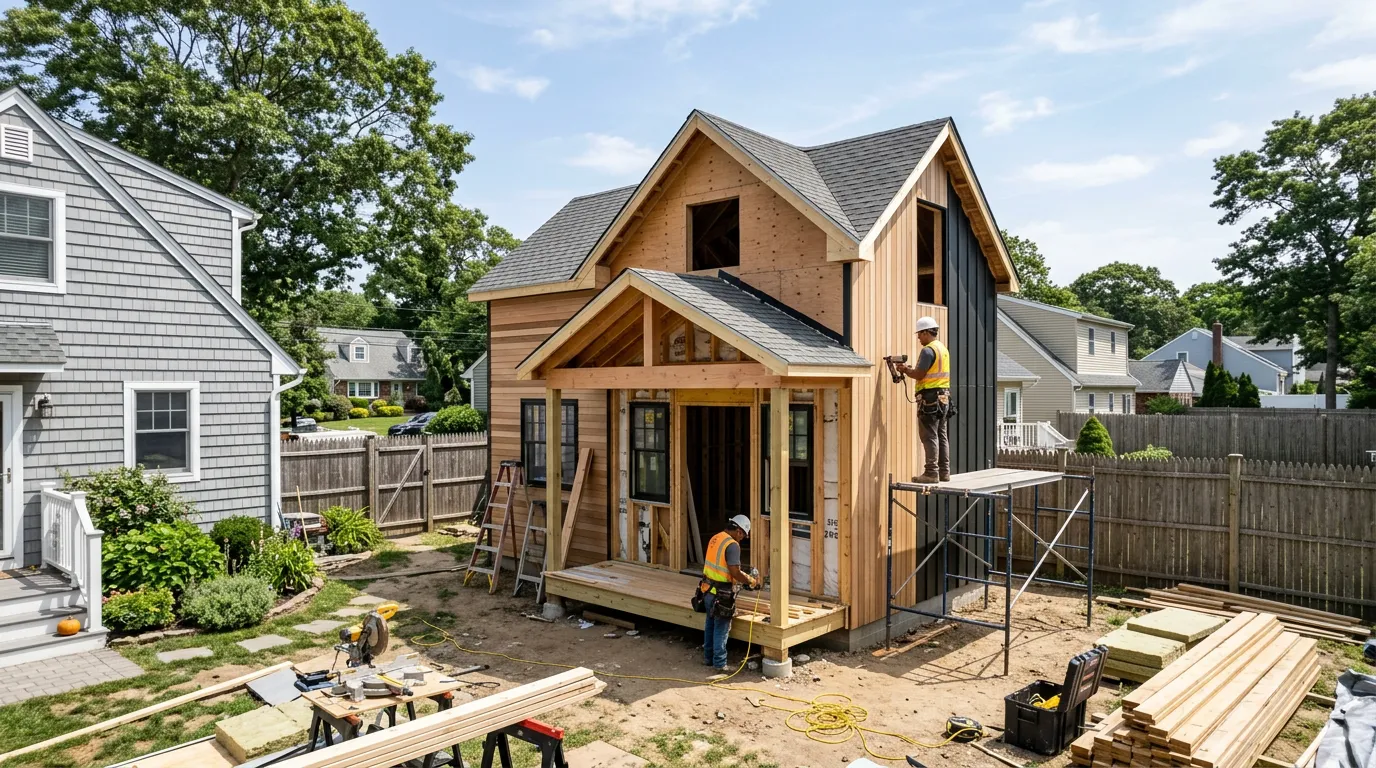
Sag Harbor is unlike anywhere else in the Hamptons. While neighboring communities are defined by expansive estates and agricultural landscapes, Sag Harbor is a compact, walkable village with a layered history stretching back to the colonial whaling era. Its streets are lined with Federal, Greek Revival, and Victorian homes — many dating to the 18th and 19th centuries — alongside the shops, galleries, restaurants, and theaters that make it one of the most culturally vibrant communities on the East End.
This historic richness comes with a modern problem. Sag Harbor faces the same workforce housing crisis as the rest of the Hamptons, but its smaller lot sizes, stricter architectural standards, and unique jurisdictional complexity make the challenge more acute. Workers who serve the village's restaurants, boutiques, marina, and cultural institutions cannot afford to live where they work. Accessory dwelling units — particularly conversions of the carriage houses, outbuildings, and secondary structures that are already woven into Sag Harbor's built fabric — offer a historically appropriate, village-scale solution.
Sag Harbor's Unique Character and Housing Crisis
Sag Harbor's identity is rooted in its history as a whaling port. In the mid-1800s, it was one of the busiest ports in the world, and the wealth generated by the whaling industry built the grand captains' houses that still line Main Street and Madison Street. The village's character reflects this heritage — dense, walkable, architecturally significant, and deeply resistant to anything that does not honor its past.
But the same qualities that make Sag Harbor desirable have made it unaffordable. The median home price in the village exceeds $2 million. Year-round rental inventory is nearly zero. The workers who keep the village functioning — the restaurant cooks, shop clerks, marina attendants, teachers, and municipal employees — face a choice between unaffordable rents, impossible commutes, or leaving the community entirely.
- Restaurant and retail workers. Sag Harbor's Main Street economy depends on employees who can walk or bike to work. When those workers are commuting from Riverhead or beyond, businesses suffer from staffing shortages, reduced hours, and high turnover. A walking-distance ADU changes this equation entirely.
- Marina and waterfront staff. Sag Harbor's marina and waterfront businesses require staff during early mornings, evenings, and weekends. Housing within the village means workers are available when needed, not constrained by commuter schedules.
- Arts and culture workers. The Bay Street Theater, the Sag Harbor Cinema, the Whaling Museum, and the village's galleries employ staff who are themselves part of the creative community. Losing these workers to housing costs diminishes the cultural life that defines Sag Harbor.
- Municipal and school employees. The village government, police department, and Sag Harbor School District rely on employees who ideally live within or near the community they serve.
ADUs in Sag Harbor are not just housing units — they are the infrastructure that sustains the village's character, economy, and community life.
The Plus One ADU Program: $125,000 Grants
The Plus One Accessory Dwelling Unit Program provides grants of up to $125,000 toward ADU construction or conversion costs. In Sag Harbor, where many properties already have carriage houses or outbuildings that can be converted, this grant often covers the majority of the project cost.
Program status — verified September 2026
Plus One ADU is a New York State program (an $85 million allocation through the Housing Trust Fund Corporation) but it is run town by town, and each town's intake opens and closes on its own schedule. As of September 2026 on Long Island: Huntington and Riverhead are accepting applications; Brookhaven, Islip and Southold are closed. Babylon, East Hampton, Shelter Island and Southampton run their programs through Community Development Long Island rather than the Long Island Housing Partnership.
The $125,000 is a cap, not an amount every applicant receives, and it is awarded as a grant. Huntington's published guidelines cap household income at 100% of Nassau/Suffolk area median income (2023 HUD limits: $109,400 for a one-person household, $156,300 for four) and require that you have owned and lived in the home for at least one year. Applications go on a first-come waitlist and are then re-ranked on priority points, including whether the unit will be affordable at or below 80% AMI and whether it can be permitted without a zoning variance. Municipal code always overrides the program guidelines. Verify your town's status before you budget around a grant: LIHP (631) 435-4710. We also check it for you on the walkthrough — see our Plus One ADU grant page for the eligibility checklist and what the build costs if your town's round is closed.
- Grant amount. Up to $125,000 toward construction costs. For a carriage house conversion that might cost $90,000 to $160,000, the grant can cover 75% or more of the total investment.
- Income targeting. The completed ADU must be rented to tenants earning at or below 80% of the Area Median Income. This ensures the unit houses the service workers, teachers, and tradespeople that Sag Harbor needs most.
- Rental commitment. Grant recipients commit to affordable rental rates for a specified period, typically 10 years. The unit serves as long-term housing, not a seasonal or vacation rental.
- Conversion-friendly. The program explicitly covers conversions of existing structures — making it ideal for Sag Harbor's abundance of carriage houses, outbuildings, and secondary structures that were never designed as primary living spaces but can be transformed into comfortable apartments.
A Sag Harbor homeowner with a detached carriage house could convert it into a one-bedroom apartment for $120,000, receive a $125,000 grant, and have zero net construction cost while creating a housing unit that generates rental income and strengthens the community. This is among the most compelling ADU opportunities in all of Suffolk County.
Have a carriage house or outbuilding in Sag Harbor?
The $125K grant could cover your entire conversion — free consultation.
Carriage House and Outbuilding Conversions
Sag Harbor's historic properties often include secondary structures that were built alongside the main house during the whaling era and the decades that followed. Carriage houses, servants' quarters, workshops, and storage buildings dot the village's residential lots. Many of these structures have solid bones — thick timber framing, durable foundations, and architectural details that new construction cannot replicate. Converting these structures into ADUs is both historically appropriate and practically efficient.
- Carriage houses. The most common conversion candidate in Sag Harbor. These one-and-a-half or two-story structures originally housed horses and carriages on the ground floor with hay storage or quarters above. The ground floor converts into living space with high ceilings and open floor plans, while the upper level becomes a bedroom loft or second bedroom. Original details — wide-plank floors, exposed beams, barn-door hardware — become design features rather than liabilities.
- Captain's quarters outbuildings. Wealthier Sag Harbor families maintained separate structures for staff, guests, or domestic operations. These buildings often have plumbing rough-ins, separate entrances, and layouts that translate naturally into small apartments.
- Workshop and studio conversions. Smaller outbuildings — former workshops, artist studios, or storage sheds — can be converted into efficient studio apartments of 400 to 550 square feet. These compact units are perfectly suited for single workers who need affordable, walking-distance housing.
- Garage conversions. More recent properties may lack historic outbuildings but have detached garages that convert well. In the historic district, the garage exterior may need to be updated to comply with architectural review standards as part of the conversion.
The key advantage of conversion projects in Sag Harbor is that the structure already exists. You are not introducing a new building into a historically sensitive streetscape — you are repurposing an existing one. This distinction matters enormously in a village that values preservation above all else.
Historic Preservation Requirements
Sag Harbor's historic character is protected through a combination of village regulations, historic district guidelines, and community expectations. Any ADU project — whether a conversion or new construction — must navigate these requirements:
- Historic District and Landmarks Commission. The Village of Sag Harbor has an Architectural Review Board (ARB) that reviews exterior changes to buildings within the historic district. Conversions that alter a building's exterior appearance — new windows, doors, siding, or additions — must receive ARB approval. The goal is ensuring that changes are compatible with the building's historic character and the surrounding streetscape.
- Material compatibility. The ARB generally requires that exterior materials match or complement the original construction. Vinyl siding on a 19th-century carriage house will not be approved. Cedar shingles, clapboard, and historically appropriate trim materials are expected. While this increases material costs modestly, it produces results that honor the building and the village.
- Window and door specifications. Replacement windows and new door openings in historic structures must be compatible with the original architectural style. This typically means divided-light windows, wood or wood-clad frames, and period-appropriate hardware. Modern energy-efficient windows that replicate historic profiles are available and generally accepted.
- Scale and massing. Additions to historic structures must be subordinate in scale and distinguishable from the original construction. The ARB discourages additions that overwhelm the original building or create a false sense of historical authenticity. Honest, well-designed additions that clearly read as contemporary while respecting the original are preferred.
- Secretary of the Interior's Standards. For properties listed on the National Register of Historic Places, the Secretary of the Interior's Standards for Rehabilitation provide the guiding framework. These standards prioritize preservation of character-defining features while allowing sensitive adaptation for modern use.
Alec's Construction has experience working within historic preservation frameworks. We understand what Sag Harbor's review boards expect, and we design projects that earn approval efficiently rather than generating rounds of revisions. The goal is always a project that the homeowner, the village, and the preservation community can all be proud of.
Licensed & Insured
Full coverage on every project
36+ Cities Served
Suffolk County & Long Island
Free Walkthrough
No obligation, no pressure
Get a Free Estimate
Tell us about your project — we respond within 24 hours.
No spam. No obligation.
Village vs. Town Jurisdiction: A Critical Distinction
Sag Harbor sits in a jurisdictionally unusual position. The village straddles the boundary between the Town of Southampton and the Town of East Hampton. Understanding which jurisdiction governs your property is essential for ADU planning:
- Village of Sag Harbor jurisdiction. Properties within the incorporated Village of Sag Harbor are governed by village zoning, building codes, and the village's Architectural Review Board. The village has its own building department and planning process that is separate from either town.
- Town of Southampton portion. Properties in the Southampton portion of Sag Harbor (outside the village boundary but within the Sag Harbor postal area) fall under Southampton Town zoning and building permit jurisdiction. The regulations, review process, and approval path differ from the village.
- Town of East Hampton portion. Similarly, properties in the East Hampton portion of Sag Harbor are governed by East Hampton Town regulations. Each town has its own approach to ADUs, its own building department, and its own design review standards.
- Practical impact. A homeowner on one side of a Sag Harbor street may face entirely different ADU regulations than a homeowner on the other side. Setback requirements, lot coverage limits, design review processes, and approval timelines can vary significantly depending on jurisdiction. We determine your exact jurisdictional status during our initial consultation and tailor the project plan accordingly.
This jurisdictional complexity is one of the strongest reasons to work with a contractor who understands Sag Harbor's regulatory landscape. Alec's Construction knows which department to file with, which boards to present to, and which standards apply to your specific property.
Construction Costs in Sag Harbor
Sag Harbor construction costs reflect the Hamptons premium plus the additional requirements of working within a historic district. Materials must be historically compatible, craftsmanship must meet preservation standards, and design review can add time to the schedule. Realistic 2026 ranges include:
- Carriage house conversion: $90,000 to $160,000. The most historically appropriate and cost-effective option in Sag Harbor. Scope depends on structural condition, extent of needed upgrades, and ARB requirements for exterior modifications.
- Outbuilding conversion: $70,000 to $130,000. Smaller structures require less work but may need more significant utility installations. A well-preserved workshop or storage building with good bones can convert efficiently.
- Garage conversion: $75,000 to $140,000. Straightforward when the structure is already permitted and in good condition. In the historic district, exterior treatment may need upgrading to meet ARB standards.
- Interior apartment conversion: $60,000 to $110,000. Converting unused space within the primary residence — a walk-out basement, an unused wing, or an oversized attic — avoids exterior changes entirely, which simplifies the historic review process.
- Detached new construction: $175,000 to $325,000. New ADU construction in Sag Harbor requires careful design to complement the existing streetscape. ARB review of new construction is thorough and may require design iterations before approval.
The Plus One grant's $125,000 is particularly impactful in Sag Harbor because so many projects involve conversions rather than new construction. A carriage house conversion at $120,000 with a $125,000 grant means the homeowner pays nothing out of pocket while creating a housing unit that serves the community and generates rental income.
Walking-Distance Workforce Housing
What makes Sag Harbor ADUs uniquely valuable is the village's walkability. Unlike sprawling Hamptons communities where everything requires a car, Sag Harbor's compact layout means that an ADU within the village places a worker within walking or biking distance of their job. This has cascading benefits:
- Zero-commute housing. A restaurant worker living in an ADU behind a Main Street property can walk to work in five minutes. No car payment, no gas, no insurance, no two-hour commute. The savings compound — for the worker, for the employer, and for the community's traffic and parking.
- Extended availability. When workers live in the village, they are available for split shifts, early openings, late closings, and emergency coverage. Businesses can operate more flexibly, which improves service quality and revenue.
- Community integration. Workers who live in the village become part of the community. They shop locally, eat locally, and participate in civic life. This reinforces the village's identity as a year-round community rather than a seasonal resort.
- Reduced parking demand. Sag Harbor's parking is limited and contested, especially during summer. A workforce ADU that eliminates a commuter vehicle directly reduces parking pressure in the village core.
Permit Process in Sag Harbor Village
The permit process for an ADU within the Village of Sag Harbor involves several steps that reflect the village's commitment to preserving its historic character:
- Property assessment and jurisdictional determination. We confirm whether your property falls within the village, the Town of Southampton, or the Town of East Hampton, and identify the applicable zoning district, overlay districts, and historic designations.
- Design development. We develop plans that respect the property's architectural context, meet zoning requirements, and anticipate ARB concerns. For conversions, this means preserving character-defining features while creating functional, code-compliant living space.
- Architectural Review Board presentation. For projects within the historic district that involve exterior changes, we present the design to the ARB. Our presentations include material samples, precedent photographs, and detailed drawings that demonstrate compatibility with the village's architectural standards.
- Village Building Department submission. Plans are filed for building permit review, including zoning compliance, building code, and energy code requirements.
- Suffolk County Health Department. Septic or wastewater capacity must be confirmed. In the village center, some properties connect to municipal sewer; others are on private septic systems.
- Construction and inspections. Building proceeds with inspections at each critical phase. Work within the historic district requires particular attention to detail in exterior finishes, material installation, and architectural detailing.
- Certificate of occupancy. The village issues a CO upon successful final inspection.
The ARB review adds time compared to non-historic communities, but it is a predictable process when you work with a contractor who understands what the board expects. Alec's Construction prepares thorough submissions that address potential concerns proactively, minimizing revision cycles and keeping your project on schedule.
Preserve your building's history. Create housing for today.
We navigate Sag Harbor's historic review process for you — free consultation.
Frequently Asked Questions
Can I convert my Sag Harbor carriage house into an ADU?+
What does the Sag Harbor Architectural Review Board require for ADU projects?+
Is my Sag Harbor property under village, Southampton, or East Hampton jurisdiction?+
How does the $125K Plus One grant work for historic conversions in Sag Harbor?+
Work With Alec's Construction
This guide is written by the crew that does the work. See Alec's ADUs service — accessory apartments, garage conversions and grant paperwork. Licensed and insured on Long Island, one crew start to finish, free walkthrough and a written estimate inside 48 hours.
Booking the cold months now: we also handle Additions & New Construction and Bathroom Remodeling.
We keep a permit office directory for Nassau and Suffolk, checked against each jurisdiction's own site, because we file in these counters constantly.
Ready to Build an ADU in Sag Harbor?
Contact Alec's Construction for a free consultation. We will assess your Sag Harbor property, evaluate your carriage house or outbuilding for conversion potential, navigate the historic review process, and guide you through the Plus One grant application.
Get a Free Consultation