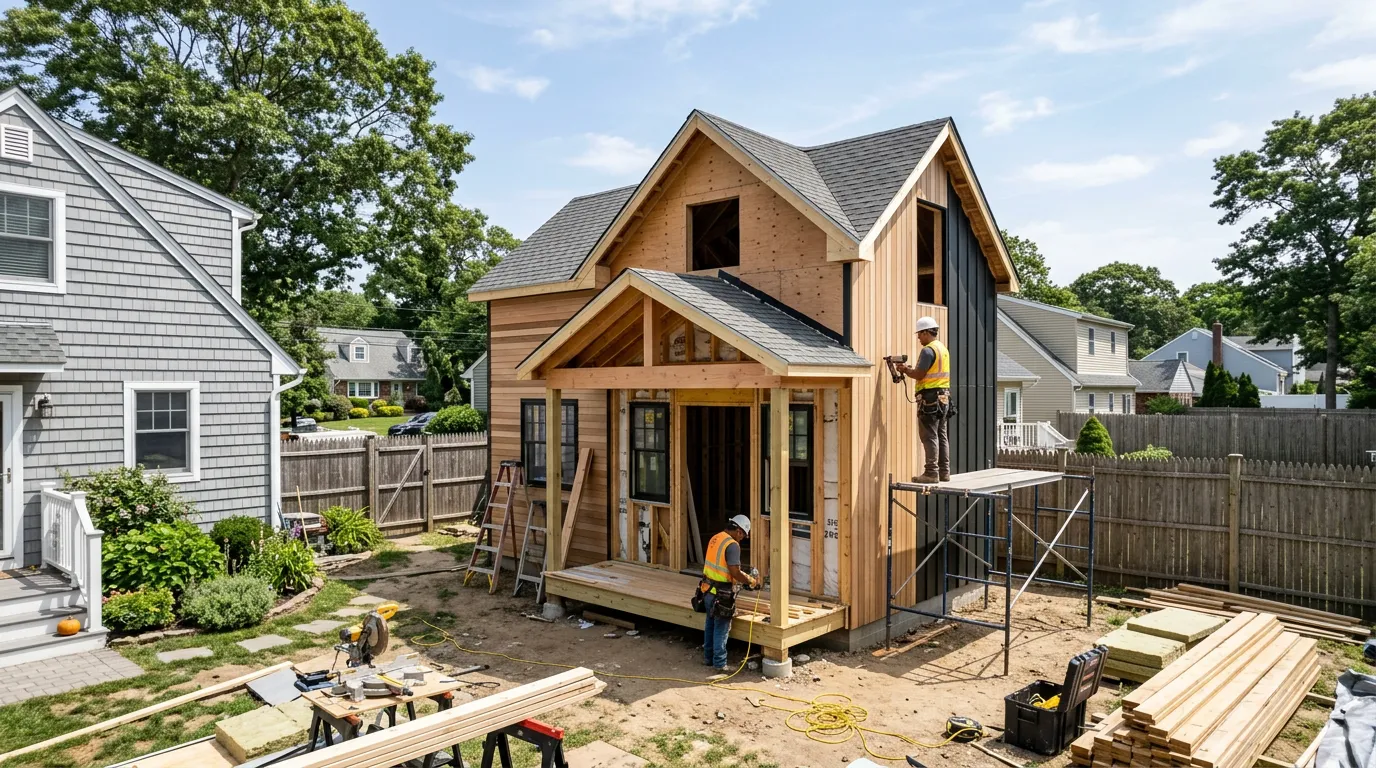
The Town of Smithtown sits in the heart of Suffolk County, stretching from the North Shore communities of Kings Park and St. James south through Nesconset and Hauppauge. With a population of roughly 120,000 residents spread across generously sized lots, Smithtown has become one of the most promising markets for accessory dwelling unit construction on Long Island. In Smithtown that demand comes mostly from multigenerational families: the Town's path is family-member living quarters, not a rental apartment.
Smithtown's rules are narrower than the statewide ADU conversation suggests, so this guide starts with what the Town actually allows. It covers what Smithtown homeowners need to know before building an ADU on their property.
ADU Regulations in Smithtown
The Town of Smithtown does not have a general accessory-apartment or rental ADU permit. What it does allow is a Special Exception Use Permit for Temporary Separate Living Quarters for a Family Member, approved by the Smithtown Board of Zoning Appeals (BZA) and renewed every three years with a re-inspection (Town renewal form). It is for a relative of the owner, not a tenant. Because approval runs through the BZA, we check zoning first, before any design work.
Smithtown: what to ask for by name — verified September 2026
- In Smithtown these are known as “mother/daughter” permits: a Special Exception for Temporary Separate Living Quarters for a Family Member, approved by the Board of Zoning Appeals. The Building Department handles the paperwork and inspections.
- The living quarters must be occupied by a family member of the owner, and the permit must be renewed every three years after a Town inspection. It is not a rental permit.
- The zoning requirement tables — lot size, setbacks, coverage by district — are in Town Code §322.
- Building and Planning: (631) 360-7540.
- Smithtown is not in the NYS Plus One ADU program, so Smithtown homeowners are not eligible for Plus One grant money. As of September 2026 the Long Island Plus One towns are Huntington and Riverhead (open), and Brookhaven, Islip and Southold (closed).
- Suffolk County Health Department approval still applies to any Smithtown property on septic — which is most of them.
- Owner-occupancy requirement. Smithtown generally requires the property owner to live in either the primary dwelling or the accessory unit. This is consistent with most Suffolk County towns and is intended to maintain neighborhood character.
- Size and layout. Size, layout and conditions are set case by case in the BZA approval and by Town Code §322 for your district. We do not quote a square-footage allowance until we have checked your zoning.
- One family-member unit. The special exception covers living quarters for a family member of the owner on a single-family lot; it does not create a second rentable home.
- Parking requirements. Additional off-street parking, usually one designated space, is required for the accessory unit beyond what the primary residence already provides.
Regulations can shift as New York State continues to push municipalities toward more permissive ADU policies. We stay current on every code change so our Smithtown clients always have accurate information.
Thinking about an ADU in Smithtown?
Free walkthrough — we assess your property and explain your options.
Zoning Districts and Residential Zones
Smithtown's residential zoning is organized into several districts, each with different minimum lot sizes, setback requirements, and permitted uses. The most common residential zones include R-10 (10,000 square foot minimum lots), R-15, R-21, R-43 (roughly one acre), and larger rural-residential designations in parts of the town's eastern sections.
ADU eligibility often depends on which zone your property falls in. Properties in R-21 and larger zones tend to have the most straightforward path to approval because they meet minimum lot size thresholds with room to spare. Properties in denser R-10 zones may face tighter constraints on setbacks and lot coverage that limit ADU placement options.
We pull your property's zoning classification as part of our initial feasibility assessment. Before you invest time or money, we confirm exactly what your lot allows under current Smithtown zoning.
Lot Size Advantages in Smithtown
One of the biggest advantages Smithtown homeowners have when it comes to ADU construction is lot size. Half-acre and larger lots are common throughout the town, particularly in communities like St. James, Head of the Harbor, and the northern sections of Kings Park. These generous parcels give homeowners significantly more flexibility in ADU placement and design than what is typical in more densely developed Suffolk County towns.
- Setback compliance is easier. Larger lots make it simpler to meet front, side, and rear setback requirements without compromising the size or layout of the ADU.
- More room for an addition or conversion. Larger lots give more flexibility in where family-member living quarters can go. Whether a detached structure can qualify is a question for the BZA, so we check zoning first.
- Lot coverage ratios are less restrictive. On larger lots, new floor area is less likely to run into the district's lot coverage limit.
- Yard space is preserved. Families do not have to sacrifice their entire backyard to accommodate an ADU. There is room for the unit, landscaping, and outdoor living space.
Septic System Considerations
Nearly all of Smithtown is served by private septic systems rather than municipal sewer. This is one of the most important factors in ADU planning because the Suffolk County Health Department must approve any additional dwelling on a septic-served property.
- Capacity assessment. Your existing septic system must have the capacity to handle the additional wastewater generated by the ADU. A typical one-bedroom ADU adds one to two occupants and a kitchen, which increases daily flow.
- System upgrade may be required. If your current system is undersized, aging, or not in compliance, you may need to install a new or expanded septic system before or during ADU construction. This can add $15,000 to $30,000 or more to your project.
- Nitrogen-reducing systems. Suffolk County has been pushing for innovative/alternative (I/A) septic systems that reduce nitrogen output. Depending on your property's location relative to groundwater and waterways, an upgraded nitrogen-reducing system may be required.
- Perc tests and soil evaluation. If a new leaching field is needed, the county will require percolation tests and soil analysis to determine appropriate system sizing and placement.
We coordinate directly with the Suffolk County Health Department on every Smithtown ADU project. Septic planning happens early in our process so there are no surprises once construction begins.
Licensed & Insured
Full coverage on every project
36+ Cities Served
Suffolk County & Long Island
Free Walkthrough
No obligation, no pressure
Get a Free Estimate
Tell us about your project — we respond within 24 hours.
No spam. No obligation.
Types of ADUs for Smithtown Properties
Smithtown's lot sizes and property layouts open up most ADU configurations. Here is what works best for typical Smithtown homes:
- Detached structures. Smithtown's permit is for family-member living quarters approved by the BZA, not a stand-alone rental cottage. Whether a detached building can qualify on your lot is a BZA question, so we check zoning first before anyone designs one.
- Garage conversion. Many Smithtown homes have oversized detached garages, especially in older neighborhoods in Kings Park and St. James. Where the BZA approves it, converting one into family-member living quarters can be cost-effective because the shell already exists.
- Above-garage apartment. Detached garages with adequate structural capacity can support a second-story apartment. This preserves ground-level parking while adding 400 to 600 square feet of living space above.
- Basement conversion. Full basements are standard in Smithtown homes. With proper ceiling height, egress windows, and a separate entrance, a basement can become a comfortable ADU at a lower cost than new construction.
- Interior conversion. Larger colonial and ranch-style homes common in Smithtown sometimes have unused wings or oversized spaces that can be partitioned into an independent unit with its own entrance and amenities.
Permit Process in Smithtown
Family-member living quarters in the Town of Smithtown require a special exception from the Board of Zoning Appeals, permits from the Smithtown Building Department and, for septic-served properties, the Suffolk County Health Department. Here is the typical process:
- Feasibility assessment. We visit your property to evaluate lot size, zoning, existing structures, septic capacity, and the best ADU configuration for your goals.
- Architectural plans. Licensed plans are prepared showing the ADU design, floor plan, elevations, site plan with setbacks, and utility connections.
- Zoning review. Plans are submitted to the Smithtown Building Department for zoning compliance review. The special exception application goes to the Board of Zoning Appeals, which holds a hearing; we prepare and file it.
- Health Department approval. For septic properties, the Suffolk County Health Department reviews the septic system capacity and approves the additional dwelling load.
- Building permit issuance. Once zoning and health approvals are secured, the building permit is issued and construction can begin.
- Inspections and certificate of occupancy. The building department conducts inspections at key stages. A certificate of occupancy is issued upon final approval.
Alec's Construction manages the entire permit process from start to finish. We have working relationships with the Smithtown Building Department and handle all submissions, follow-ups, and inspections on your behalf.
Not sure what your property allows?
We check your zoning and septic — completely free.
ADU Construction Costs in Smithtown
Costs for ADU construction in Smithtown are consistent with broader Suffolk County pricing, though septic system work can add a significant variable. Here are realistic ranges for 2026:
- Garage conversion: $50,000 to $100,000. The most affordable option when the structure is sound.
- Basement conversion: $60,000 to $120,000. Costs depend on ceiling height, waterproofing needs, and egress window installation.
- Above-garage apartment: $80,000 to $150,000. Structural reinforcement and stair access are the main cost drivers.
- Detached new construction: $150,000 to $300,000+, only where zoning and the BZA allow it. We check zoning first.
- Septic system upgrade: $15,000 to $30,000+ if your existing system cannot support the additional dwelling.
We provide detailed written estimates after our initial walkthrough. Every cost is itemized and transparent, with no hidden fees or surprise charges.
Smithtown Communities We Serve
Alec's Construction serves homeowners throughout the Town of Smithtown, including:
- Kings Park — established neighborhoods with mature lots and room for additions
- St. James — large wooded properties with room for family-member living quarters
- Nesconset — family-oriented community with growing multigenerational housing demand
- Commack (shared with Town of Huntington) — suburban lots with strong ADU potential
- Hauppauge (shared with Town of Islip) — mixed residential areas with varied ADU opportunities
- Smithtown hamlet — the town center area with a range of lot sizes and zoning classifications
Whether you are in a quiet cul-de-sac in Kings Park or on a wooded acre in St. James, we will evaluate your specific property and design an ADU solution that fits your lot, your budget, and your goals.
Frequently Asked Questions
Can I build a detached ADU on my Smithtown property?+
Will I need to upgrade my septic system?+
Do I have to live on the property to build an ADU?+
How long does the permit process take in Smithtown?+
Work With Alec's Construction
This guide is written by the crew that does the work. See Alec's ADUs service — family-member living quarters, garage conversions and permit paperwork. Licensed and insured on Long Island, one crew start to finish, free walkthrough and a written estimate inside 48 hours.
Booking the cold months now: we also handle Additions & New Construction and Bathroom Remodeling.
Not sure whether the town or village files your permit? That question trips up more Long Island projects than any other — the directory sorts it out.
Also Serving Smithtown
- Attic Insulation in Smithtown — air sealing, baffles and R-49 depth
- Basement Finishing in Smithtown — egress, ceiling height and moisture
- Bathroom Remodeling in Smithtown — full gut renovations
- Chimney Repair in Smithtown — repointing, crowns, caps and flashing
- Deck Builders in Smithtown — new builds, repairs and railings
- Driveway Paving in Smithtown — blacktop, resurfacing and repairs
- Emergency Roof Repair in Smithtown — tarping, leaks and storm response
- Fallen Tree Removal & Roof Repair in Smithtown — tree off the house, roof supported and repaired
- Flood & Water Damage Cleanup in Smithtown — wet material out, drying metered
- Front Steps & Stoops in Smithtown — rebuilds, treads and railings
- Garage Conversion in Smithtown — turning the garage into living space
- Gutter Installation in Smithtown — seamless gutters, fascia and drainage
- House Painters in Smithtown — exteriors while the fall window holds
- Hurricane & Storm Damage Repair in Smithtown — trees, flooding, cleanup and repairs
- Storm Damage & Insurance Restoration in Smithtown — emergency tarping and the claim
- Interior Painting in Smithtown — the right work for the cold months
- Kitchen Remodeling in Smithtown — cabinets, counters and layout
- Masonry & Pavers in Smithtown — patios, walkways and retaining walls
- Roofing in Smithtown — tear-offs, repairs and storm damage
- Siding in Smithtown — James Hardie, vinyl and cedar
- Storm Debris Removal & Cleanup in Smithtown — trees, building debris and hauling
- Storm Roof & Siding Repair in Smithtown — wind damage, tarped and rebuilt
- Windows & Doors in Smithtown — insert and full-frame replacement
Ready to Build Your ADU in Smithtown?
Contact Alec's Construction for a free consultation. We will assess your Smithtown property, check your zoning and septic, and provide a detailed estimate with no obligation.
Get a Free Consultation