Westhampton Beach is the gateway to the Hamptons. Positioned at the western edge of the South Fork's premier beach communities, this Village of Westhampton Beach marks the transition from suburban Long Island into the exclusive coastal landscape that stretches east to Montauk. It is the first Hamptons community that visitors encounter traveling east on Sunrise Highway or the Long Island Expressway, and that accessibility has shaped its character — more approachable than East Hampton, more year-round than Bridgehampton, but still unmistakably a Hamptons beach town.
That gateway position also means Westhampton Beach feels the Hamptons workforce housing crisis early and acutely. The village's restaurants, shops, salons, and seasonal businesses depend on workers who increasingly cannot afford to live within the community — or anywhere nearby. The median home price in Westhampton Beach exceeds $1.2 million, and year-round rentals under $2,500 per month are virtually nonexistent. Accessory dwelling units offer a practical, neighborhood-compatible path to creating the workforce housing this community needs, and the Plus One ADU Program's $125,000 grants make building financially accessible.
Program status — verified September 2026
Plus One ADU is a New York State program (an $85 million allocation through the Housing Trust Fund Corporation) but it is run town by town, and each town's intake opens and closes on its own schedule. As of September 2026 on Long Island: Huntington and Riverhead are accepting applications; Brookhaven, Islip and Southold are closed. Babylon, East Hampton, Shelter Island and Southampton run their programs through Community Development Long Island rather than the Long Island Housing Partnership.
The $125,000 is a cap, not an amount every applicant receives, and it is awarded as a grant. Huntington's published guidelines cap household income at 100% of Nassau/Suffolk area median income (2023 HUD limits: $109,400 for a one-person household, $156,300 for four) and require that you have owned and lived in the home for at least one year. Applications go on a first-come waitlist and are then re-ranked on priority points, including whether the unit will be affordable at or below 80% AMI and whether it can be permitted without a zoning variance. Municipal code always overrides the program guidelines. Verify your town's status before you budget around a grant: LIHP (631) 435-4710. We also check it for you on the walkthrough — see our Plus One ADU grant page for the eligibility checklist and what the build costs if your town's round is closed.
Why Westhampton Beach Needs Workforce Housing
Westhampton Beach's economy depends on a service and retail workforce that has been priced out of the housing market. The consequences are visible every summer — and increasingly year-round:
- Restaurant and bar staff. Westhampton Beach's dining scene — from Main Street restaurants to beachside eateries — requires cooks, servers, bartenders, and dishwashers. These positions pay $35,000 to $55,000 per year, a fraction of what housing costs in the area. When workers commute from Mastic, Shirley, or Coram, they face 45 to 90-minute drives each way. Late-night restaurant shifts followed by long commutes lead to burnout, turnover, and chronic understaffing.
- Retail and salon workers. Main Street's boutiques, galleries, and personal care businesses depend on staff who are present, reliable, and available during peak hours. Long commutes make flexibility impossible. An ADU within walking distance of Main Street transforms a retail worker's quality of life and an employer's ability to staff their business.
- Landscaping and property maintenance. Westhampton Beach properties require year-round maintenance — landscaping, pool care, snow removal, and general upkeep. These workers start early and often service multiple properties in a day. Housing within the community reduces drive time between jobs and allows more productive hours.
- Teachers and school staff. The Westhampton Beach Union Free School District competes for educators against districts in more affordable areas. When teachers cannot afford to live in or near the community they serve, recruitment and retention suffer. An ADU rented to a teacher creates a direct benefit for the school system.
- Healthcare and elder care workers. Westhampton Beach has a significant population of retirees and seasonal residents who require home health aides, nurses, and care providers. These workers need to be nearby and available, not commuting from an hour away.
The workforce housing problem is not seasonal — it is structural. And ADUs are one of the few solutions that create housing without altering the residential character that defines Westhampton Beach.
The Plus One ADU Program: $125,000 Grants
The Plus One Accessory Dwelling Unit Program provides grants of up to $125,000 to offset ADU construction or conversion costs. For Westhampton Beach homeowners, this grant dramatically improves the return on investment and makes ADU projects feasible for a wider range of property owners.
- Grant amount. Up to $125,000 toward construction, applicable to new detached ADUs, garage conversions, basement conversions, above-garage apartments, and interior buildouts.
- Income targeting. The ADU must be rented to tenants earning at or below 80% of the Area Median Income. This income bracket includes restaurant workers, retail staff, teachers, and tradespeople — the exact workforce Westhampton Beach needs to retain.
- Rental commitment. Recipients agree to maintain affordable rental rates for a specified period, typically 10 years. The unit must serve as year-round housing, not a seasonal or short-term rental.
- Application support. Alec's Construction prepares detailed construction estimates, project plans, and supporting documentation that strengthen grant applications. We understand the program requirements and help position your application for approval.
A $125,000 grant applied to a $155,000 garage conversion leaves the homeowner with just $30,000 in out-of-pocket costs — while creating a rental unit that generates $1,800 to $2,600 per month in income. The investment typically pays for itself within two years.
Westhampton Beach homeowner? The $125K ADU grant is available now.
We handle zoning, flood compliance, and grant paperwork — free consultation.
Village Zoning vs. Town of Southampton Jurisdiction
One of the most important — and most commonly misunderstood — aspects of building in Westhampton Beach is understanding which jurisdiction governs your property. The incorporated Village of Westhampton Beach and the surrounding Town of Southampton have overlapping but distinct regulatory frameworks:
- Village of Westhampton Beach. Properties within the incorporated village are governed by village zoning codes, which establish their own setback requirements, lot coverage limits, height restrictions, and permitted accessory uses. The village has its own building department and planning board. ADU projects within the village must comply with village-specific regulations and obtain permits from the village building inspector.
- Town of Southampton. Properties in the greater Westhampton Beach area that fall outside the village boundary are governed by Southampton Town zoning. The town's ADU regulations, permit process, and review standards differ from the village's. Southampton Town has been progressively supportive of ADU construction as part of its workforce housing strategy.
- Zoning district variations. Within both the village and the town, different zoning districts impose different requirements. A property in a residential R-1 zone faces different lot coverage and setback rules than one in an R-2 or commercial-adjacent zone. Your specific zoning district determines what is buildable on your lot.
- Practical implications. Two neighbors on the same street can be in different jurisdictions with different rules. One property might allow a 900 square foot detached ADU; the adjacent property might cap accessory structures at 600 square feet. We determine your exact jurisdiction and zoning district during our initial site visit and design the project to comply fully.
Navigating this dual-jurisdiction landscape requires a contractor who works in both systems regularly. Alec's Construction files permits with both the Village of Westhampton Beach and the Town of Southampton and understands the nuances of each process.
Flood Zone and Coastal Building Considerations
Westhampton Beach sits on a barrier island and adjacent mainland, with significant exposure to both ocean and bay flooding. Hurricane-force storms, nor'easters, and coastal flooding have shaped the community's building requirements. ADU construction must account for these realities:
- FEMA flood zone mapping. Many Westhampton Beach properties — particularly those south of Montauk Highway on Dune Road and the barrier beach — fall within Zone AE or Zone VE flood designations. Properties north of the highway may still be in moderate-risk zones (Zone X shaded) that carry their own considerations.
- Elevation requirements. ADUs in designated flood zones must have their lowest habitable floor at or above the Base Flood Elevation. For Zone VE properties on the barrier beach, this means construction on pilings with the area below designed as breakaway or open construction. These elevated foundations add $15,000 to $30,000 to project costs but are required by code and essential for insurability.
- Flood-resistant construction. Below the BFE, all materials must be flood-resistant. Electrical panels, HVAC equipment, and utility connections must be positioned above the BFE. We specify these requirements from the design phase to avoid costly mid-construction revisions.
- Wind load engineering. Westhampton Beach's coastal exposure requires ADUs engineered for high wind loads. Roof-to-wall connections, impact-resistant windows or shutters, and engineered sheathing are standard specifications on our coastal builds.
- Post-storm resilience. Westhampton Beach learned harsh lessons from Hurricane Sandy in 2012 and subsequent storms. ADUs built to current coastal codes are far more resilient than older structures. A well-engineered ADU is an asset that withstands the storms that define life on the South Fork.
Not every Westhampton Beach property is in a flood zone. Properties on the mainland north of Montauk Highway, particularly in the village center, may have minimal flood risk and can be built with standard foundations. We determine your property's flood zone status during our initial evaluation and design accordingly.
Licensed & Insured
Full coverage on every project
36+ Cities Served
Suffolk County & Long Island
Free Walkthrough
No obligation, no pressure
Get a Free Estimate
Tell us about your project — we respond within 24 hours.
No spam. No obligation.
ADU Types for Westhampton Beach Properties
Westhampton Beach lots are moderately sized compared to the expansive estates further east. Most residential properties range from a quarter acre to one acre, with barrier beach properties sometimes smaller. This lot profile supports several ADU configurations:
- Garage conversions. The most common and cost-effective option for Westhampton Beach properties. Many homes have oversized two-car garages that convert into spacious studio or one-bedroom apartments. Ground-level conversions work well on properties outside flood zones; in flood areas, the living space may need to be elevated.
- Above-garage apartments. Adding a second story over an existing garage maximizes a moderate lot without increasing the building footprint. This approach naturally elevates the living space — a significant advantage in flood-prone areas. The result is a private apartment with parking below and views from above.
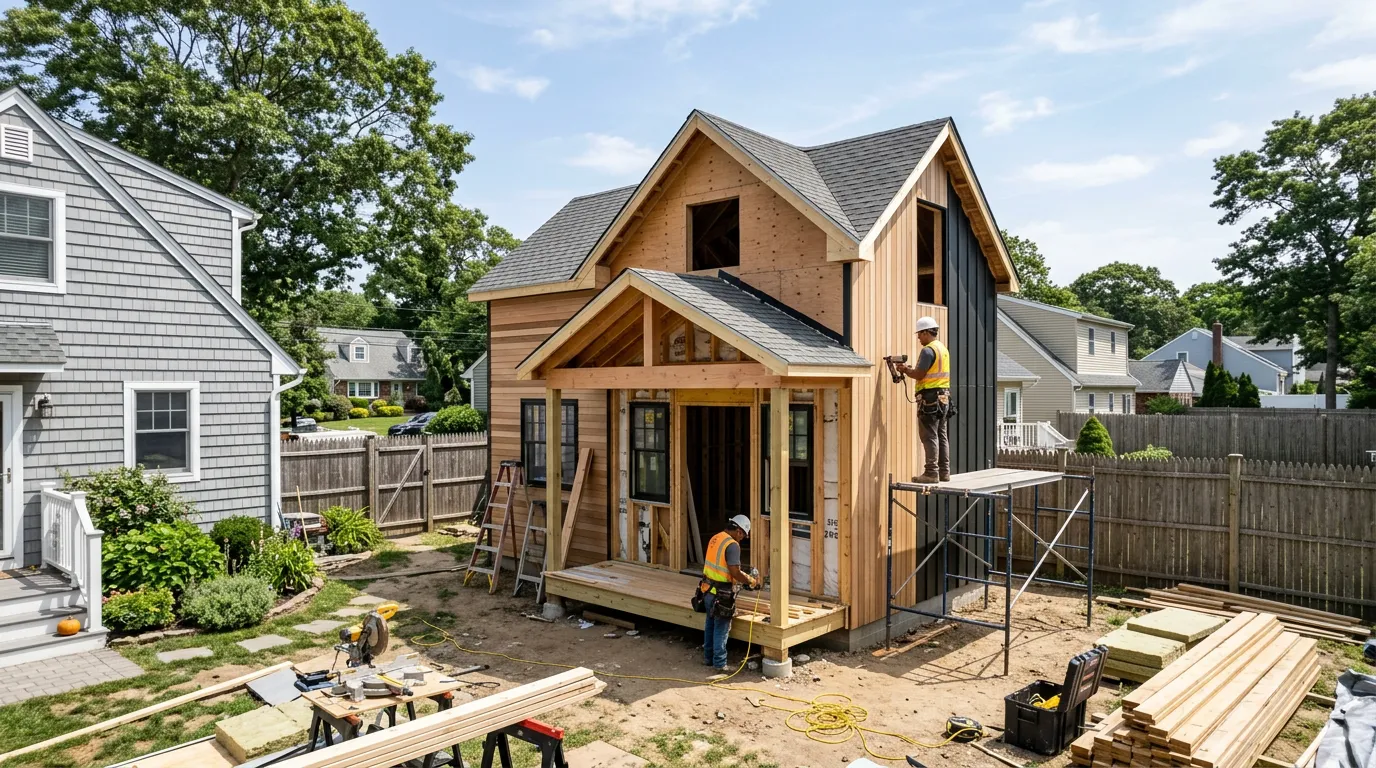
- Compact detached cottages. On lots of a half acre or more, a detached 550 to 800 square foot cottage provides complete independence for the tenant. Cedar shingle or clapboard siding maintains the beach community aesthetic. Thoughtful siting near the rear of the property preserves the primary residence's yard and privacy.
- Basement and interior conversions. Homes with walk-out basements or unused lower levels can create self-contained apartments with separate entrances. These conversions are among the most affordable options but are limited to properties outside flood zones where habitable basement space is permitted.
- Accessory apartments within the home. Some larger Westhampton Beach homes can accommodate an interior apartment — a separate living space with its own kitchen, bathroom, bedroom, and entrance — carved from existing square footage. This approach requires no new construction and has the lowest cost.
Construction Costs in Westhampton Beach
Westhampton Beach construction costs fall between central Suffolk County rates and the higher premiums of communities further east. The Hamptons premium applies but is moderated by Westhampton Beach's greater accessibility to suppliers and labor from the broader Suffolk County market. Realistic 2026 ranges include:
- Interior or basement conversion: $55,000 to $105,000. The most affordable option when existing space is suitable and the property is not in a flood zone.
- Garage conversion: $70,000 to $135,000. Cost depends on garage condition, flood zone requirements, and desired finish level.
- Above-garage apartment: $100,000 to $180,000. Includes structural reinforcement, full second-story buildout, and exterior treatment to maintain neighborhood character.
- Detached cottage (new construction): $155,000 to $300,000. Range reflects differences in size, foundation type (standard vs. elevated for flood zones), and finish level.
The Plus One grant's $125,000 covers a substantial portion of any Westhampton Beach ADU project. A garage conversion at $115,000 with the grant leaves just $0 in out-of-pocket cost. Even a new detached cottage at $200,000 becomes a $75,000 net investment that generates $1,800 to $2,600 per month in rental income.
Beach Community Character and Design
Westhampton Beach has a distinct architectural identity — cedar shingle siding, white trim, natural landscaping, and a relaxed coastal aesthetic that balances elegance with beach-town informality. ADUs built here should complement this character rather than clash with it:
- Material palette. Cedar shingles (natural or painted), clapboard siding, standing-seam metal roofing, and white or light-toned trim are the vocabulary of Westhampton Beach architecture. We specify these materials to ensure your ADU reads as a natural part of the property and the neighborhood.
- Scale and proportion. ADUs should be visually subordinate to the primary residence. A cottage that is too large or too tall disrupts the property's balance. We design ADUs that are proportionate to the main house and the lot, maintaining the residential scale that defines the community.
- Landscape integration. Native plantings, privet hedges, and dune grasses provide natural screening between the ADU and the primary residence, creating privacy without fencing that feels out of place in a beach community. Landscape design is part of every ADU project we deliver.
- Outdoor living. A covered porch, deck, or patio extends the ADU's livable space and connects it to the outdoor environment. In Westhampton Beach, where the climate is mild from spring through fall, outdoor space is not a luxury — it is an expectation.
Permit Process in Westhampton Beach
The permit process depends on whether your property falls within the Village of Westhampton Beach or the Town of Southampton. Both follow a similar general sequence, but the specific departments, forms, and review standards differ:
- Jurisdiction and zoning determination. We confirm whether your property is within the village or the town, identify the applicable zoning district, and determine flood zone status. This shapes the entire project plan.
- Site evaluation. We assess the property for ADU placement, existing structures suitable for conversion, setback compliance, lot coverage, and utility access (sewer vs. septic, water supply, electrical service).
- Design and plans. Licensed architectural plans are prepared that comply with all applicable zoning, building code, energy code, and flood zone requirements.
- Building department submission. Plans are filed with either the village building inspector or the Southampton Town building department, depending on jurisdiction.
- Suffolk County Health Department (if on septic). Properties on septic systems require Health Department approval for the additional wastewater load. This may require a septic system evaluation and potentially an upgrade.
- Flood zone compliance review (if applicable). For properties in FEMA-designated flood zones, the floodplain administrator reviews elevation plans, flood-resistant construction details, and compliance with local floodplain management ordinances.
- Permit issuance and construction. Once all approvals are secured, the building permit is issued and construction begins with scheduled inspections at every critical phase.
- Certificate of occupancy. The building department issues a CO upon successful final inspection, authorizing occupancy of the completed ADU.
The timeline from consultation to completion in Westhampton Beach typically runs 5 to 10 months, depending on project scope, flood zone requirements, and permit processing times. Conversions generally move faster than new construction. Alec's Construction manages the entire process — every application, every inspection, every coordination call — so you deal with one point of contact rather than a maze of municipal departments.
The gateway to the Hamptons needs workforce housing. Your property can help.
Free consultation — we evaluate your property and ADU options.
Return on Investment for Westhampton Beach ADUs
Westhampton Beach ADUs offer strong financial returns driven by high rental demand and moderate construction costs relative to other Hamptons communities:
- Workforce rental rates. A one-bedroom ADU in Westhampton Beach rents for $1,800 to $2,600 per month at workforce-affordable rates. Studio apartments command $1,500 to $2,000. These rates are achievable within Plus One grant income targeting requirements.
- Annual income. At $2,200 per month, a Westhampton Beach ADU generates $26,400 in annual gross rental income. Over the 10-year grant commitment period, that totals $264,000.
- Payback period. With the Plus One grant covering most or all of the construction cost, many homeowners see positive cash flow from day one. Even without the grant, the payback period for a well-executed ADU project is typically 4 to 7 years.
- Property value enhancement. A permitted, code-compliant ADU adds permanent value to your property. When the grant commitment period ends, the unit can serve any purpose — continued rental at market rates, guest housing, home office, or family use.
Frequently Asked Questions
Is my Westhampton Beach property under village or town jurisdiction?+
Are there flood zone restrictions for building an ADU in Westhampton Beach?+
How much can I earn renting a Westhampton Beach ADU?+
What design style should my Westhampton Beach ADU follow?+
Work With Alec's Construction
This guide is written by the crew that does the work. See Alec's ADUs service — accessory apartments, garage conversions and grant paperwork. Licensed and insured on Long Island, one crew start to finish, free walkthrough and a written estimate inside 48 hours.
Booking the cold months now: we also handle Additions & New Construction and Bathroom Remodeling.
We keep a permit office directory for Nassau and Suffolk, checked against each jurisdiction's own site, because we file in these counters constantly.
Also Serving Westhampton Beach
- Attic Insulation in Westhampton Beach — air sealing, baffles and R-49 depth
- Basement Finishing in Westhampton Beach — egress, ceiling height and moisture
- Bathroom Remodeling in Westhampton Beach — full gut renovations
- Fallen Tree Removal & Roof Repair in Westhampton Beach — tree off the house, roof supported and repaired
- Flood & Water Damage Cleanup in Westhampton Beach — wet material out, drying metered
- Gutter Installation in Westhampton Beach — seamless gutters, fascia and drainage
- Hurricane & Storm Damage Repair in Westhampton Beach — trees, flooding, cleanup and repairs
- Interior Painting in Westhampton Beach — the right work for the cold months
- Kitchen Remodeling in Westhampton Beach — cabinets, counters and layout
- Roofing in Westhampton Beach — tear-offs, repairs and storm damage
- Storm Debris Removal & Cleanup in Westhampton Beach — trees, building debris and hauling
- Storm Roof & Siding Repair in Westhampton Beach — wind damage, tarped and rebuilt
Ready to Build an ADU in Westhampton Beach?
Contact Alec's Construction for a free consultation. We will evaluate your Westhampton Beach property, determine your zoning jurisdiction, assess flood zone requirements, walk you through the Plus One grant process, and provide a detailed construction estimate.
Get a Free Consultation