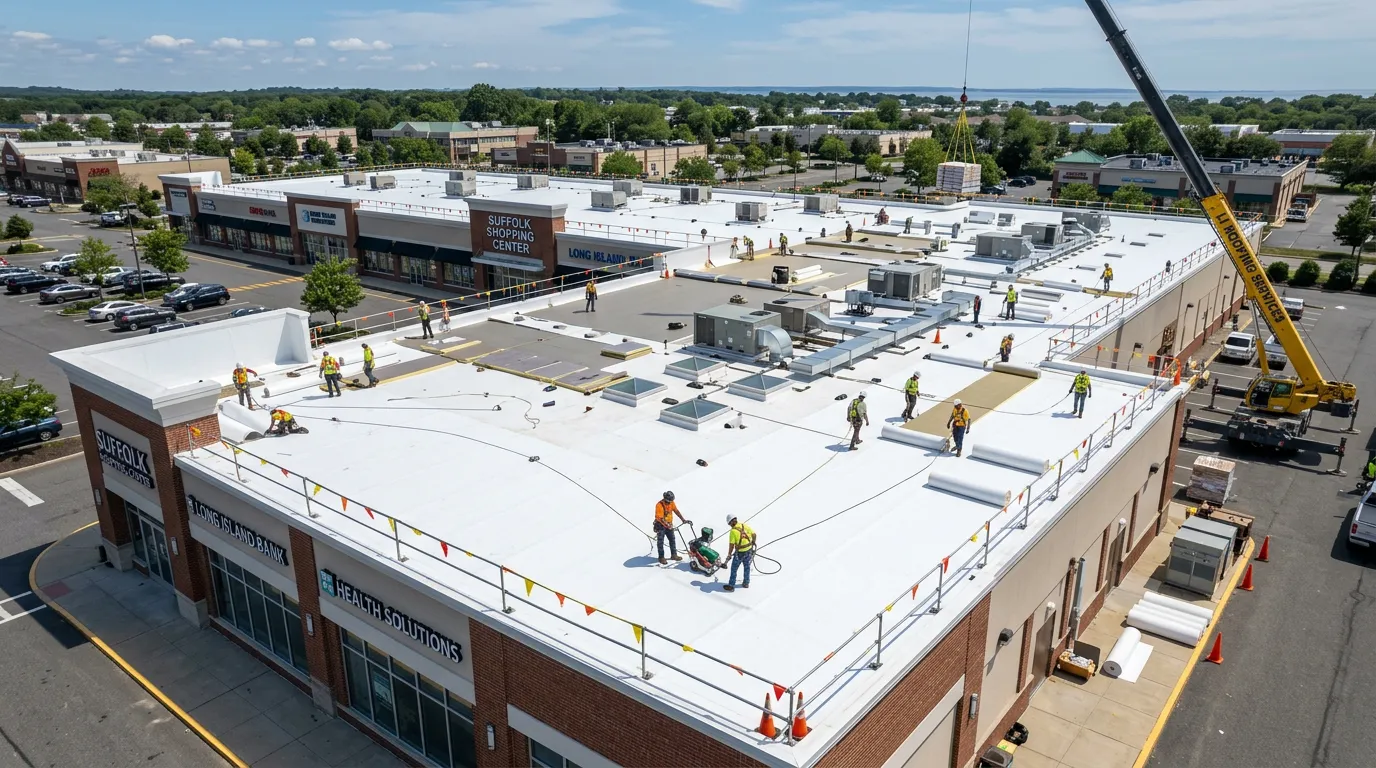
Your flat roof on that strip plaza in Islip or that warehouse in Bohemia doesn't fail in one dramatic moment. It fails slow, then all at once. You get a ceiling stain in the back office in August, call it a one-off, patch it, move on. By October you've got three more stains, a tenant complaining about the smell, and a roofer telling you the membrane has maybe one more freeze-thaw season left in it. Now you're deciding whether to spend capex money before winter or gamble on getting through to spring.
I've been doing roofs across Nassau and Suffolk since 2018, and flat commercial roofs are a different animal from a pitched residential roof. There's no slope doing the work of shedding water for you. Every seam, every penetration, every low spot is a potential failure point, and on Long Island you're asking that membrane to survive roughly 40 to 50 freeze-thaw cycles a season, salt air coming off two coasts, nor'easter wind uplift, and a load of oak and pine debris that clogs drains faster than inland properties ever see.
The decision in front of you isn't really "TPO or EPDM." It's "patch this one more year or commit to a full tear-off now." That decision has a right answer most of the time, and it usually has more to do with what's happening to the insulation underneath the membrane than what's happening on top of it.
Why Flat Roofs Fail Faster Here
Freeze-thaw is the big one. Water gets into a seam or a flashing detail, freezes overnight, expands, and widens the gap. Do that 40 to 50 times a season and a seam that was marginal in September is open by February. Add salt air pulling at metal edge flashing and rooftop units, and you get corrosion at exactly the fasteners holding your membrane down.
Then there's drainage. Oak and pine leaf litter piles up at drains and scuppers every fall, and on a flat roof that means ponding water instead of a quick runoff. Ponding water sitting on a membrane for 48 or more hours is one of the fastest ways to turn a 15-year membrane into a 7-year membrane. If your roof has standing water in more than a couple spots a day after rain, that's not cosmetic, that's a drainage design problem on top of a membrane problem, and it's worth pairing a roof assessment with a look at our commercial gutter and drainage work.
Patch or Replace: How We Actually Decide
I don't make this call off one site visit and a gut feeling. We core the roof in a few spots, which tells us whether the insulation underneath is still dry or has gone to mush. Wet insulation is the real decision point, not the membrane surface. A membrane with a few open seams but dry insulation underneath can often get another season or two out of a proper patch and reinforced flashing. A membrane sitting over saturated insulation is done, because you're not fixing it, you're just paying twice, once for the patch and once for the tear-off you'll do anyway in a year or two.
The other factor is coverage. If failures are isolated to one corner, a few penetrations, or one bad seam run, patch it. If you're finding soft spots scattered across the field of the roof, or the membrane is brittle and cracking when we walk it, that's a roof that's failing everywhere at once, just not all visible yet. If the failure traces back to a specific storm event rather than age, that's a different conversation, one we handle through our insurance restoration process instead of straight capex.
TPO vs EPDM: What Drives the Choice
Both materials work on Long Island, but they fail differently, which matters more than the brand name. TPO seams are heat-welded, which makes a stronger seam than EPDM's glued seams, but TPO is less forgiving of a sloppy install. EPDM is the material I've seen hold up longest against UV and ozone exposure over a 20-plus year span, but its adhered seams are the weak point if the install crew rushed them or worked in cold, wet conditions.
For a building with a lot of rooftop HVAC traffic and penetrations, like most medical offices and retail strips around here, I lean toward TPO for the seam strength and reflectivity. For a simpler low-slope roof with fewer penetrations, EPDM's track record against Long Island's salt air and freeze-thaw cycles is hard to argue with. Neither is the budget answer by itself. The deck condition and the insulation underneath matter more than which membrane you pick.
What Actually Drives the Cost Per Square Foot
I'm not going to hand you a number here, because any flat number you see online is built for a different roof than yours. What actually moves the cost on a commercial tear-off and replace is the condition of the deck once we pull the old membrane off, how much insulation has to come out wet, how many penetrations and curbs need new flashing, whether the drains and scuppers need rework for better flow, and how much crane or hoist access the building allows. A single-story strip plaza in Bohemia with ground access is a different job than a multi-tenant building in Huntington where everything has to go up by hoist.
Tell your roofer you want the cost broken down by these line items, not one lump per-square-foot figure. That kind of line-item scope is standard on every roofing project we run, residential or commercial, and it's also what you hand to your insurer or capex committee when they ask what they're paying for.
Why Fall Is the Install Window
Membrane adhesives and heat-welded seams need a minimum temperature to cure and bond correctly. Once you're into consistent freezing nights, which on Long Island usually locks in by late November into December, you're either paying a premium for cold-weather installation methods or you're waiting until spring. Spring means your failing roof rides out an entire winter of freeze-thaw cycles, nor'easter wind uplift, and ice sitting in whatever low spots haven't been fixed. That's the scenario where a patchable roof becomes a roof with a collapsed deck section.
Fall gives you a dry install window, workable temperatures for seam bonding, and the chance to get through one winter with a membrane that's actually sealed instead of one you're hoping holds. If you're deciding now, in October, you still have a window. Wait until Thanksgiving and you've likely lost it for this year.
Permits and Inspections
Commercial roof replacement generally requires a permit, and most Long Island towns, including Brookhaven, Islip, Smithtown, Huntington, Babylon, Southampton, and the towns across Nassau, will want to see the scope of work and sometimes an engineer's letter if you're changing insulation thickness or roof weight. Timelines and exact requirements vary by town and by whether your building sits in a flood zone or has deed restrictions tied to its commercial certificate of occupancy. Confirm the specifics with your town's building department before you lock in a start date, because a permit delay in November can push you past your install window entirely.
What We Do
We handle commercial flat roof assessments, core sampling, and full TPO and EPDM tear-off and replacement across Nassau and Suffolk, and we'll give you a line-item scope instead of a guess so your capex committee knows exactly what they're approving.
Call (631) 312-7441 or book a free walkthrough before the freeze locks in your install window.
Frequently Asked Questions
How do I know if my flat roof needs full replacement or just a patch?
We core sample the roof in a few spots to check whether the insulation underneath is still dry. Dry insulation with isolated seam failures can usually be patched and monitored. If the insulation is saturated or soft spots show up across the field of the roof, that's a full tear-off situation because patching won't stop water that's already moved underneath the membrane.
Is TPO better than EPDM for a commercial building on Long Island?
Neither is universally better. TPO's heat-welded seams hold up well on roofs with a lot of rooftop equipment and penetrations, while EPDM has a long track record against UV exposure and the salt air on both coasts. The right choice depends more on your deck condition, penetration count, and how the roof is used than on the membrane brand alone.
How long does a commercial flat roof replacement take?
It depends heavily on building size, deck condition, and access. A single-story strip plaza with ground access moves faster than a multi-tenant building needing a hoist for materials. Weather windows in fall also matter, since crews need dry, mild days for proper seam bonding.
Can a flat roof be replaced in winter on Long Island?
It's possible but not ideal. Membrane adhesives and heat-welded seams need minimum temperatures to cure correctly, so winter work often requires slower cold-weather methods and tighter scheduling around freezing nights. Fall installation gives a more reliable seal going into the worst of the freeze-thaw season.
What causes ponding water on a flat roof?
Ponding usually comes from clogged drains or scuppers, often from oak and pine leaf litter that's heavier on Long Island properties than in many other regions, or from low spots in the roof deck itself that never drained properly to begin with. Water sitting on a membrane for more than a day or two accelerates membrane breakdown regardless of material.
Do I need a permit to replace a commercial roof in Nassau or Suffolk County?
Commercial roof replacement generally requires a permit, and requirements can vary by town, especially if insulation thickness or roof weight is changing. Confirm the specific process and timeline with your town's building department before scheduling the work, since permit delays can push a project past the fall install window.
Related Guides
- Commercial Roofing Services
- Gutter and Drainage Services
- Insurance Restoration Services
- Siding Services
Get a Free Estimate from Alec's Construction
Licensed and insured, working across Nassau and Suffolk County since 2018. We come out, look at the actual job, and put a written number in your hand — no pressure, no obligation.
Or call (631) 312-7441