A tenant calls or emails about a ceiling stain, a drip over the register, water coming down a wall by the stockroom. You tell yourself it's probably minor, you'll get to it. That delay is where the real exposure starts, not the leak itself.
I've been called into commercial buildings in Brookhaven and Islip where a landlord sat on a tenant complaint for six weeks because the roof wasn't actively pouring water, just staining. By the time I got on the roof, the insulation board under the membrane was saturated across a twelve by twenty foot section, the tenant had pulled inventory off a shelf that got wet, and now there was a claim letter involved instead of a work order.
On Long Island, your lease almost always puts roof maintenance on you as the owner, even on a triple net deal, unless the lease specifically shifts structural repairs to the tenant. That means a known leak you didn't act on fast isn't just a maintenance headache. It's a documented notice-and-delay problem if the tenant's goods, equipment, or business gets damaged.
What the Tenant Complaint Actually Creates
The moment a tenant tells you about water intrusion, verbally or in writing, you have notice. Notice matters because it's the clock that starts running on your duty to act. If you wait and the damage spreads, mold develops, or the tenant's own customers get hurt from a slip near a drip, your defense gets a lot weaker. You can't claim you didn't know.
Most commercial leases I've read for strip retail and small office buildings from Huntington down through Babylon and out to Southampton put the roof, the structure, and common areas on the landlord. The tenant is responsible for their fixtures and interior finishes. When a leak damages their stock or stops them from operating, you're the party on the hook for both the repair and potentially for business interruption if your lease or a court finds you negligent in response time.
Why Flat and Low-Slope Commercial Roofs Fail Here Specifically
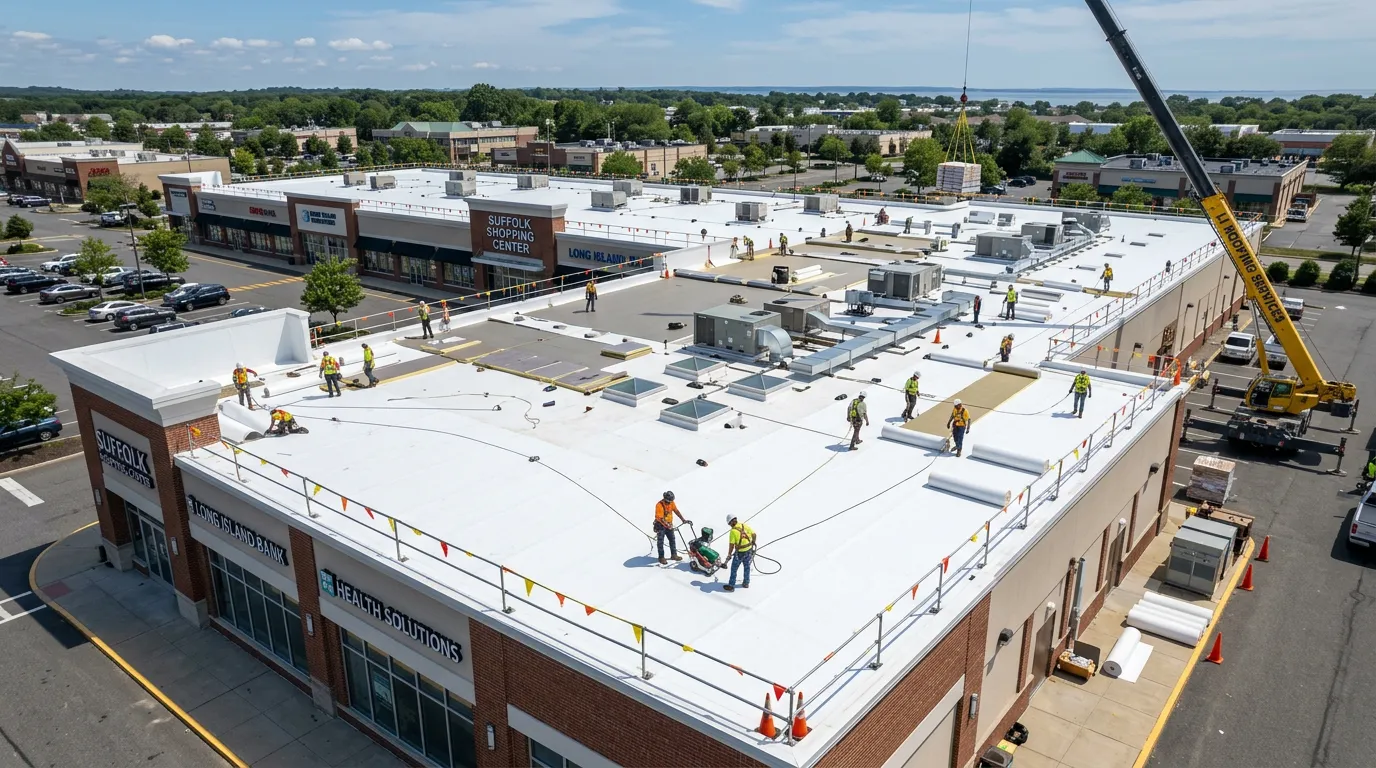
Most commercial buildings on Long Island run flat or low-slope membrane roofs, EPDM, TPO, or built-up systems, not pitched shingle roofs. These systems fail differently than a house roof, and they fail faster once water gets under the membrane.
- Ponding water from poor drainage sits on the membrane through repeated freeze-thaw, and Long Island runs somewhere around 40 to 50 of those cycles a season, each one working a pinhole or seam open a little more
- Seam separation at membrane laps is the number one leak source I find, especially on older EPDM where the adhesive has UV-dried and lost tack
- Rooftop HVAC curbs and penetrations get walked on by service techs doing unrelated work, and the flashing around them cracks without anyone noticing until it rains sideways
- Oak and pine leaf litter clogs internal drains and scuppers every fall, backing water up against parapet walls until it finds a weak point
- Salt air off the Sound or the Atlantic accelerates corrosion on exposed metal flashing and fasteners faster than it would fifty miles inland
Once water gets under a membrane, it doesn't stay where it entered. It travels along the insulation board until it finds a low point or a seam, which is why the stain the tenant sees is often ten or fifteen feet from the actual failure. That's also why patching the visible spot without finding the real entry point just buys you a few more weeks before the stain reappears somewhere else.
Why Waiting Until Spring Costs You More Than Money
A small leak in October is a membrane and insulation problem. The same leak in March, after a full winter of freeze-thaw cycling pushing water deeper into the insulation board and decking, is often a full tear-off. Saturated polyiso insulation doesn't dry out, it has to come out, and if the decking underneath started to delaminate or rust, that's a structural repair, not a roofing repair.
There's also the liability clock. If a tenant documents that they told you about a leak in October and you didn't get it inspected until February, that paper trail works against you if anything happens in between, a slip on a wet floor, damaged inventory, an electrical issue from water near a panel. Acting fast and documenting that you acted fast is half the liability protection right there.
What a Professional Inspection Actually Checks
A tenant complaint tells you where the water showed up inside. It doesn't tell you where it's getting in. A proper commercial roof inspection traces the actual entry point, which usually isn't directly above the stain.
- Full membrane walk checking every seam, not just the area over the complaint
- Flashing inspection at every penetration, curb, and parapet wall, since these fail more often than the open field of the membrane
- Drain and scupper check for clogs, standing water, and proper slope toward drainage
- Moisture scan of the insulation board where access allows, to see how far saturation has already spread
- Interior inspection of the ceiling assembly and any electrical or HVAC equipment near the stain
Insurance and Your Lease Before You Spend a Dollar
Before any repair work starts, pull your commercial property policy and your lease and read the maintenance and repair clauses together. Some policies treat a known, unaddressed leak as a maintenance failure rather than a covered loss, which can limit what they'll pay if the damage gets worse because you delayed. If you already have a tenant claim or insurance claim in motion from storm damage, our insurance restoration team can walk the documentation alongside the repair so you're not fighting the carrier and the roof at the same time.
If the building also has gutter or drainage issues feeding water toward the roofline or foundation, that's worth a look too since commercial buildings on the South Shore sit on the same high water table that gives residential basements trouble, and backed-up gutters can make roof drainage problems worse by holding water against the fascia and parapet longer than it should sit.
Permits and Scope on Commercial Work
Roof repairs beyond a simple patch generally require a permit in most Long Island towns, and commercial buildings often have additional requirements around fire rating, insulation R-value upgrades, and sometimes energy code compliance depending on the scope. Nassau and Suffolk towns handle this differently from each other and even from town to town within Suffolk, so confirm with your specific building department, whether that's Brookhaven, Islip, Smithtown, Huntington, Babylon, or a Nassau town, before assuming a repair is simple enough to skip the permit step. Don't let a contractor tell you it's exempt without you confirming that yourself.
What We Do
We inspect the whole roof system, not just the spot the tenant pointed to, give you a written scope tied to the actual entry point, and handle the insurance paperwork if a claim is in play, so you've got documentation showing you acted on notice instead of sitting on it.
Call (631) 312-7441 or book a free walkthrough.
Frequently Asked Questions
Am I liable if my tenant's inventory gets damaged by a roof leak?
In most commercial leases on Long Island, the landlord holds responsibility for the roof and structure unless the lease specifically shifts that to the tenant. If you had notice of the leak and didn't act within a reasonable time, that delay can work against you if the tenant pursues a claim for damaged goods or lost business. Review your specific lease language and talk to your insurance carrier before assuming either way.
How fast should I respond once a tenant reports a leak?
Get an inspection scheduled within days, not weeks, even if the leak looks minor from the stain inside. Documenting that you responded promptly is one of the strongest things you can do to limit liability, and it also keeps a small membrane repair from turning into a saturated insulation and decking problem.
Does my commercial property insurance cover this?
It depends on your policy and whether the leak is treated as sudden damage versus a known maintenance issue that was allowed to continue. Pull your policy's maintenance and repair clauses before work starts, and loop in your adjuster early if there's any chance this becomes a claim.
Why does the leak show up in a different spot than the stain?
Water travels along the top of the insulation board or deck until it finds a seam, fastener, or low point, so the entry point is often several feet away from where it finally shows up on the ceiling. Patching only the visible stain usually just delays the next appearance of the same leak.
Do I need a permit for a commercial roof repair?
Most Long Island towns require a permit for anything beyond a small patch, and commercial buildings can have added requirements around fire rating or energy code depending on scope. Confirm directly with your town's building department since requirements differ between Nassau and Suffolk towns and even between neighboring Suffolk towns.
Is it worth repairing now or waiting until spring?
Waiting lets a membrane-level problem keep cycling through freeze-thaw all winter, which pushes water deeper into insulation and decking and can turn a repair into a full tear-off. Acting now, while it's still a seam or flashing fix, is almost always the cheaper and lower-liability path.
Related Guides
- Insurance Restoration Services Guide
- Gutter Services and Drainage Guide
- Roofing Services Overview
- Siding Services Guide
Get a Free Estimate from Alec's Construction
Licensed and insured, working across Suffolk County since 2018. We come out, look at the actual job, and put a written number in your hand — no pressure, no obligation.
Or call (631) 312-7441