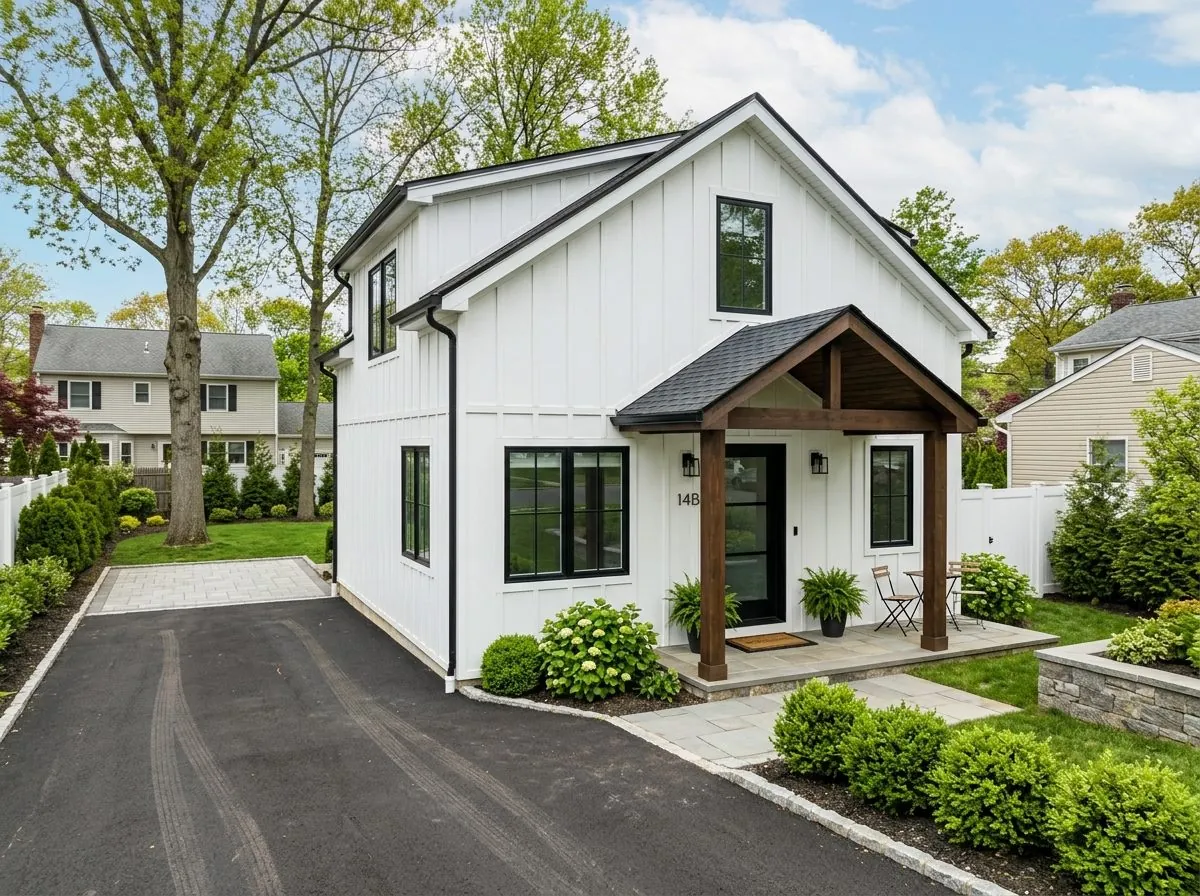
Prefab ADUs have become one of the most talked-about options in the accessory dwelling unit market. The pitch is appealing: a factory-built unit delivered to your property, set on a foundation, and ready for occupancy in weeks instead of months. Companies across the country market prefab ADUs with sleek renderings, fixed pricing, and timeline promises that make the whole process sound painless.
The reality on Long Island is more nuanced. Prefab ADUs can be a viable option for certain properties and certain homeowners, but they come with delivery challenges, cost surprises, zoning complications, and design limitations that the glossy marketing materials do not always address. This guide breaks down the real picture — what prefab ADUs cost, how they compare to site-built construction, where they work well, and where they fall short for Long Island homeowners.
What Is a Prefab ADU?
A prefab (prefabricated) ADU is an accessory dwelling unit that is manufactured in a factory and transported to the homeowner's property for installation. The unit arrives as either a single piece (for smaller models) or in modular sections that are assembled on-site. The factory handles the majority of construction — framing, insulation, interior finishing, plumbing, electrical — in a controlled environment, and the on-site work focuses on foundation preparation, utility connections, and final assembly.
Prefab ADUs come in several categories:
- Modular ADUs. Built in sections in a factory, transported by truck, and assembled on-site with a crane. These are built to the same building codes as site-built structures and are inspected during manufacturing by a third-party agency. They range from 400 to 1,200 square feet and are the closest to traditional construction in terms of quality and durability.
- Panelized ADUs. The walls, floor, and roof are manufactured as panels in a factory and shipped flat to the site, where they are assembled by a construction crew. This approach blends factory efficiency with on-site flexibility, as the panels can be assembled in configurations that adapt to the specific site.
- Shipping container ADUs. Converted steel shipping containers that are retrofitted with insulation, windows, plumbing, and electrical to create living space. These are the most affordable prefab option but face significant challenges on Long Island, including aesthetic concerns, insulation performance in our climate, and building department resistance.
- Tiny home-style prefabs. Smaller units (typically under 400 square feet) that are built on trailers or permanent foundations. These are common in western states but face zoning challenges on Long Island, where minimum size requirements and accessory structure regulations may not accommodate them.
Prefab ADU Costs on Long Island
The advertised price of a prefab ADU and the actual total cost to a Long Island homeowner are two very different numbers. Understanding the full cost picture is critical before committing to this approach.
The unit itself typically costs between $80,000 and $200,000 from the manufacturer, depending on size, design, and finish level. A basic 400-square-foot studio might start around $80,000, while a well-appointed 800-square-foot one-bedroom can reach $180,000 to $200,000. High-end models with premium finishes and larger footprints can exceed $250,000.
But the unit price is only part of the total cost. On Long Island, you also need to budget for:
- Site preparation: $10,000 to $30,000. Grading, clearing, and preparing the location where the unit will be placed. Hilly or wooded sites cost more.
- Foundation: $15,000 to $40,000. Prefab ADUs need a proper foundation — typically a concrete slab, pier foundation, or crawl space. The foundation must be engineered for the specific unit and site conditions.
- Delivery and crane placement: $5,000 to $20,000. Transporting the unit to your property and using a crane to set it on the foundation. Long Island's narrow residential streets, mature trees, overhead power lines, and fenced yards can make delivery complicated and expensive.
- Utility connections: $10,000 to $30,000. Connecting the unit to water, sewer (or septic), electrical, and gas. The cost depends on the distance from existing connections and the complexity of the hookup.
- Permits and engineering: $3,000 to $8,000. Building permits, engineering drawings for the foundation and utility connections, and any required surveys or environmental assessments.
- Landscaping and site restoration: $3,000 to $10,000. Restoring the yard, driveway, and landscaping after the delivery and installation process.
Total realistic cost for a prefab ADU on Long Island: $130,000 to $300,000+. This is significantly higher than the base unit price alone and, in many cases, comparable to or even higher than site-built custom construction.
Prefab or custom? Get an honest comparison.
Free site evaluation — we assess which approach makes sense for your property.
Prefab vs. Site-Built: Head-to-Head Comparison
Here is an honest comparison of prefab and site-built ADUs across the factors that matter most to Long Island homeowners:
- Cost. Prefab units have a fixed base price, which provides cost certainty for the unit itself. However, site work, foundation, delivery, and utility connections add $50,000 to $100,000+ on top of that. Site-built ADUs have more variable pricing but allow the builder to optimize for the specific site, which can reduce unnecessary costs. For conversions of existing structures (garages, basements), site-built is almost always cheaper because there is no delivery or heavy crane work. Verdict: Similar total cost for detached units; site-built wins for conversions.
- Timeline. Prefab manufacturers advertise faster timelines — 8 to 12 weeks from order to delivery. However, this does not include the 4 to 8 weeks for permitting and site preparation that must happen before delivery, or the 2 to 4 weeks of on-site work after delivery. Total real-world timeline: 14 to 24 weeks. Site-built construction for a detached ADU typically takes 14 to 22 weeks of construction time after permits, making the actual timelines comparable. Verdict: Prefab has a slight edge on very simple sites; comparable overall.
- Design flexibility. Prefab ADUs come in standard configurations. You can typically choose from a catalog of floor plans and select finishes from a predetermined palette. Custom modifications are limited or expensive. Site-built ADUs can be designed to fit any lot shape, match any architectural style, and incorporate any feature you want. Verdict: Site-built wins decisively.
- Quality. Factory-built modular ADUs can be high quality — the controlled environment reduces weather damage to materials and allows consistent craftsmanship. However, the transportation process subjects the unit to road vibration and crane handling, which can cause settlement cracks, joint separation, and finish damage that must be repaired after installation. Site-built quality depends entirely on your contractor. Verdict: Comparable when both are done well.
- Site compatibility. This is where prefab ADUs face their biggest challenge on Long Island. Many residential properties have narrow driveways, mature trees, overhead utility lines, fences, and tight access that make delivering a large factory-built module difficult or impossible. A crane needs clear overhead space and solid ground to operate. If your backyard is accessible only through a 10-foot gate and a path between the house and a fence, a prefab delivery may not be feasible. Site-built construction uses materials that can be carried in by hand or with small equipment. Verdict: Site-built wins for access-constrained properties.
- Zoning compliance. Prefab ADUs must meet the same zoning and building code requirements as site-built structures. There is no regulatory shortcut for prefab. The unit needs building permits, must comply with setbacks, height limits, and size restrictions, and must pass inspections. Some building departments on Long Island are less familiar with prefab and may require additional documentation. Verdict: Equal requirements; site-built may have smoother approval.
Delivery Challenges on Long Island
Delivery logistics are the single biggest practical challenge for prefab ADUs on Long Island. This issue deserves special attention because it is frequently underestimated by homeowners who see prefab companies marketing to western states where properties have wide driveways, flat lots, and open access.
Long Island's residential landscape presents several delivery obstacles:
- Narrow streets and driveways. Many Long Island neighborhoods were built in the 1950s through 1970s with narrow streets and single-car driveways. Getting an oversized truck carrying a full-size ADU module down these streets and into your driveway can require road closures, utility company coordination, and escort vehicles.
- Mature trees. Long Island properties often have mature trees with canopies that extend over driveways and backyards. A crane lifting an ADU module over the house or through the yard may require significant tree trimming or removal, adding cost and reducing the environmental appeal of the property.
- Overhead power lines. Electric, cable, and telephone lines run along most residential streets and across many properties. Crane operations near power lines require PSEG coordination, possible temporary line disconnection, and safety setbacks that complicate placement.
- Fences and landscaping. Getting a large module from the street to the backyard often requires removing sections of fencing, paving, and landscaping that must be restored after installation.
- Soil conditions. The crane that places the module needs stable ground to operate. Soft soil, high water tables, or sloped terrain can require ground reinforcement before the crane can safely lift and place the unit.
None of these challenges is insurmountable, but each adds cost, time, and complexity. Before committing to a prefab ADU, have a contractor evaluate your property's access and delivery feasibility. We offer this assessment as part of our free walkthrough.
Licensed & Insured
Full coverage on every project
36+ Cities Served
Suffolk County & Long Island
Free Walkthrough
No obligation, no pressure
Get a Free Estimate
Tell us about your project — we respond within 24 hours.
No spam. No obligation.
When Prefab Makes Sense
Despite the challenges, there are scenarios where a prefab ADU is a good choice for a Long Island homeowner:
- Open access properties. If your property has a wide driveway, open backyard access, and no overhead obstructions, delivery and crane placement are straightforward and affordable.
- Large, flat lots. Properties with ample flat space for foundation work and unit placement simplify the entire process and reduce site preparation costs.
- Speed is the priority. If you need an ADU as fast as possible and your site is delivery-friendly, the factory lead time advantage can shave a few weeks off the total timeline compared to site-built construction.
- Standard design is acceptable. If you are comfortable with a catalog floor plan and standard finish options, prefab can deliver a quality unit without the design phase of a custom build.
- Temporary or relocatable use. Some prefab ADUs are designed to be relocatable, which can be an advantage if you plan to move the unit in the future or if you want the option of removing it from the property.
When Custom Site-Built Is the Better Choice
For most Long Island properties, site-built construction offers advantages that prefab cannot match:
- Existing structures to convert. If you have a garage, basement, attic, or outbuilding to convert, site-built is the only option. Prefab does not apply to conversion projects, and conversions are the most cost-effective ADU approach available.
- Tight access. If a crane cannot reach your backyard, or if the delivery truck cannot navigate your street and driveway, prefab is not feasible. Site-built construction uses materials that can be brought in piece by piece.
- Architectural matching. If you need the ADU to match your home's specific architectural style — Colonial, Tudor, Victorian, Shingle, or other traditional Long Island styles — a custom design is essential. Prefab units have a distinct, often modern aesthetic that may not fit every setting.
- Complex sites. Sloped lots, irregular shapes, proximity to wetlands, and other site complexities are better served by designs that adapt to the terrain rather than requiring the terrain to adapt to a factory-built box.
- Maximum value addition. A custom ADU designed specifically for your property typically adds more appraised value than a generic prefab unit because it is permanently integrated into the site and matches the property's character.
- Plus One grant projects. The Plus One program funds both prefab and site-built projects, but the grant's $125,000 goes further when applied to a cost-efficient conversion project rather than a prefab unit plus delivery and installation costs.
Program status — verified September 2026
Plus One ADU is a New York State program (an $85 million allocation through the Housing Trust Fund Corporation) but it is run town by town, and each town's intake opens and closes on its own schedule. As of September 2026 on Long Island: Huntington and Riverhead are accepting applications; Brookhaven, Islip and Southold are closed. Babylon, East Hampton, Shelter Island and Southampton run their programs through Community Development Long Island rather than the Long Island Housing Partnership.
The $125,000 is a cap, not an amount every applicant receives, and it is awarded as a grant. Huntington's published guidelines cap household income at 100% of Nassau/Suffolk area median income (2023 HUD limits: $109,400 for a one-person household, $156,300 for four) and require that you have owned and lived in the home for at least one year. Applications go on a first-come waitlist and are then re-ranked on priority points, including whether the unit will be affordable at or below 80% AMI and whether it can be permitted without a zoning variance. Municipal code always overrides the program guidelines. Verify your town's status before you budget around a grant: LIHP (631) 435-4710. We also check it for you on the walkthrough — see our Plus One ADU grant page for the eligibility checklist and what the build costs if your town's round is closed.
Zoning and Permits: Same Rules Apply
A critical point that many homeowners miss: prefab ADUs must meet the exact same zoning and building code requirements as site-built construction. There is no regulatory fast-track for factory-built units on Long Island. You still need:
- A building permit from your town's building department
- Compliance with zoning setbacks, height limits, and lot coverage ratios
- Suffolk County Health Department approval if on a private septic system
- Owner occupancy compliance (in most jurisdictions)
- Required off-street parking
- All standard inspections including foundation, electrical, plumbing, and final
The factory may build the unit, but your local building department governs whether it can be placed on your property and occupied as a dwelling. We have seen homeowners purchase prefab units before confirming that their property could legally accommodate one — a costly mistake that is entirely avoidable with proper planning.
Before you order a prefab — check your zoning.
Free zoning review and site evaluation for Long Island homeowners.
Our Recommendation
As a general contractor that builds custom ADUs across Long Island, we have an obvious stake in the site-built approach. But our honest assessment is that the right choice depends entirely on your property, your budget, and your priorities. We have worked alongside prefab manufacturers when the situation called for it, and we have steered homeowners toward custom construction when that made more sense.
If you are exploring an ADU and wondering whether prefab or site-built is the right approach, start with a professional site evaluation. We will walk your property, assess delivery feasibility, review zoning requirements, and give you an honest comparison of both approaches for your specific situation. There is no charge for this consultation, and there is no pressure to choose one direction over the other.
The goal is getting you the right ADU at the right price — however it gets built.
Frequently Asked Questions
How much does a prefab ADU cost on Long Island?+
Is a prefab ADU cheaper than building a custom one?+
How long does it take to get a prefab ADU installed?+
Do prefab ADUs need building permits on Long Island?+
Can a prefab ADU be delivered to any Long Island property?+
Work With Alec's Construction
This guide is written by the crew that does the work. See Alec's ADUs service — accessory apartments, garage conversions and grant paperwork. Licensed and insured on Long Island, one crew start to finish, free walkthrough and a written estimate inside 48 hours.
Booking the cold months now: we also handle Additions & New Construction and Bathroom Remodeling.
Every town here has villages inside it running their own building department. Our directory sorts out which counter your address actually files at.
Need Help Deciding Between Prefab and Custom?
Alec's Construction provides free, no-pressure property evaluations. We will assess your site, compare prefab and custom options for your specific situation, and give you honest numbers. Contact us to schedule your walkthrough.
Get a Free Consultation