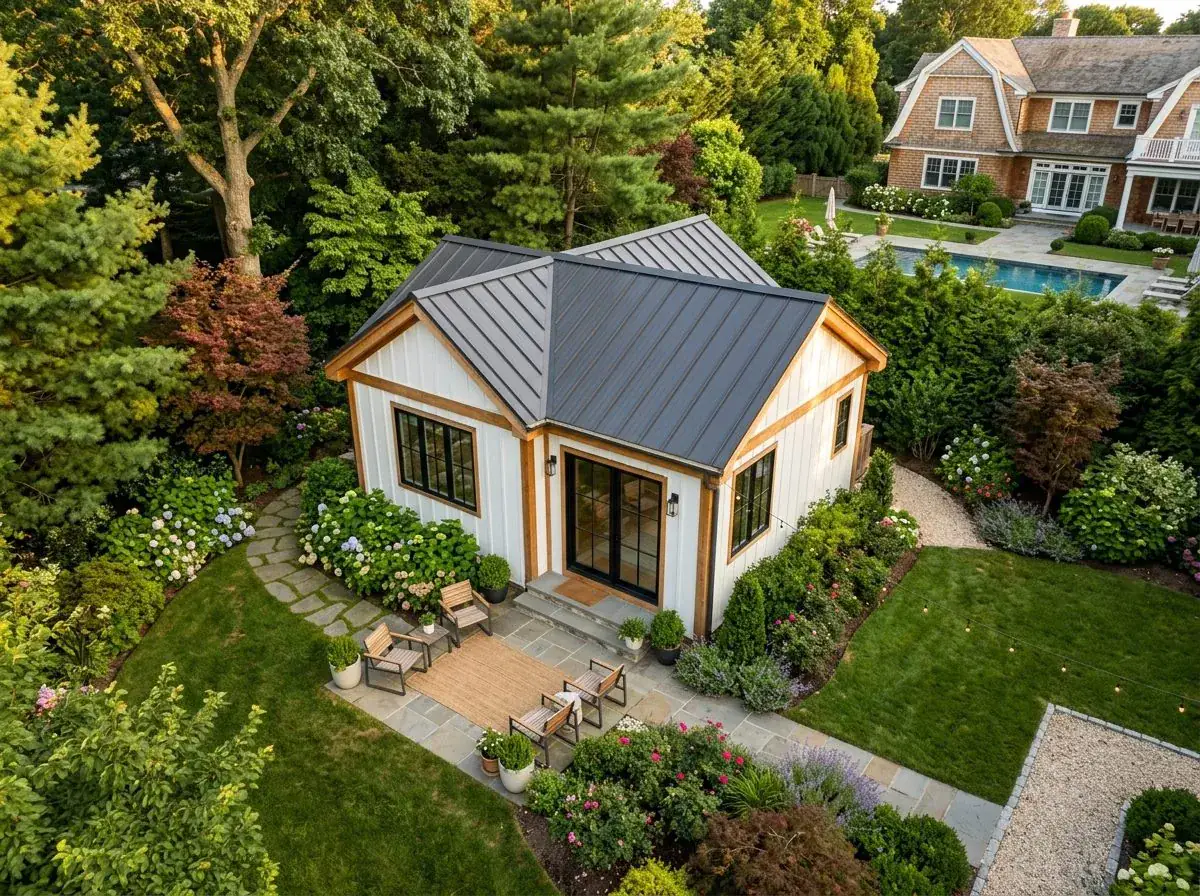
The Town of Huntington stands apart from every other municipality on Long Island when it comes to accessory dwelling units. While most Suffolk County towns handle ADU applications through their general building departments, Huntington has created a dedicated Accessory Apartment Bureau (AAB) specifically to guide homeowners through the ADU process. This level of institutional support is unique on Long Island and reflects Huntington's genuine commitment to making ADU construction accessible and well-regulated.
Whether you live in Cold Spring Harbor, Commack, Dix Hills, Melville, Northport, or Huntington Village, this guide covers everything you need to know about building an ADU in the Town of Huntington: how the Accessory Apartment Bureau works, what the zoning rules are, how to take advantage of the Plus One ADU Program's $125,000 grants, and what construction will cost.
Program status — verified September 2026
As of September 2026, Huntington is accepting Plus One ADU applications through the Long Island Housing Partnership. Intakes open and close town by town — Brookhaven, Islip and Southold are closed right now — so Huntington being open is worth acting on rather than sitting on.
The $125,000 is a cap, not an amount every applicant receives, and it is awarded as a grant. Huntington's published guidelines cap household income at 100% of Nassau/Suffolk area median income (2023 HUD limits: $109,400 for a one-person household, $156,300 for four) and require that you have owned and lived in the home for at least one year. Applications go on a first-come waitlist and are then re-ranked on priority points, including whether the unit will be affordable at or below 80% AMI and whether it can be permitted without a zoning variance. Municipal code always overrides the program guidelines. Verify your town's status before you budget around a grant: LIHP (631) 435-4710. We also check it for you on the walkthrough — see our Plus One ADU grant page for the eligibility checklist and what the build costs if your town's round is closed.
Huntington's Accessory Apartment Bureau
The Accessory Apartment Bureau is a dedicated office within the Town of Huntington's government that exists solely to help homeowners navigate the ADU process. No other town in Suffolk County has anything like it. The AAB serves several important functions:
Huntington: what the permit actually is — verified September 2026
- The Bureau sits in Town Hall, Room 205, 100 Main Street — (631) 351-3009.
- The permit is a temporary exemption from the zoning code, granted at a Hearing Officer's discretion for a maximum of one year, renewable. It is explicitly not a guaranteed right.
- The address must be your primary residence.
- Every renewal requires a re-inspection, and the inspector must have access to the entire dwelling — attic, basement and garage included. A $75 re-scheduling fee applies if the inspector is turned away or the inspection fails.
- Selling? The permit can pass to the buyer only if they file the application and legal documents within 90 days of the transfer of title.
- Renew one month before expiration. Fees paid 30–120 days late incur penalties under Accessory Apartment Code §198-136E(2); after 120 days the permit can be revoked.
- If you do not renew, you must remove the second kitchen, restore free access through the dwelling, and pass a removal inspection.
- If a permit is revoked, no new application can be filed for that address for three years.
- All occupants must use off-street parking. Street parking is not accepted.
- Pre-application guidance. Before you submit a single form, the AAB can review your property's eligibility, explain the requirements for your specific zoning district, and identify potential obstacles early. This saves homeowners significant time and money compared to starting the process blind.
- Application processing. The AAB handles accessory apartment applications from intake through approval, coordinating with the building department, zoning board, and other agencies as needed.
- Compliance monitoring. The bureau ensures that approved accessory apartments continue to meet the town's requirements, including owner-occupancy provisions and safety standards.
- Community education. The AAB provides information to homeowners and the community about the benefits and rules governing accessory apartments, helping reduce misunderstandings and neighborhood concerns.
Having a dedicated bureau means that the staff you interact with specialize in ADUs. They are not generalists handling everything from commercial permits to sign variances. They understand the nuances of accessory apartment applications and can answer specific questions that a general-purpose building department might struggle with.
ADU Rules in Huntington
Huntington's ADU regulations share some common elements with other Suffolk County towns but include provisions that reflect the town's specific character. Key requirements include:
- Owner-occupancy. The property owner must live in either the primary home or the accessory apartment. This is enforced by the AAB and is a condition of the accessory apartment permit.
- Residential zones. Accessory apartments are permitted in the town's residential zoning districts. Huntington's residential zones generally feature larger minimum lot sizes than towns in central Suffolk, which provides more flexibility for ADU placement.
- Setbacks and coverage. All construction must comply with the setback requirements and maximum lot coverage for the applicable zoning district. Huntington's generous lot sizes often make meeting these requirements easier than in more densely developed towns.
- Single-family appearance. The exterior of the property must maintain a single-family appearance. Any new entrances should be discreet and architecturally consistent with the existing home.
- Parking. Additional off-street parking is required for the accessory apartment occupant, with the number of spaces determined by the AAB based on the unit size and location.
- Safety standards. The accessory apartment must meet all building code requirements for habitable space, including egress, fire safety, ventilation, and minimum room dimensions.
Considering an ADU in Huntington?
Free walkthrough — we assess your property and explain your options.
Plus One ADU Program in Huntington
Huntington is a participating municipality in New York's Plus One ADU Program, which offers grants of up to $125,000 to help eligible homeowners build accessory dwelling units. Given Huntington's higher construction costs compared to central Suffolk County, this grant can be especially impactful for homeowners in the town.
The Plus One Program works particularly well in Huntington because:
- Higher property values mean higher rents. Accessory apartments in Huntington communities like Cold Spring Harbor, Dix Hills, and Northport can command premium rental rates, making the investment even more attractive beyond the grant.
- Larger lots create more options. Many Huntington properties have the lot size needed for detached ADUs or larger above-garage apartments, and the $125,000 grant covers a meaningful portion of these builds.
- The AAB streamlines the process. Having a dedicated bureau to work with makes the grant application and ADU permitting process more efficient, reducing the risk of costly delays.
Eligibility depends on income limits, rent restrictions on the completed ADU, and compliance with local building codes. We help our Huntington clients determine their eligibility and coordinate the grant application alongside the construction process.
Types of ADUs for Huntington Properties
Huntington's residential landscape is characterized by larger lots, mature landscaping, and a mix of architectural styles ranging from historic colonial homes in Huntington Village and Cold Spring Harbor to mid-century ranches in Commack and contemporary builds in Dix Hills. This diversity creates a range of ADU opportunities:
- Detached cottages and guest houses. Huntington's larger lots, particularly in Dix Hills, Cold Spring Harbor, and parts of Northport, can accommodate standalone ADU structures. A detached cottage provides maximum privacy for both the homeowner and the tenant, and can be designed to complement the existing home's architecture.
- Above-garage apartments. Many Huntington homes have substantial detached garages, especially in older neighborhoods. Converting the space above a two-or-three-car garage into a studio or one-bedroom apartment is a natural fit that preserves parking below.
- Basement conversions. Full basements are standard in Huntington homes, and the quality of construction in many neighborhoods means these spaces often have high ceilings and solid foundations, ideal for ADU conversion.
- Interior conversions. Larger homes in Huntington sometimes have wings, separate levels, or bonus rooms that can be converted into self-contained apartments with their own entrance, kitchen, and bathroom.
- Garage conversions. Converting an attached or detached garage into living space remains the most cost-effective option when the structure and location are suitable.
Licensed & Insured
Full coverage on every project
36+ Cities Served
Suffolk County & Long Island
Free Walkthrough
No obligation, no pressure
Get a Free Estimate
Tell us about your project — we respond within 24 hours.
No spam. No obligation.
North Shore Building Considerations
Huntington's location on Long Island's North Shore introduces building considerations that differ from the flatter, sandier terrain of central and south Suffolk County towns. If you are planning an ADU in Huntington, these factors affect design, construction methods, and costs:
- Terrain and grading. Huntington's landscape includes significant elevation changes, hills, and slopes that are not found in towns like Brookhaven or Islip. Foundation work for a detached ADU may require more extensive excavation, retaining walls, or grading to create a level building pad.
- Rocky soil. Parts of Huntington, particularly in areas closer to the harbor and along the north shore bluffs, have rocky soil that increases excavation costs for foundations and utility trenching. Standard backhoe work may need to be supplemented with rock breaking equipment.
- Drainage. Hilly terrain means water runoff patterns are more complex. ADU construction must account for proper drainage to prevent water intrusion issues in the new structure and avoid directing runoff onto neighboring properties.
- Mature trees and landscaping. Many Huntington properties have significant mature trees that are both aesthetically valuable and, in some cases, protected by local ordinances. ADU placement must account for root zones and canopy coverage, and tree removal permits may be required.
These factors are not obstacles; they are simply realities of building on the North Shore that experienced contractors plan for. We factor these considerations into our initial assessment and pricing so there are no surprises during construction.
Permit Process Through the AAB
One of the advantages of Huntington's Accessory Apartment Bureau is a more streamlined permit process compared to towns where ADU applications go through the general building department queue. Here is how the process works:
- Initial consultation with the AAB. Contact the bureau to discuss your property and plans. They will confirm eligibility and outline the requirements for your zoning district.
- Application submission. Submit the accessory apartment application along with architectural plans, a current survey, and any supporting documentation requested by the AAB.
- Review and approval. The AAB reviews the application for compliance with all zoning and building requirements. Because the staff specializes in ADUs, the review process tends to be more focused and efficient.
- Health Department coordination. For properties on septic, the AAB coordinates with the Suffolk County Health Department for system capacity approval.
- Building permit issuance. Once the AAB approves the accessory apartment application, the building permit is issued and construction can begin.
- Inspections and CO. Standard construction inspections are conducted at each phase. Upon passing final inspection, a certificate of occupancy is issued for the accessory apartment.
We work directly with the Huntington AAB on behalf of our clients, handling all application preparation, document submission, and coordination. Our goal is that you never need to visit the town offices yourself unless you want to.
Let us handle the AAB process for you.
From application to certificate of occupancy — we manage it all.
ADU Construction Costs in Huntington
Construction costs in Huntington tend to run slightly higher than central Suffolk County due to a combination of factors: more challenging terrain, higher expectations for finish quality in affluent neighborhoods, and increased site preparation costs. Here are realistic 2026 ranges for ADU construction in Huntington:
- Basement conversion: $60,000 to $130,000. Many Huntington basements are well-built with high ceilings, making conversion straightforward. Higher-end finishes push costs toward the upper range.
- Garage conversion: $55,000 to $115,000. Standard conversion costs with potential premium for matching higher-quality exterior finishes.
- Above-garage apartment: $90,000 to $170,000. Structural reinforcement and stairway access are the main cost additions, plus matching the home's architectural style.
- Detached new construction: $175,000 to $350,000+. Ground-up builds on Huntington properties often involve more site preparation (grading, rock removal, tree preservation) and higher finish expectations.
The Plus One ADU Program grant of up to $125,000 can offset a substantial portion of these costs. For a garage or basement conversion, the grant could cover the majority of the expense. For detached new construction, it significantly reduces the homeowner's out-of-pocket investment. We provide transparent, itemized estimates during our free walkthrough so you know exactly what your specific project will cost.
Communities in Huntington
The Town of Huntington includes several distinct communities, each with its own character and ADU opportunities:
- Huntington Village — the historic downtown area with a mix of older homes, walkable streets, and strong rental demand from professionals and commuters.
- Cold Spring Harbor — an affluent waterfront community with larger lots and premium property values. ADUs here often serve as guest quarters or space for aging family members.
- Northport — a charming harbor village with a mix of home sizes. ADUs in Northport benefit from proximity to the waterfront and vibrant village center.
- Commack — a large suburban community with mid-century homes on generous lots. Basement and garage conversions are particularly well-suited here.
- Dix Hills — known for large lots and upscale homes. Detached ADU cottages are viable here due to the spacious properties, and they blend well with the neighborhood's estate-like character.
- Melville — a community with a mix of residential and commercial areas, offering ADU opportunities near employment centers.
For a comprehensive overview of ADU construction across Suffolk County, visit our Long Island ADU guide or read our breakdown of Suffolk County ADU laws. You can also learn more about our ADU building process on our ADU service page.
Frequently Asked Questions
What is the Huntington Accessory Apartment Bureau?+
Is Huntington part of the Plus One ADU Program?+
Are ADUs more expensive to build in Huntington than other Suffolk County towns?+
Can I build a detached ADU cottage in Dix Hills or Cold Spring Harbor?+
Work With Alec's Construction
This guide is written by the crew that does the work. See Alec's ADUs service — accessory apartments, garage conversions and grant paperwork. Licensed and insured on Long Island, one crew start to finish, free walkthrough and a written estimate inside 48 hours.
Booking the cold months now: we also handle Additions & New Construction and Bathroom Remodeling.
We keep a permit office directory for Nassau and Suffolk, checked against each jurisdiction's own site, because we file in these counters constantly.
Also Serving Huntington
- Attic Insulation in Huntington — air sealing, baffles and R-49 depth
- Basement Finishing in Huntington — egress, ceiling height and moisture
- Bathroom Remodeling in Huntington — full gut renovations
- Chimney Repair in Huntington — repointing, crowns, caps and flashing
- Deck Builders in Huntington — new builds, repairs and railings
- Emergency Roof Repair in Huntington — tarping, leaks and storm response
- Fallen Tree Removal & Roof Repair in Huntington — tree off the house, roof supported and repaired
- Flood & Water Damage Cleanup in Huntington — wet material out, drying metered
- Front Steps & Stoops in Huntington — rebuilds, treads and railings
- Garage Conversion in Huntington — turning the garage into living space
- Gutter Installation in Huntington — seamless gutters, fascia and drainage
- House Painters in Huntington — exteriors while the fall window holds
- Hurricane & Storm Damage Repair in Huntington — trees, flooding, cleanup and repairs
- Storm Damage & Insurance Restoration in Huntington — emergency tarping and the claim
- Interior Painting in Huntington — the right work for the cold months
- Kitchen Remodeling in Huntington — cabinets, counters and layout
- Masonry & Pavers in Huntington — patios, walkways and retaining walls
- Roofing in Huntington — tear-offs, repairs and storm damage
- Siding in Huntington — James Hardie, vinyl and cedar
- Storm Debris Removal & Cleanup in Huntington — trees, building debris and hauling
- Storm Roof & Siding Repair in Huntington — wind damage, tarped and rebuilt
- Windows & Doors in Huntington — insert and full-frame replacement
Ready to Build Your ADU in Huntington?
Contact Alec's Construction for a free consultation. We will assess your Huntington property, coordinate with the Accessory Apartment Bureau, and provide a detailed estimate.
Get a Free Consultation