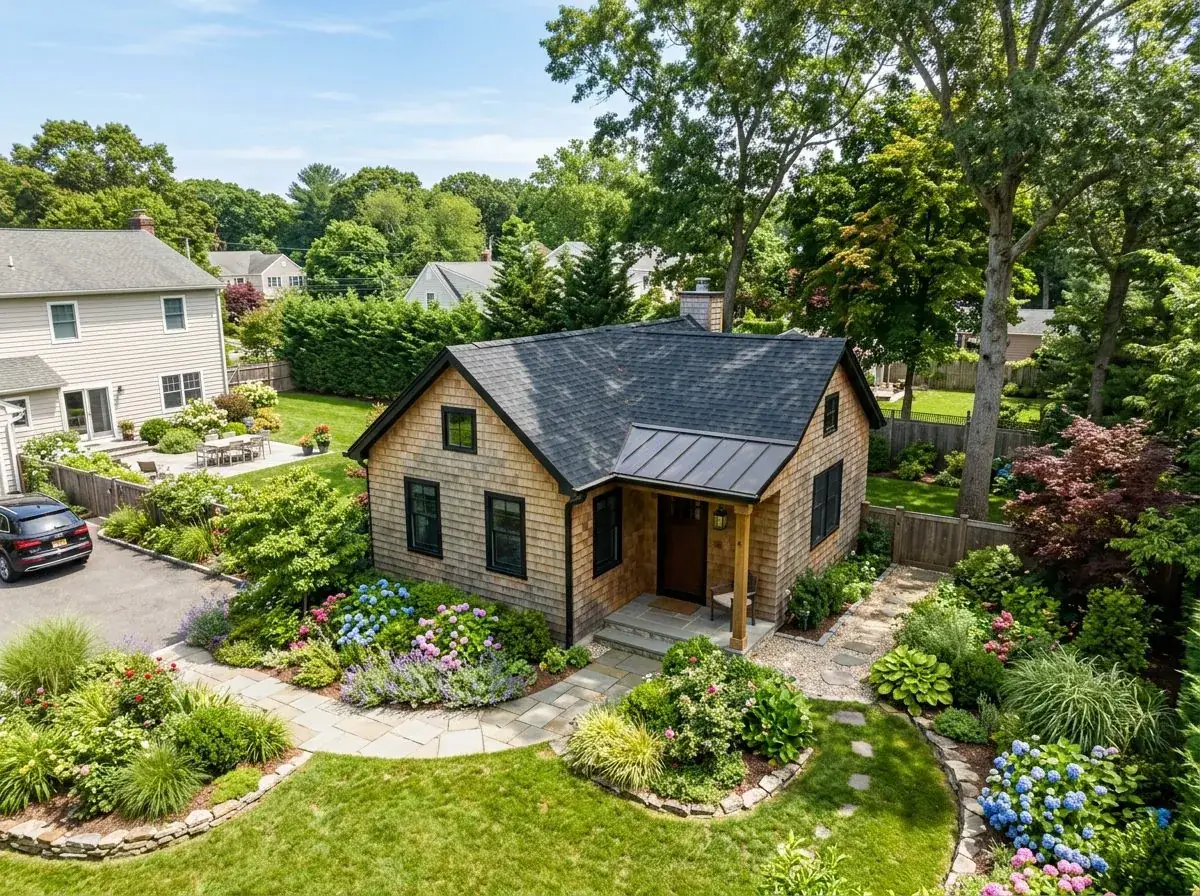
Building an accessory dwelling unit in Suffolk County is not as simple as hiring a contractor and breaking ground. Unlike many parts of the country where a single statewide law governs ADU construction, Suffolk County operates under a patchwork of town-level zoning codes, county health department requirements, and evolving state legislation. The regulatory landscape can feel overwhelming, but understanding it is the difference between a smooth project and one that stalls for months in permitting limbo.
This guide breaks down every layer of ADU regulation that affects Suffolk County homeowners in 2026, from town-specific zoning rules to the health department approvals that trip up most first-time ADU builders.
How ADU Regulations Work in Suffolk County
The first thing every homeowner needs to understand is that there is no single Suffolk County ADU law. Zoning authority in New York State rests primarily with individual towns. Suffolk County contains ten towns, and each one has its own zoning code that dictates whether, where, and how you can build an accessory dwelling unit on your property.
This means that a homeowner in Babylon may face entirely different requirements than a homeowner five miles away in Islip. Lot size minimums, parking requirements, owner-occupancy rules, and even the terminology used to describe ADUs vary from town to town.
On top of town-level zoning, the Suffolk County Department of Health Services plays a critical role for any property that relies on a septic system rather than municipal sewer. Since the vast majority of Suffolk County properties use septic systems, this adds a second layer of approval that does not exist in most other parts of the state. The health department must verify that your existing septic system can handle the additional wastewater flow from an ADU, or require you to upgrade before construction can proceed.
Finally, New York State legislation has been increasingly supportive of ADU construction. Several bills have been introduced to standardize ADU rules across the state, and grant programs like the Plus One ADU Program now provide significant financial incentives. Understanding all three layers of regulation is essential before you start planning your project.
Program status — verified September 2026
Plus One ADU is a New York State program (an $85 million allocation through the Housing Trust Fund Corporation) but it is run town by town, and each town's intake opens and closes on its own schedule. As of September 2026 on Long Island: Huntington and Riverhead are accepting applications; Brookhaven, Islip and Southold are closed. Babylon, East Hampton, Shelter Island and Southampton run their programs through Community Development Long Island rather than the Long Island Housing Partnership.
The $125,000 is a cap, not an amount every applicant receives, and it is awarded as a grant. Huntington's published guidelines cap household income at 100% of Nassau/Suffolk area median income (2023 HUD limits: $109,400 for a one-person household, $156,300 for four) and require that you have owned and lived in the home for at least one year. Applications go on a first-come waitlist and are then re-ranked on priority points, including whether the unit will be affordable at or below 80% AMI and whether it can be permitted without a zoning variance. Municipal code always overrides the program guidelines. Verify your town's status before you budget around a grant: LIHP (631) 435-4710. We also check it for you on the walkthrough — see our Plus One ADU grant page for the eligibility checklist and what the build costs if your town's round is closed.
Not sure what your town allows?
We research the zoning for you. Free walkthrough, no obligation.
Town-by-Town Overview of ADU Regulations
Here is what you need to know about accessory dwelling unit rules in each of Suffolk County's ten towns. Keep in mind that zoning codes change, and the information below was verified in September 2026. Always verify current requirements with your town's building department or work with a local contractor who stays current on these rules.
- Town of Babylon. Babylon regulates accessory apartments under Zoning Code Chapter 213, Article XXIIA, and runs them through an Accessory Apartment Review Board. The dwelling must be owner-occupied, each dwelling unit needs a minimum of 350 habitable square feet, and on-site parking has to be paved. A Building Inspector inspects both apartments, and a licensed engineer's report is sometimes required. You cannot hold an accessory apartment permit on a Babylon property if you already hold one on another Babylon dwelling. Accessory Apartment Division: (631) 957-7468.
- Town of Brookhaven. Brookhaven's accessory apartment rules live in Town Code §85-258. Apartments are allowed in the A, A-1, A-2, A-5, B, B-1 and C Residence Districts, one per lot. The owner must live in the dwelling containing the apartment — either unit is fine — and own at least 50%. The apartment may have no more than one bedroom, and its size is tied to the house: 300 to 650 sq ft may not exceed 40% of the home, 651 to 750 sq ft not more than 35%, and 751 to 850 sq ft not more than 30% at the Review Board's discretion. Parking is two spaces for the owner plus one designated space for the apartment. The first Provisional Accessory Apartment License runs two years.
- Town of Islip. Islip's accessory apartment law (Town Code Article XLVII) sets a minimum lot size of 7,500 square feet. Note the owner-occupancy detail that trips people up: in Islip the owner must live in the principal dwelling, not the accessory apartment, and must hold at least a 50% title interest. Occupancy is capped at one person per 100 square feet, and the permit terminates on the applicant's death, on transfer of title, or when the owner stops living there — it does not pass to a buyer.
- Town of Huntington. Huntington runs a dedicated Accessory Apartment / ADU Bureau (Town Hall Room 205, 631-351-3009), but understand what the permit actually is: a temporary exemption from the zoning code, granted at a Hearing Officer's discretion for a maximum of one year and renewable — not a permanent right. Every renewal requires a re-inspection with access to the whole dwelling including attic, basement and garage, and there is a $75 fee if the inspector cannot get in. On a sale, the buyer has 90 days from transfer of title to file. Let it lapse past 120 days and the permit can be revoked — after which no new application can be filed for that address for three years. If you do not renew, you must remove the second kitchen and pass a removal inspection.
- Town of Smithtown. Smithtown handles these as “mother/daughter” permits issued by the Building Department, and the permit must be renewed every three years. The zoning requirement tables are in Town Code §322. Building and Planning: (631) 360-7540.
- Town of East Hampton. East Hampton permits accessory apartments in certain zones, with regulations that reflect the town's focus on preserving residential character. Lot size requirements, setback compliance, and architectural compatibility are all considerations. East Hampton also participates in the state's Plus One ADU Program.
- Town of Southampton. Southampton's accessory apartment requirements vary by zoning district, and the eastern towns generally pair larger minimum lot sizes with stricter design review than central Suffolk. Southampton runs its Plus One ADU allocation through Community Development Long Island rather than the Long Island Housing Partnership. Because the district-by-district thresholds change, confirm your specific parcel with the Town before assuming it qualifies.
- Town of Riverhead. Riverhead allows accessory apartments in several residential zones. The town has been actively participating in affordable housing initiatives, which has created a more favorable environment for ADU construction. Riverhead is also a participating town in the Plus One ADU Program.
- Town of Southold. Southold made the most significant ADU change on Long Island in years. In April 2026 the Town Board removed the requirement that an accessory apartment be created inside a “permanently existing” one-family dwelling — meaning homeowners can now build a new detached accessory apartment rather than only convert an existing structure. The Board had already dropped the three-year occupancy prerequisite in May 2025. Units run 450 to 750 square feet of livable floor area, three off-street parking spaces are required, and the occupant must be a family member or someone on Southold's Affordable Housing registry. The permit is not transferable — a new owner reapplies to the ZBA (631-765-1809) — and there is an annual renewal inspection.
- Town of Shelter Island. As an island community accessible only by ferry, Shelter Island has unique housing pressures. The town allows accessory apartments and participates in the Plus One ADU Program. Zoning restrictions reflect the island's limited land area and infrastructure constraints.
Common Zoning Requirements Across Suffolk County
While each town has its own code, several requirements appear consistently across Suffolk County:
- Lot size minimums. Most towns require a minimum lot size to add an ADU. Islip, for example, sets 7,500 square feet. The eastern towns generally run higher. Thresholds are set district by district, so the only number that matters is the one attached to your parcel's zoning district. If your lot does not meet the minimum, you may need to apply for a variance, which adds time and uncertainty to the process.
- Owner-occupancy. Nearly every Suffolk County town requires the property owner to live on the property — but which unit varies, and it matters. Brookhaven and Southold let the owner occupy either unit. Islip requires the owner to live in the principal dwelling, not the apartment. Huntington requires the address to be your primary residence and re-verifies it at every annual renewal inspection. This means you cannot build an ADU and rent both the main house and the apartment to tenants. The owner-occupancy requirement is typically enforced through annual certification or affidavit.
- Parking. Most towns require at least one additional off-street parking space for the ADU, beyond what is already required for the primary residence. This usually means having space for three total vehicles, two for the main home and one for the ADU.
- Square footage limits. ADUs are typically limited to a maximum percentage of the primary dwelling's floor area, or a fixed cap such as 800 or 1,000 square feet, whichever is less. The exact formula depends on the town and zoning district.
- Setback compliance. The ADU must meet the same setback requirements as the primary structure, meaning minimum distances from property lines, the street, and neighboring buildings. Detached ADUs face the strictest setback requirements.
- Single-family zones only. In most towns, ADUs are only permitted on properties zoned for single-family residential use. Multi-family zones, commercial zones, and mixed-use zones may have different rules or may not permit additional accessory apartments.
Licensed & Insured
Full coverage on every project
36+ Cities Served
Suffolk County & Long Island
Free Walkthrough
No obligation, no pressure
Suffolk County Health Department Requirements
For most Suffolk County properties, the health department approval is the most consequential step in the ADU permitting process. Here is why: the majority of homes in Suffolk County are not connected to municipal sewer systems. They rely on private septic systems, also known as onsite wastewater treatment systems. When you add a dwelling unit to a property, you are adding bathrooms, a kitchen, and potentially bedrooms, all of which increase wastewater flow.
Septic sizing in Suffolk County runs off Article 6 of the Suffolk County Sanitary Code, and bedroom count is the variable that drives everything. SCDHS Memorandum #19 governs how the county decides what counts as a bedroom — which is not always what you would call a bedroom. Minimum septic tank capacity is 1,000 gallons for three bedrooms or fewer, with an additional 250 gallons per bedroom beyond that. If your ADU pushes the property's total bedroom count past what your existing system was sized for, the system has to be upgraded before a building permit is issued. See also the full list of Long Island towns we serve.
A full innovative/alternative onsite wastewater treatment system (I/A OWTS) is the expensive branch of this decision, and it is the one homeowners fail to budget for. But the funding picture changed materially and most ADU articles have not caught up. Suffolk County's Septic Improvement Program provides a base grant of up to $10,000, plus up to $10,000 more ($5,000 for a pressurized shallow drainfield, $5,000 for income-eligible applicants). More importantly, as of July 2025 combined New York State and Suffolk County grants can reach $45,000 toward an I/A OWTS. That funding has a durable source behind it: in November 2024, Suffolk voters passed Proposition 2, the Water Quality Restoration Act, with 72% of the vote, creating a 1/8% county sales tax split between sewers and individual septic projects. It had collected close to $40 million by December 2025. Start at ReclaimOurWater.info or SepticGrants@SuffolkCountyNY.gov, (631) 852-5811.
A smart strategy is to design your ADU in a way that avoids adding bedrooms to the official count. For example, converting an existing finished basement into an accessory apartment without adding new rooms that qualify as bedrooms under the building code may allow you to avoid a septic upgrade entirely. Your contractor should evaluate this early in the design phase.
Get a Free Estimate
Tell us about your project — we respond within 24 hours.
No spam. No obligation.
The Permit Process Step by Step
Here is the typical sequence for permitting an ADU in Suffolk County. The exact process varies by town, but the general framework is consistent:
- Pre-application research. Before you invest in plans or engineering, determine whether your property qualifies for an ADU under your town's zoning code. Check lot size, zoning district, and any overlay restrictions. This is where working with a knowledgeable local contractor pays off immediately.
- Design and engineering. Hire an architect or work with your contractor's design team to create plans that meet building code, zoning setbacks, and accessibility requirements. The plans must show the ADU layout, structural details, electrical, plumbing, and HVAC systems.
- Town sign-off, then Suffolk County Health Department review. The health department application is Form WWM-105, “Application for Sewage Disposal and Water Supply Facilities for a Residential Accessory Apartment.” The order of operations catches people out: a Town or Village building official must sign WWM-105 first, verifying the application conforms to the local accessory apartment law, before the form goes to the county. The form asks for your total bedroom count after construction, your sewage method (conventional septic, I/A OWTS, or public sewer), your water supply, and whether you are reusing any existing sanitary components. Office of Wastewater Management, 360 Yaphank Avenue, Suite 2C, Yaphank · (631) 852-5700 · HealthWWM@suffolkcountyny.gov.
- Building permit application. Submit your plans, health department approval, survey, and application to your town's building department. The plan review typically takes 2 to 6 weeks depending on the town's workload.
- Construction. Once permitted, your contractor builds the ADU according to the approved plans. Inspections occur at key milestones: foundation, framing, rough plumbing, rough electrical, insulation, and final.
- Certificate of occupancy. After passing final inspection, the building department issues a certificate of occupancy for the accessory apartment. This document is what makes the unit legal and rentable.
The total timeline from initial consultation to move-in typically ranges from 4 to 9 months, with permitting being the most variable phase. Towns like Brookhaven and Islip tend to process permits on a predictable schedule, while smaller towns may have less predictable timelines.
New York State ADU Legislation
New York State has been moving toward more ADU-friendly policies, driven by the ongoing housing shortage that is especially acute on Long Island. Several pieces of legislation are relevant to Suffolk County homeowners:
- The Accessory Homes Enabling Act (A4854 / S4547). This is the bill that would require municipalities across New York to allow ADUs in areas zoned for residential use, overriding local prohibitions. It was reintroduced for the 2025–26 session and remains in committee. It is not law. Plan your project around your town's current code, not around this bill passing.
- Assembly Bill A7569 (2025–26). A Suffolk-County-specific bill creating a real property tax exemption for homes with an ADU rented to a household in need. Introduced April 1, 2025 by Assemblymember Ramos and referred to the Committee on Real Property Taxation, where it currently sits. As drafted, the ADU would have to represent no more than 30% of the property's total assessed value and the tenant would have to earn at or below 80% of area median income. Also not law yet.
- The Housing Compact is dead — do not plan around it. You will still find articles describing the Governor's Housing Compact as pending. It is not. The statewide ADU mandate was pulled from the executive budget in February 2022 after local pushback, the broader Compact was scrapped in April 2023 budget negotiations, and by November 2023 the administration had abandoned construction mandates for localities entirely. What replaced the mandate was money and incentives, chiefly the Plus One ADU Program, rather than a requirement that towns say yes.
- Plus One ADU Program. This state-funded grant program provides up to $125,000 in forgivable loans to homeowners who build ADUs and rent them at affordable rates. Several Suffolk County towns participate, making it one of the most impactful programs available to Long Island homeowners. Read our complete guide to the Plus One ADU Program.
Up to $125,000 in ADU grants available.
We help you apply. Schedule your free walkthrough today.
Why Work with a Local Contractor
ADU regulations in Suffolk County are genuinely complex. Between ten different town zoning codes, health department septic requirements, and evolving state legislation, there are dozens of potential pitfalls that can delay or derail a project. Here is why working with a contractor who specializes in Suffolk County construction matters:
- Zoning expertise. A local contractor knows which zoning districts in each town allow ADUs, what the lot size minimums are, and whether your specific property is likely to qualify. This saves you weeks of research and avoids costly mistakes.
- Building department relationships. Contractors who regularly pull permits in towns like Brookhaven, Islip, and Babylon understand how each building department operates, what they look for during plan review, and how to avoid the most common rejection reasons.
- Health department experience. Navigating the septic approval process requires understanding Memorandum #19, bedroom counting rules, and when I/A-OWTS systems are required versus when they can be avoided. A contractor who has handled dozens of these applications can anticipate issues before they become problems.
- Design for compliance. Local contractors design ADUs from the start with code compliance in mind. This means the plans submitted for permit are far less likely to require revisions, which keeps the project on schedule.
At Alec's Construction, we handle every aspect of ADU permitting and construction across Suffolk County. From the initial zoning check through certificate of occupancy, we manage the regulatory process so you can focus on planning your new living space. Read our complete guide to ADU construction on Long Island for more on the building process itself.
Need it legalized, not just built?
Most calls we get on this are not really construction questions — they are permit questions. An unpermitted apartment, an expired C of O, a stop-work order, a rental you cannot legally advertise. We are a licensed general contractor, and we work alongside permit expediters, architects, and engineers who file this work on Long Island every week. Talk to us first: we tell you which of the two problems you actually have, and who needs to touch it in what order.
Frequently Asked Questions
Can I build an ADU in any Suffolk County town?+
Do I have to live on the property to have an ADU?+
How long does the ADU permitting process take?+
Will new state laws override my town's ADU restrictions?+
Related Articles
ADU Guides by Town
Accessory dwelling rules change from town to town, and inside Nassau County they change again from village to village. These town-by-town guides cover the zoning, permit process and costs where you actually live.
Suffolk County: Amagansett · Babylon · Bay Shore · Bridgehampton · Brookhaven · Cold Spring Harbor · East Hampton · Huntington · Islip · Medford · Montauk · Northport · Patchogue · Port Jefferson · Quogue · Riverhead · Sag Harbor · Sayville · Shelter Island · Smithtown · Southampton · Southold · Water Mill · Westhampton Beach
Nassau County: Hempstead · North Hempstead · Oyster Bay
Work With Alec's Construction
This guide is written by the crew that does the work. See Alec's ADUs service — accessory apartments, garage conversions and grant paperwork. Licensed and insured on Long Island, one crew start to finish, free walkthrough and a written estimate inside 48 hours.
Booking the cold months now: we also handle Additions & New Construction and Bathroom Remodeling.
Filing something yourself? Our Long Island building department directory lists the address, phone and counter hours for all 23 permit offices in Nassau and Suffolk.
Ready to Navigate ADU Regulations?
Contact Alec's Construction for a free consultation. We will assess your property, research your town's zoning requirements, and provide a clear path to your ADU permit.
Get a Free Consultation