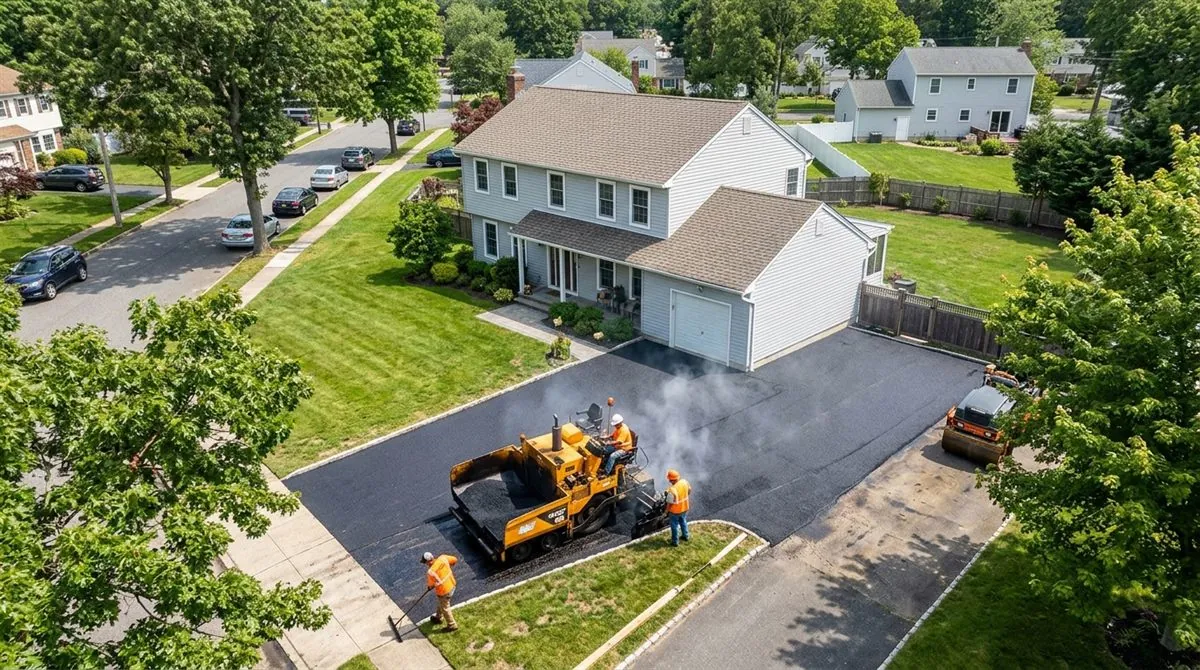
Thickness is one of the most important factors in how long your asphalt driveway lasts — and one of the easiest places for a contractor to cut corners invisibly. Here's what the numbers should look like for a properly built driveway in Nassau or Suffolk County.
The Two-Layer System: Asphalt and Base
A properly built asphalt driveway isn't just pavement — it's a system of layers. The finished surface you park on is only part of the story. What's underneath determines how long it holds up.
Gravel base: 4–6 inches. The base is a compacted layer of crushed stone (typically 3/4" clean stone or processed gravel) that provides structural support and drainage. Without adequate base, asphalt flexes under load and cracks. On Long Island, where soil types vary from sandy loam near the shore to clay-heavy subsoil in parts of Nassau County, a well-compacted base is especially important. Sandy soils drain well but shift; clay soils hold water and swell. In either case, 4–6 inches of compacted base is the standard minimum.
Asphalt surface: 2–3 inches. For a standard residential driveway used by passenger vehicles, 2 inches of compacted asphalt is the minimum. Three inches is the better choice for most homeowners — it costs modestly more but lasts significantly longer and handles edge stress better. If you regularly park heavy vehicles (pickup trucks, SUVs, a boat trailer, a camper), 3 inches is strongly recommended.
Why Contractors Lay It Thin
Asphalt is sold by the ton and priced by the square foot of coverage at a given thickness. A contractor who lays 1.5 inches instead of 2.5 inches saves meaningful material cost on a 1,000 square foot driveway — cost that goes straight to their margin, not into your job. You can't see the difference when the job is freshly done. You see it three to five years later when the surface starts failing.
This is why it's important to ask explicitly in writing: "How thick will the finished asphalt layer be?" and "How thick is the base preparation included in this quote?" Get those numbers in the contract. A contractor who won't commit to thickness in writing is telling you something.
Overlay vs full-depth installation: Some contractors offer an asphalt overlay — laying fresh asphalt over existing pavement without removing the old surface. This works when the existing surface and base are in good structural condition. An overlay typically adds 1.5–2 inches. If the old surface has significant cracking or the base has failed, overlay is not appropriate — it's cosmetic, and the underlying problems will show through within a few years.
For most Long Island homes, the right spec is simple: 4 inches of compacted gravel base, 2.5–3 inches of finished asphalt. That combination, properly installed, should last 20 years in our climate.
Work With Alec's Construction
This guide is written by the crew that does the work. See Alec's Driveways & Blacktop service — asphalt paving, resurfacing and sealcoating. Licensed and insured on Long Island, one crew start to finish, free walkthrough and a written estimate inside 48 hours.
Booking the cold months now: we also handle Masonry & Pavers and Roofing.
Every town here has villages inside it running their own building department. Our directory sorts out which counter your address actually files at.
Ready to Get Started?
Ready to pave? Call Alec's Construction at (631) 312-7441 for a free estimate. We quote the right thickness and deliver what we promise — serving Nassau and Suffolk County.
Get a Free Consultation