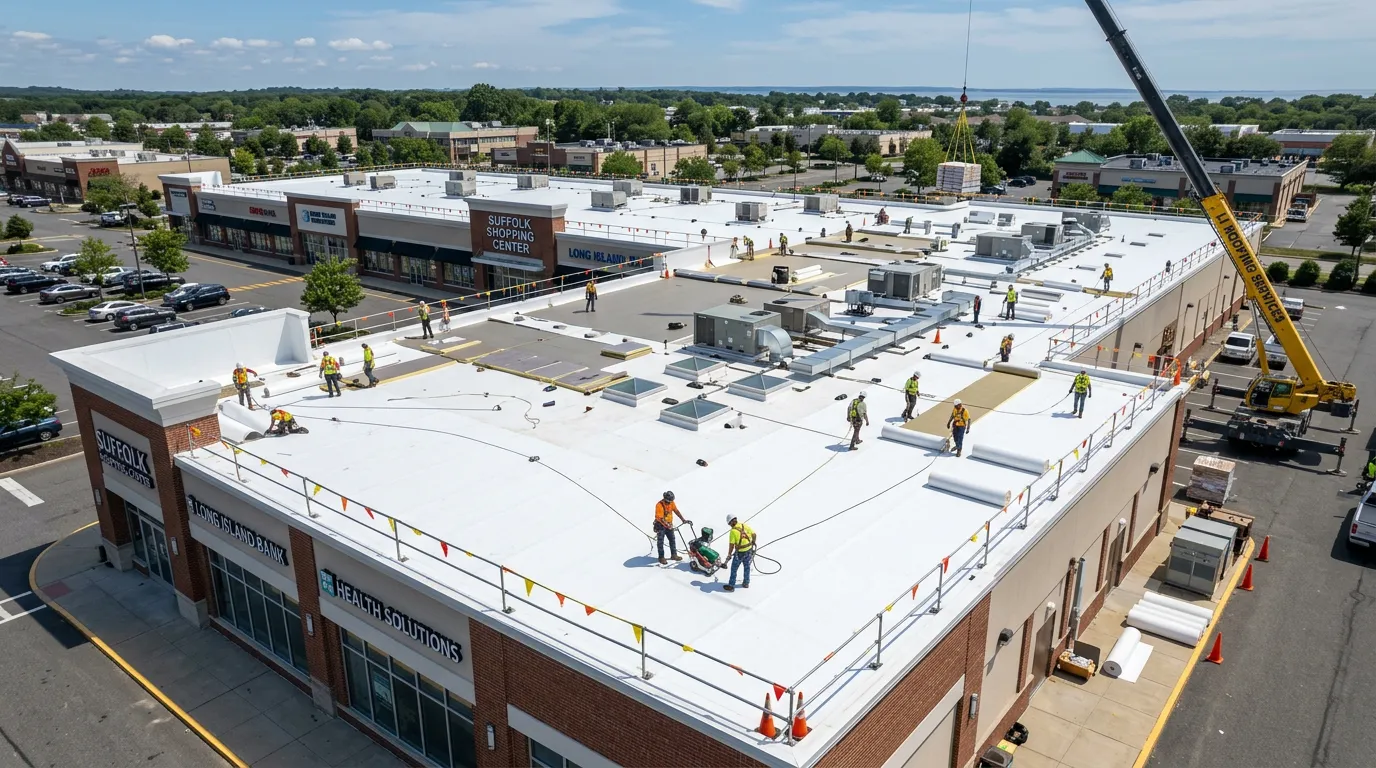
You get the call on a Tuesday afternoon: a water stain spreading across a ceiling tile in Suite 4, and your tenant wants to know what you're doing about it. If you own a flat-roofed commercial building anywhere between Huntington and Southampton, this call almost always lands in October or November, right when the roof has spent a whole summer baking and a whole fall collecting oak and pine leaves in every low spot.
The leak itself isn't the liability problem. The liability problem is what happens in the gap between the day you find out and the day the roof is actually fixed. That gap matters more here than almost anywhere else in the Northeast, because once a nor'easter parks offshore and drops a foot of wet snow on a membrane that already has ponding water sitting in it, a slow drip turns into a structural question.
This is the timeline I give clients: what a tenant complaint actually obligates you to do, what your lease and your carrier expect once that complaint is in writing, and why waiting until the first real snow load to deal with a flat roof leak is one of the most expensive mistakes a Long Island commercial owner can make.
The Liability Clock Starts the Moment the Complaint Is in Writing
A tenant who texts or emails you about a ceiling stain has given you notice. That's the legal trigger, not the leak itself. From that point, you're expected to act within a reasonable time, and "reasonable" gets a lot shorter once the tenant can show you knew and sat on it. I've walked into buildings where the landlord had three months of emails about the same leak before calling a contractor, and that paper trail is exactly what a tenant's attorney goes looking for if drywall collapses or inventory gets ruined.
Document everything from your side too. Photos, the date you were notified, the date you scheduled an inspection, the date repairs started. If this ever turns into a dispute over rent abatement or a damaged-goods claim, the owner who can show a fast, documented response looks completely different to a judge than the one who can't.
Why Flat Roofs Fail Faster Here Than Inland
Long Island runs roughly 40 to 50 freeze-thaw cycles a season. Every one of those cycles works on any crack, blister, or old patch in a membrane, expanding it a little more each time. Add salt air coming off three sides of the Island and you get accelerated corrosion on metal edge flashing, scuppers, and drain rings, the parts that are supposed to keep water moving off the roof instead of under it.
Then there's the leaf load. Oak and pine debris packs into internal drains and scupper boxes every fall, and on a dead-flat commercial roof that means ponding water sitting for days after a normal rain, not just after a storm. Ponding water finds every weak seam eventually. On South Shore properties with a high water table, I've also seen roof structures with slightly more deflection than you'd expect from a building that age, which makes ponding worse in the exact spots where the membrane is already thinnest.
What Happens Once Snow Load Enters the Picture
Wet nor'easter snow is heavier than the dry powder you get further inland, and a flat commercial roof holding ponding water plus a foot of wet snow is carrying real additional dead load. If your roof was built to an older code and is already marginal, that load matters. Worse, a leak path lets water soak into the roof insulation underneath the membrane. Wet insulation loses R-value and gets heavier, and when it refreezes it stays heavier. Roof drains can also freeze shut in a hard cold snap, which forces meltwater to back up and find the weakest point in the membrane instead of draining off the building.
This is the part most owners don't picture until they're standing under a sagging ceiling tile in January. A leak you could patch in October becomes a drain, insulation, and structural conversation by February if it sits through a few freeze-thaw cycles and one real snow load event.
What Your Lease and Your Carrier Actually Expect From You
Most commercial leases on Long Island put roof and structural repairs on the landlord, even in a triple net arrangement where the tenant covers maintenance. Tenants generally can't be made responsible for a membrane failure, and if you drag out the fix, you're exposed to a rent abatement claim or, in a bad case, a constructive eviction argument if the space becomes unusable.
Your insurance carrier is watching a different angle. If a storm claim comes in on a roof with a documented, unaddressed leak, the carrier can argue the damage was a pre-existing maintenance issue, not storm damage, and deny part or all of the claim. A licensed, insured contractor who documents the repair with dated photos and a written scope gives you the paper trail that actually holds up if you need to file. We walk clients through exactly that kind of documentation on storm and insurance claims because the paperwork decides more claims than the roof condition does.
Repair or Replace: Decide Before the Temperature Drops
Cold weather narrows your options. Some membrane systems need adhesives or torch-down methods that have a minimum workable temperature, and once you're consistently below that window, a contractor is limited to emergency patching rather than a proper repair. If your roof already has two or three patch layers from past leaks, you're usually better off committing to a full roof replacement now, while the weather still allows a clean installation, instead of chasing the same leak through four more freeze-thaw cycles.
A single, isolated seam failure on an otherwise sound membrane is a different story and can often be patched properly in a day. The honest answer depends on the roof's age and how many prior repairs are already on it, which is why I walk the whole roof before quoting anything, not just the spot where the stain showed up inside.
Drainage Is Usually the Real Problem, Not the Membrane
In my experience, most "leaking roof" calls on Long Island commercial buildings are actually drainage failures. Clogged internal drains and parapet scuppers hold water against the membrane far longer than the membrane was designed to tolerate, and that's what finally opens the seam. Clearing drains, scuppers, and gutters before the first hard freeze is the cheapest thing you can do this season, and it's the step most property managers skip because it doesn't look urgent until the ceiling tile tells you otherwise.
Permits and Town Reality for Suffolk County
Commercial reroofing generally requires a permit in Suffolk County, and inspection scheduling, required documentation, and timelines can vary quite a bit between Brookhaven, Islip, Smithtown, Huntington, Babylon, and Southampton. Some towns move fast on commercial permits this time of year, others get backed up once everyone is trying to close out exterior work before winter. Confirm the specific permit requirements and current timeline with that town's building department before you lock in a start date, since what a job needed last year isn't always what it needs this year.
What We Do
We inspect the full roof, not just the leak location, give you a straight repair-or-replace recommendation with the reasoning behind it, and handle the documentation your lease and your carrier will actually want to see if this goes any further than a patch.
Call (631) 312-7441 or book a free walkthrough.
Frequently Asked Questions
How long do I legally have to fix a commercial roof leak once a tenant reports it?
There's no fixed number of days written into most leases, but you're expected to act within a reasonable time once you have notice. What counts as reasonable gets shorter the more documentation exists showing you knew and delayed. Document your response timeline from the first complaint forward so you can show a fast, good-faith response if it's ever questioned.
Can a tenant withhold rent over an unresolved roof leak?
It depends on the lease and how severe the impact on the space is, but rent abatement claims and even constructive eviction arguments are both things a tenant can raise if a landlord sits on a known leak too long. The stronger your documentation of a prompt response, the weaker that argument becomes.
Will my insurance cover a leak that's been going on for a while before a storm hits?
Often not fully. Carriers can argue that pre-existing, unaddressed damage is a maintenance issue rather than storm damage, which is one of the fastest ways a claim gets reduced or denied. Getting a documented repair done before the next storm protects both the building and the claim.
Is it too cold to repair or replace a flat commercial roof in the winter on Long Island?
Some membrane systems have a minimum workable temperature for adhesives or torch-down application, so there's a real window that closes as the season gets colder. Isolated seam repairs can usually still be done in cold weather, but a full replacement is better scheduled before temperatures are consistently below that workable range.
What's usually causing a flat roof leak that seems to come from nowhere?
In most cases on Long Island it's a clogged drain or scupper holding ponding water against the membrane far longer than it was built to handle, not a random membrane failure. Clearing drainage before the first freeze catches a lot of these before they ever become an indoor leak.
Do I need a permit to repair or replace a commercial roof in Suffolk County?
Commercial reroofing generally requires a permit, and the exact process and inspection timeline can vary by town. Confirm the current requirements with the building department in whichever Suffolk town the property sits in before scheduling the work.
Related Guides
- Commercial & Residential Roofing
- Storm Damage & Insurance Restoration
- Gutter Installation & Repair
- Ice Dam Warning Signs Before First Snow
Get a Free Estimate from Alec's Construction
Licensed and insured, working across Nassau and Suffolk County since 2018. We come out, look at the actual job, and put a written number in your hand — no pressure, no obligation.
Or call (631) 312-7441