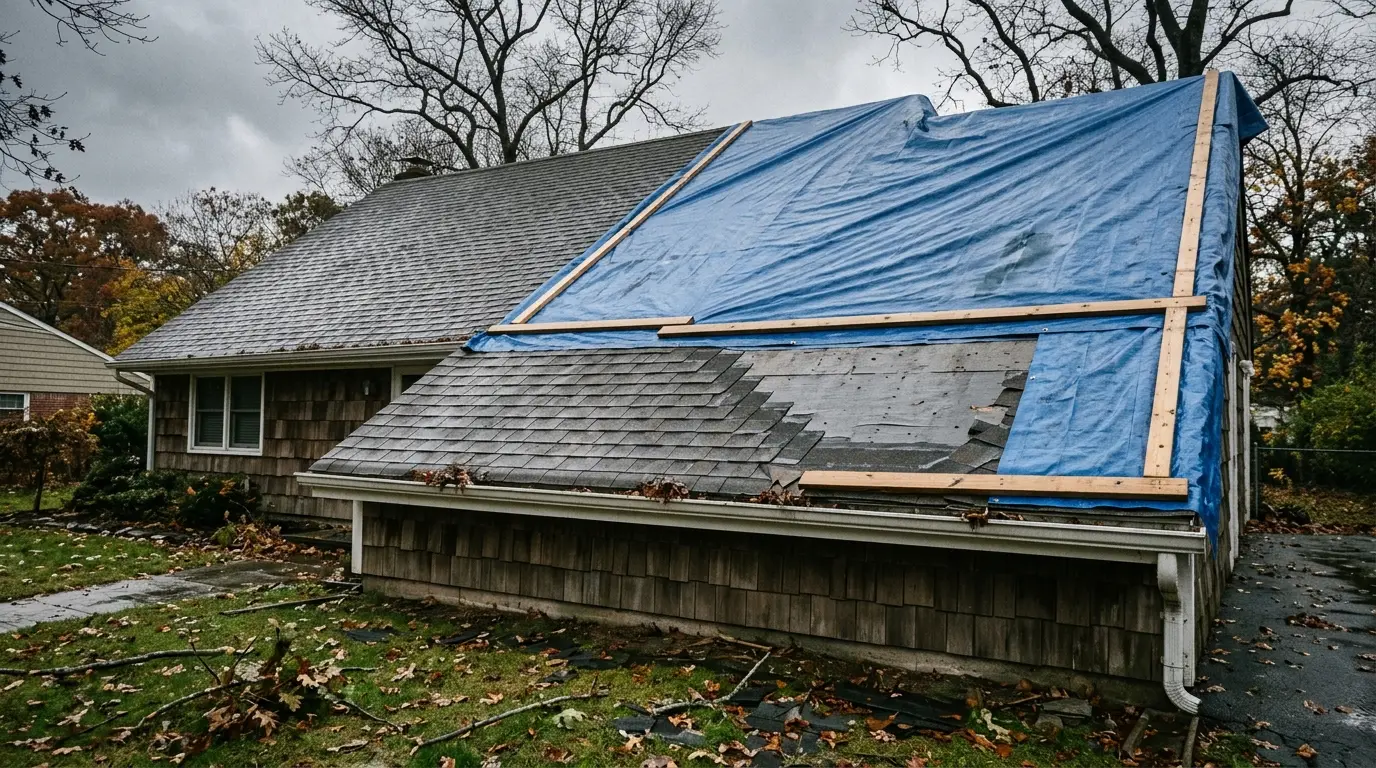
A flat roof over a garage bump-out, a dormer cricket, or a rear porch addition is the most common leak call Alec's Construction gets between November and February. The roof looks fine from the ground. Then a nor'easter blows through, the wind drives rain sideways into a seam that's been quietly failing since August, and water tracks along the rafters until it finds the coldest spot on the ceiling to show up as a stain.
Most of these roofs are membrane, either EPDM rubber or TPO, and most homeowners have no idea which one they have until we're standing on it. That matters, because EPDM and TPO fail differently in a Long Island winter, and the repair that actually holds through March depends on knowing which failure you're looking at.
By the time you see a stain on the ceiling, the membrane has usually been letting water through for weeks. Once nighttime temperatures start dropping below freezing while days stay above it, and we get 40 to 50 of those freeze-thaw swings a season out here, a small pinhole becomes a split seam fast. The question isn't whether to spend money before winter. It's whether a patch will get you through to spring or you're already past that.
Why Long Island Winters Break Flat Roof Seams
Every flat membrane roof moves with temperature. EPDM and TPO both expand in the afternoon sun and contract hard once the sun drops and the temperature falls into the 20s, which happens on and off from November through March here. The field of the membrane can take that movement. The seams can't, not indefinitely. Every freeze-thaw cycle works the seam joint a little more, and after 40 to 50 cycles in a season, adhesive that was fine in October is brittle by February. Add in salt air coming off the Sound, the Atlantic, and the Great South Bay, all three sides of this Island, and you get faster breakdown of the metal edge flashing and termination bars holding those seams down too.
EPDM vs TPO: How Each Fails in the Cold
EPDM rubber roofs, the black membrane you see on most additions built before 2010, are usually seamed with contact adhesive or seam tape. That adhesive is the weak point. Below a certain temperature it loses tack, and if the original installer didn't prime the seam correctly, and a lot of them didn't, you get edge lift starting at a corner or a pipe penetration. Once the edge lifts, wind gets under it, and a seam that was a hairline gap in October is peeled back three inches by January.
TPO, the white or gray membrane on newer flat roofs, is heat-welded, not glued, and a proper weld holds up better in cold than adhesive does. The problem with TPO is what we call a cold weld, a seam that was welded a little too fast or a little too cool during installation. It looks solid. It passes a visual check. Then the first hard freeze-thaw cycle finds the weak spot and it splits open exactly where nobody was looking. The same movement that opens a membrane seam is what opens chimney flashing where a chimney or vent stack punches through a flat roof, so check that transition at the same time you check the field.
Ponding Water Is the Real Enemy
Any flat roof holds some water after it rains, that's normal for the first day. The problem is water that's still sitting there 48 hours later, which we see constantly on additions built with minimal pitch or drains that were never sized right. In summer that ponded water just evaporates slowly. In winter it freezes, and ice sitting directly over a seam or a pinhole works its way in as it expands, then melts and refreezes the next cold snap. That cycle turns a small leak into a real one over a single winter.
South Shore homes, especially in Bay Shore, Islip, and parts of Babylon and Patchogue near the water, deal with this worse because the water table is high and the ground under the slab settles unevenly on sandy soil. A roof that was pitched correctly when it was built can end up with a low spot five or ten years later because the structure under it moved, not because the membrane failed on its own.
Leaf Load Makes a Marginal Roof Fail
Long Island's oak and pine mix is hard on flat roofs specifically because of drains and scuppers, not the membrane itself. Oak leaves come down late, often after the first frost, and they mat over roof drains right when you need them clear for winter rain and melting snow. Pine needles do it worse, they wash into the strainer and pack down into a dense layer a homeowner can't see from the ground. A drain that's half blocked doesn't fail in a light rain. It fails in a nor'easter, when three inches falls in six hours and the water has nowhere to go but up against your seams. Keeping gutters and drains clear before the leaves really start dropping matters as much as anything you'd do to the membrane itself.
Temporary Patch vs Permanent Repair
There's a real difference between a patch that gets you through winter and a patch that's just delaying a bigger bill in March. A legitimate temporary repair, done right, is a cut-in patch of the same membrane material, torched or glued down correctly, over a section that's isolated and otherwise sound.
A patch makes sense when: - The membrane elsewhere on the roof is still flexible, not chalky or cracked - The failure is one seam or one penetration, not multiple spots - The field membrane still has real service life left in it - You need to get through this winter and plan a full replacement next season
Full membrane replacement is the honest answer when: - You've already patched this roof more than once - The membrane is EPDM older than 15 to 20 years and shows chalking or brittleness across the field, not just at the seams - The ponding is structural, from a settled deck, not just a clogged drain - Multiple seams are lifting, not one isolated spot
Permits and Getting It Done Right Across Long Island
Every town out here treats flat roof work a little differently, and it trips people up. Brookhaven, Islip, Smithtown, Huntington, and Babylon all require a permit for a full membrane tear-off and replacement, and most also want one for a full recover over the existing membrane once you're past a certain size. Southampton and the coastal Nassau towns are generally stricter about inspection timing and wind uplift requirements given the exposure. A licensed contractor pulls the permit before the work starts, not after, and that paperwork matters if a seam failure this winter turns into interior water damage and becomes an insurance restoration claim instead of a routine repair.
What We Do
We inspect the membrane, the seams, the drains, and the flashing before we tell you whether you need a patch or a full roofing replacement, and we give you a straight answer instead of the one that's easiest to sell. If you're not sure what you're looking at, get it checked before the first hard freeze, not after a ceiling stain shows up.
Call (631) 312-7441 or book a free walkthrough.
Frequently Asked Questions
How do I know if my flat roof leak needs a patch or a full replacement?
Look at how the membrane feels away from the leak. If it's still flexible and there's no chalking or cracking across the field, a patch is usually the right call. If you've already patched this roof before, or the membrane is original EPDM past 15 to 20 years old, a section patch just delays a bigger repair. Ponding that keeps coming back in the same spot points to a structural drainage problem, not something a patch fixes.
What's the difference between EPDM and TPO for a flat roof on Long Island?
EPDM is black rubber, seamed with adhesive or seam tape, and it's been the standard for decades. TPO is a white or gray membrane that's heat-welded at the seams, which generally holds up better through repeated freeze-thaw cycles when it's installed correctly. Neither material is leak-proof forever, the seam quality and the installer's technique matter more than which material you pick.
Can a flat roof leak wait until spring?
It depends on where the failure is and how much water is getting in. A small seam gap that's letting in moisture during every freeze-thaw cycle gets worse with each cycle, not better, so waiting usually means more interior damage by March. If we can isolate the problem area and it's not affecting the structure, we can sometimes stabilize it now and schedule the full repair once temperatures are reliably above freezing.
Why does my flat roof pond water even though it was pitched correctly?
Sandy soil and a high water table, especially on the South Shore, let the structure under a roof settle unevenly over the years, which changes the pitch even if nothing was done wrong at installation. Clogged drains from oak and pine leaf load also cause ponding on a roof that's pitched fine, because the water simply has nowhere to drain. Both causes need to be diagnosed separately before you spend money on the membrane itself.
Do I need a permit for flat roof repair in Suffolk or Nassau County?
Most towns, including Brookhaven, Islip, Smithtown, Huntington, and Babylon, require a permit for a full membrane replacement and often for a recover over the existing roof past a certain size. A simple isolated patch usually doesn't trigger a permit, but full replacement does, and skipping that step can be a problem later with insurance or resale. We pull permits as part of the job so you don't have to track it down yourself.
How long does a flat roof membrane actually last on Long Island?
EPDM typically runs 15 to 25 years depending on installation quality and how much direct sun and salt air exposure it gets. TPO tends to hold up a little longer if the welds were done right. Both age faster here than inland because of the freeze-thaw cycle count and the salt air coming off three sides of the Island. Regular drain clearing and catching seam issues early add real years to either material.
Related Guides
- Roofing Services
- Gutter Installation and Repair
- Insurance Restoration Services
- Chimney Flashing Leak Repair
Get a Free Estimate from Alec's Construction
Licensed and insured, working across Nassau and Suffolk County since 2018. We come out, look at the actual job, and put a written number in your hand — no pressure, no obligation.
Book a Free WalkthroughOr call (631) 312-7441