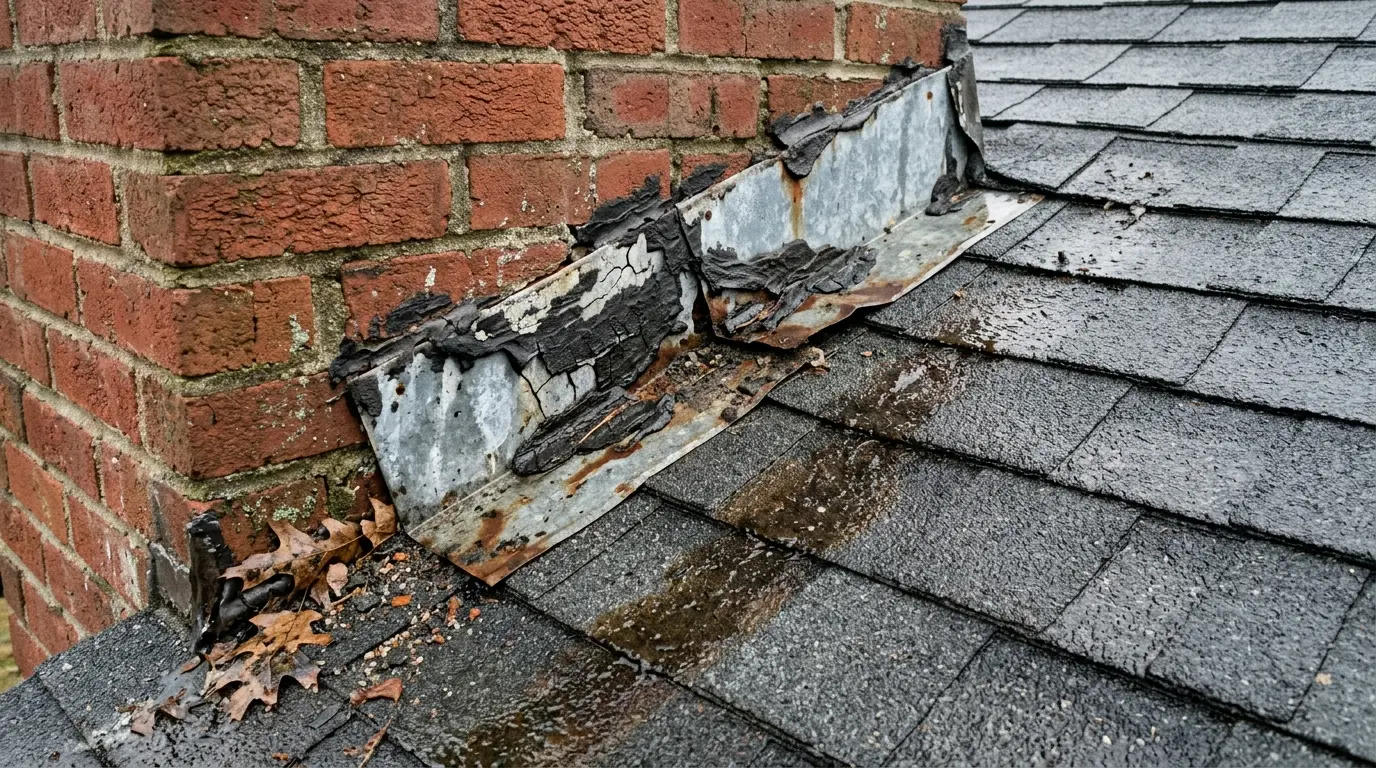
You get a brown ring on the ceiling near the chimney chase, usually after a nor'easter or a few days of sideways rain, and the first move for most homeowners is a tube of clear silicone. Somebody climbs up, runs a bead where the flashing meets the brick or the siding, and it holds for a season, maybe two. Then it comes back, worse, usually during the next storm when nobody wants to be on a roof anyway.
Caulk is not a repair. It is a stopgap that buys a few months while the actual flashing system underneath keeps failing. I have pulled more silicone-smeared step flashing off Long Island roofs than I can count, and under almost every bead there is rusted metal, a gap that has widened from thermal movement, or flashing that was never lapped correctly to start with. The caulk did not fix anything. It just hid the problem from whoever was looking at it from the ground.
This time of year, with the season's freeze-thaw cycles about to kick in, is exactly when that hidden problem turns into ice damming, saturated sheathing, and a repair that used to be a half-day flashing job turning into a full deck and drywall replacement. Here is how to tell what is actually wrong at your chimney, and what fixing it for real looks like.
What's Actually Failing at Your Chimney
A chimney flashing system on a Long Island house is almost always two separate pieces of metal doing two separate jobs. Step flashing sits on the roof plane, woven in with each course of shingles, one small L-shaped piece per course, so water running down the roof always lands on metal and gets kicked off to the side. Counter flashing is cut into a reglet, a groove ground into the mortar joint, and laps down over the top edge of the step flashing to keep water from ever getting behind it.
When one of those fails, the other cannot cover for it. I see three failure patterns constantly on Long Island roofs: step flashing that was face-nailed through the shingle instead of woven under it, counter flashing that has pulled loose from a cracked or spalled mortar joint, and mixed metals, aluminum step flashing against a copper or galvanized counter piece, corroding each other from contact. Any one of those puts you back to bare wood the next time it rains sideways.
Step Flashing vs Counter Flashing, and Why Both Matter
Think of step flashing as the piece that catches water and counter flashing as the piece that stops water from getting to the step flashing's top edge in the first place. A roof with good step flashing and failed counter flashing still leaks, because water gets behind the assembly through the open mortar joint and runs down the back side where no shingle can catch it. A roof with solid counter flashing and rotted step flashing leaks just as fast, because the step pieces are what actually shed water off the roof deck course by course.
This is also why a chimney inspection that only looks at the crown from the ground misses most flashing failures. You cannot judge a reglet joint or a step flashing lap from the driveway. It has to be checked at the roof line, by hand.
Why a Caulk-Only Repair Fails Every Time Here
Caulk was never designed to be a flashing system, it is a gap filler for movement joints, and Long Island gives it every reason to fail fast. Salt air rolling in off three sides of the Island breaks down sealant chemistry faster than it would inland, and it does the same thing to the metal underneath, so you are caulking over corrosion that keeps spreading under the bead. UV exposure on a south or west facing chimney chase dries and cracks silicone in a season or two.
Then freeze-thaw finishes the job. Long Island runs somewhere around 40 to 50 freeze-thaw cycles a season, and every one of those cycles expands and contracts the gap between brick and metal by a fraction more than the last. Caulk has some flex, but it is bonding two materials that move at completely different rates, masonry and metal, and it loses that fight every winter. By the third or fourth cycle you have a hairline crack, and hairline cracks under snow load are exactly how water gets behind the flashing and into the framing before you ever see a stain inside.
What a Real Reflash Involves
A proper reflash is not a one-hour patch, and any contractor telling you otherwise is planning to caulk it. On a typical Long Island chimney with a standard shingle roof, the work runs across a day and a half to two labor days depending on chimney size, roof pitch, and whether the mortar joints need to be reground for a new reglet.
- Day one: strip the old step and counter flashing, inspect the roof deck and sheathing around the chimney base for rot, check the chimney crown and mortar for related damage
- Day one to two: cut or clean a fresh reglet line into the mortar joint, fabricate new step flashing pieces sized to the shingle exposure, install and weave them one course at a time
- Day two: set new counter flashing into the reglet, seal the reglet joint with a masonry-rated sealant, not a general purpose caulk, and re-lay the shingle courses that were disturbed
If the crown is also cracked, and on older Long Island chimneys it usually is, that gets addressed in the same mobilization since the scaffolding or roof access is already up. Skipping it means paying for that access twice. Details on that side of the job are in our chimney crown repair guide, and the full breakdown of chimney work in general is in our chimney repair page.
How Long Island Weather Accelerates This
Nor'easters do not just bring rain, they bring wind-driven rain that gets pushed sideways and upward into gaps that would never leak in a straight downpour, which is exactly the orientation that finds a lifted counter flashing edge. Add oak and pine leaf litter piling up in the valley behind the chimney, which happens on nearly every tree-lined lot from Huntington to Babylon, and you get standing moisture held against the flashing seam for days after a storm instead of draining off.
On the South Shore, from Islip through Bay Shore and out toward Southampton, sandy soil and a high water table mean more foundation movement than homes further north see, and that movement telegraphs up through the chimney structure over years, opening mortar joints that were tight when the house was built. I have seen chimneys in Smithtown and across the Nassau towns with textbook-tight flashing on the north face and failed flashing on the south, purely from differential settling and sun exposure on opposite sides of the same stack.
Permits and What Your Town Actually Requires
A straight flashing swap, metal for metal, generally does not trigger a permit in Brookhaven, Islip, or most Nassau towns since it is a repair, not a structural or exterior alteration. Once the job expands into crown rebuild, mortar repointing above the roofline, or any chimney height or masonry work, several townships want a permit on file, and if the damage is bad enough to involve an insurance claim, you want that documentation regardless. A licensed, insured contractor pulls what is actually required for your specific town rather than guessing, and it protects you if the work ever comes up during a home sale inspection.
When You Can Wait, and When You Can't
If you caught this early, a dry attic, no staining, just a visible gap or a cracked caulk line found during a fall walk-around, you have some room to schedule it before the ground freezes. If there is already a stain on the ceiling or ridge board, or the attic insulation near the chimney chase feels damp to the touch, that is not a wait-until-spring situation. Wet sheathing sitting through a winter of freeze-thaw cycles rots fast, and what would have been a flashing repair turns into deck replacement plus insulation and drywall, which is a very different scope. Check your gutters and downspouts near the chimney at the same time, since a clogged system backs water up right at the base of the flashing.
What We Do
We handle chimney flashing as its own scope or bundled with full roofing work when the deck or shingles around the chase need attention too, and we walk every job with you before pricing it so you know exactly what is step flashing, what is counter flashing, and what is just old caulk we are cutting out.
Call (631) 312-7441 or book a free walkthrough.
Frequently Asked Questions
Is it my flashing or my chimney crown that's leaking?
The two show up differently. Crown cracks usually show as staining directly below the flue on the interior chase wall, while flashing failures show up as staining along the roofline where the chimney meets the roof deck, often on one side more than the other. Both can be present at once on an older chimney, so a hands-on roof inspection is the only way to know for sure.
Can I just re-caulk the flashing instead of replacing it?
You can, and it will buy you a season, maybe two, but it is not a fix. Caulk bonds masonry to metal, two materials that expand and contract at different rates, and Long Island's freeze-thaw cycles break that bond faster than almost anywhere else in the region.
How long does a chimney reflash actually take?
Most standard residential chimneys run about a day and a half to two labor days for tear-off, fabrication, and installation of new step and counter flashing. It runs longer if the mortar reglet needs regrinding or if the roof deck underneath has rot that needs replacing first.
Do I need a permit to reflash a chimney on Long Island?
A straight metal-for-metal flashing swap generally does not require a permit in most Long Island towns since it is classified as a repair. Once the scope grows to include crown rebuilding or mortar work above the roofline, several townships do require one, and a licensed contractor should confirm this for your specific address before starting.
What's the difference between step flashing and counter flashing?
Step flashing is the metal woven into the shingle courses on the roof plane that sheds water off the roof. Counter flashing is set into a groove cut in the mortar joint and laps over the step flashing to keep water from getting behind it. You need both working together, one without the other still leaks.
Can this wait until spring?
If there is no visible staining and the attic near the chimney is dry, you likely have some room to schedule it before the ground freezes. If you already see a ceiling stain or damp insulation near the chase, waiting through a winter of freeze-thaw cycles usually turns a flashing repair into a much larger deck and drywall job.
Related Guides
- Chimney Repair Long Island
- Chimney Inspection Long Island
- Chimney Crown Repair Long Island
- Fall Home Maintenance Checklist Long Island
Get a Free Estimate from Alec's Construction
Licensed and insured, working across Nassau and Suffolk County since 2018. We come out, look at the actual job, and put a written number in your hand — no pressure, no obligation.
Book a Free WalkthroughOr call (631) 312-7441