The first hard leaf drop on Long Island usually comes fast, one windy week in late October or early November when the oaks let go all at once on top of whatever the pines have already been dropping since September. By the time you notice water sheeting off the fascia board instead of running through the downspout, the gutter is already packed solid and holding water against your roof edge.
That water does not just sit there and wait for you to get around to it. It backs up under the first course of shingles, soaks the fascia and soffit, and on a lot of the capes and colonials I work on from Brookhaven through Smithtown, it finds the one gap in the flashing and starts a stain on the ceiling inside that nobody sees until spring. On the South Shore towns like Babylon and Islip where the water table is already high, a gutter dumping straight down next to the foundation instead of through a working downspout adds to a drainage problem you did not need.
The question I get every October is simple: how often does this actually need to happen, and are gutter guards worth paying for before winter. Both have real answers, and neither one is universal across the Island.
How Often Long Island Gutters Actually Need Cleaning
For a property with mature oaks or pines overhead, twice a year is the minimum, once after the bulk of the leaf drop in November and once in late April or May after the oak catkins and pine needles that fell all spring finish coming down. If you are under heavy oak cover in a neighborhood like you'd find in parts of Huntington or Smithtown, I tell clients to plan on a mid-season check in January too, because wet oak leaves compact into something closer to mulch than loose debris and a November cleaning can be full again by the time the real freeze-thaw cycles start.
A property with no overhanging trees and mostly open sky can usually get away with once a year, right after leaf drop finishes. The test I use on a walkthrough is simple: if you can stand under the downspout during a rain and get a steady flow instead of a trickle or nothing, the system is clear. If water is coming over the front lip of the gutter in sheets anywhere along the run, it is clogged at that point, not everywhere, and that is usually where I find the damage.
What Clogged Gutters Do to a Long Island House
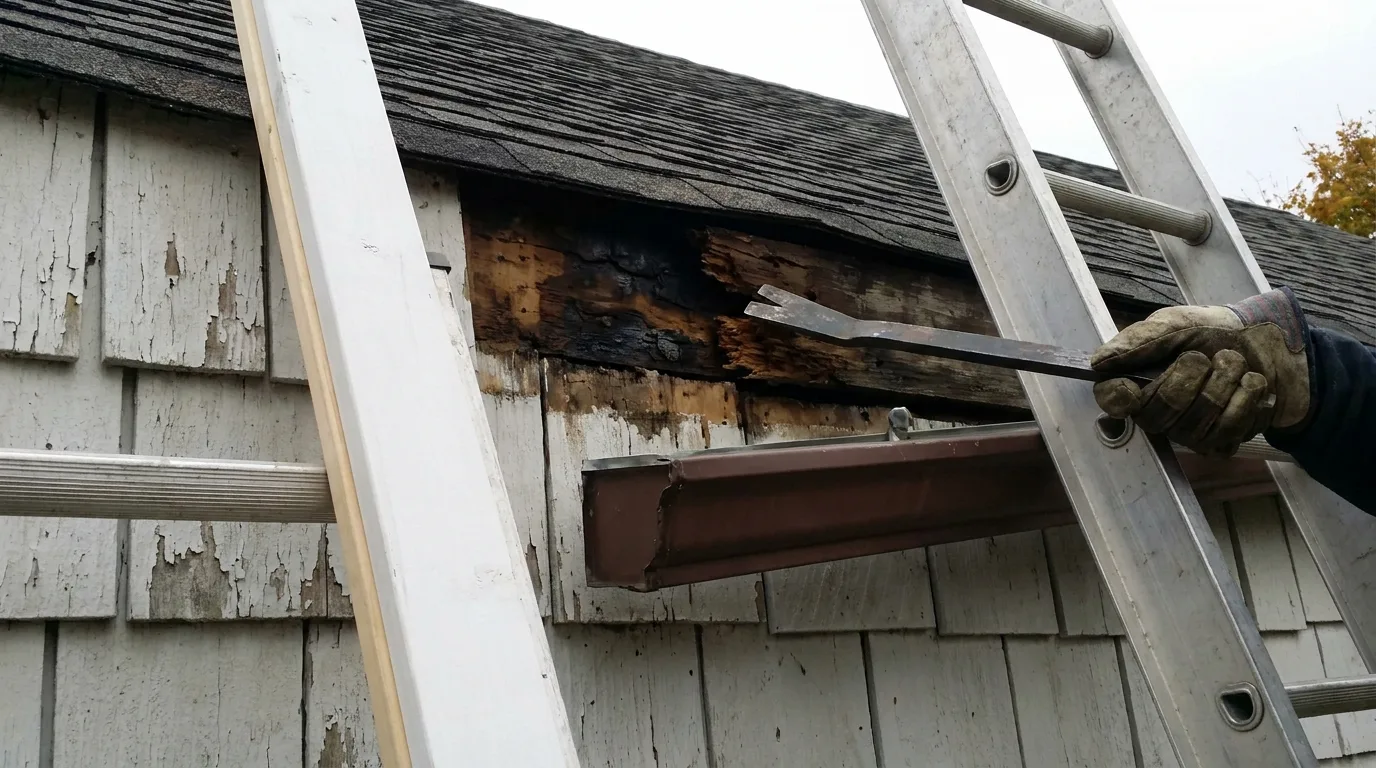
A gutter packed with wet leaves is a gutter holding ten or twenty pounds of extra weight per linear foot, and aluminum hangers were not sized for that load sitting there for a whole winter. I have pulled gutters off fascia boards on houses in Bay Shore and Central Islip where the spikes or screws simply tore out of wood that had already started to soften from years of overflow soaking the same six inches of trim every season.
Once water is running down the face of the house instead of through the downspout, it is hitting your siding, your foundation, and in a lot of older Cape and ranch homes, the band board right at the top of the basement wall. On the South Shore towns with a naturally high water table, that extra water load next to the foundation on top of what the sandy soil is already struggling to drain is how you end up with a damp basement corner that nobody can explain. If you are already dealing with basement moisture, it is worth checking our basement finishing page on what a dry, usable basement actually requires before you consider finishing it.
Ice Dams, Freeze-Thaw, and the 40 to 50 Cycle Problem
Long Island runs somewhere around 40 to 50 freeze-thaw cycles in an average winter, and that number is the whole reason gutter cleaning before the first freeze matters more here than it would somewhere with one long, steady cold season. Every clogged gutter holding standing water freezes solid on a cold night, then thaws during the next 40-degree afternoon, and that cycle repeats dozens of times between December and March.
An ice dam forms when that frozen gutter backs meltwater up under the shingles, and from there it travels along the roof deck until it finds a nail hole, a seam, or a soft spot in the underlayment. I have opened up ceilings in January on houses from Southampton to Amityville where the actual water entry point was a gutter that clogged in November and nobody dealt with it. A clean, properly pitched gutter running into a clear downspout is the cheapest ice dam prevention there is, and it has to happen before the first hard freeze, not after. For the roof side of that equation, our roofing page covers how ice and water shield and proper flashing work together with clear gutters to keep meltwater out.
Salt Air, Oak Leaves, and Why Things Clog Faster Here
Long Island's exposure to salt air on three sides accelerates corrosion on gutter hangers, screws, and seams faster than inland installations see, which is one more reason a gutter system that is already struggling with debris load fails sooner here than the national average would suggest. Add in the mix of oak and pine canopy that dominates towns like East Patchogue, Center Moriches, and the wooded sections of Huntington, and you get a double load: broad oak leaves that mat down and hold water, plus a steady drip of pine needles that packs into downspout openings and clogs them from the inside where you cannot see it from a ladder.
A gutter that looks clear on top can still have a downspout plugged solid six inches down, which is why I always run water through the system during a cleaning instead of just pulling leaves out by hand and calling it done.
Are Gutter Guards Worth It Before Winter
Gutter guards are worth it on a property with heavy, consistent tree cover where you are cleaning two or three times a season and still falling behind, especially on a two-story house where the ladder work itself is the real cost. What guards do not do is eliminate maintenance entirely. Fine pine debris and wind-blown grit still settle on top of most guard styles, and you still need to check the system once a year, just less often and with less risk of a clog turning into standing water you never saw.
What guards are not worth it for is a property with light or no tree cover, where you would be paying for a problem you do not have. And guards do not fix an existing pitch problem or an undersized downspout. If your gutters overflow in a heavy nor'easter even when they are clean, the system itself is undersized or mispitched for the water volume those storms dump, and that is a gutter replacement conversation, not a guard conversation. Our gutters page covers sizing and capacity for exactly that situation.
Signs You Already Have Damage
Staining or peeling paint on the fascia board directly under a gutter seam usually means that joint has been leaking for at least one full season. Soft or spongy fascia when you press on it from the ladder means the wood is already rotting behind the gutter, not just getting wet on the surface. Gutters pulling away from the house, visible sag between hangers, or a downspout that dumps water within a foot or two of the foundation instead of carrying it several feet out are all things I flag on every fall walkthrough, because every one of them gets worse, not better, once the ground freezes.
Inside the house, a brown ring on a ceiling near an exterior wall after a storm, or a musty smell in an attic that was not there last year, usually traces back to a gutter or ice dam problem rather than a roof failure on its own. If you are seeing drafts or moisture signs in the attic itself, it is worth having that checked alongside the gutters, since air sealing and insulation issues often compound water problems rather than cause them; our attic air sealing page explains how the two connect.
Permits and Town Rules
Gutter cleaning and most gutter guard installations generally do not require a permit on Long Island, since they are maintenance to an existing system rather than new construction. If a cleaning turns into a fascia or soffit repair, or a full gutter replacement that changes how water is directed at the foundation, some towns can have their own rules on exterior work and setbacks. Confirm directly with your town's building department, whether that is Brookhaven, Islip, Smithtown, Huntington, Babylon, or Southampton, before assuming a repair is permit-free.
What We Do
We clean, re-pitch, repair, and replace gutter systems across Nassau and Suffolk County, and on every fall call we run water through the full system to find the clog or the leak before it turns into an ice dam or a rotted fascia board.
Call (631) 312-7441 or book a free walkthrough.
Frequently Asked Questions
How often should I clean my gutters on Long Island?
Twice a year at minimum if you have oak or pine trees overhead, once after the main leaf drop in November and once in spring. Heavy canopy properties often need a mid-winter check too, since wet oak leaves compact and can clog a gutter again within a couple months of a fall cleaning.
Can I just install gutter guards instead of cleaning?
Guards reduce how often you need to clean, but they do not eliminate maintenance entirely, since fine debris and grit still settle on top of most guard styles. You still need an annual check to make sure water is flowing freely through the downspouts.
What happens if I skip gutter cleaning before winter?
Standing water in a clogged gutter freezes and thaws through Long Island's many freeze-thaw cycles each winter, and that cycle is what drives ice dams. Ice dams push meltwater under the shingles and into the roof deck, which is how a lot of winter ceiling leaks actually start.
How do I know if my gutters are already damaged?
Look for staining or peeling paint on the fascia board under a seam, soft or spongy wood when you press on it, visible sag between hangers, or a gutter pulling away from the house. Any of those mean water has already been getting behind the system for at least one season.
Are gutter guards worth it on a Long Island property with few trees?
Not usually. Guards earn their keep on heavily wooded properties where cleaning two or three times a season is falling behind. On an open property with light tree cover, a guard is solving a clog problem you do not actually have.
Do I need a permit to clean or replace my gutters?
Cleaning and most guard installations are maintenance and generally do not require a permit. A full gutter replacement or fascia repair can fall under different town rules, so confirm with your local building department, whether that's Brookhaven, Islip, Smithtown, Huntington, Babylon, or Southampton, before starting the work.
Related Guides
- Gutter Installation and Repair
- Roof Replacement and Repair
- Attic Air Sealing on Long Island
- Siding Installation and Repair
Get a Free Estimate from Alec's Construction
Licensed and insured, working across Nassau and Suffolk County since 2018. We come out, look at the actual job, and put a written number in your hand — no pressure, no obligation.
Or call (631) 312-7441