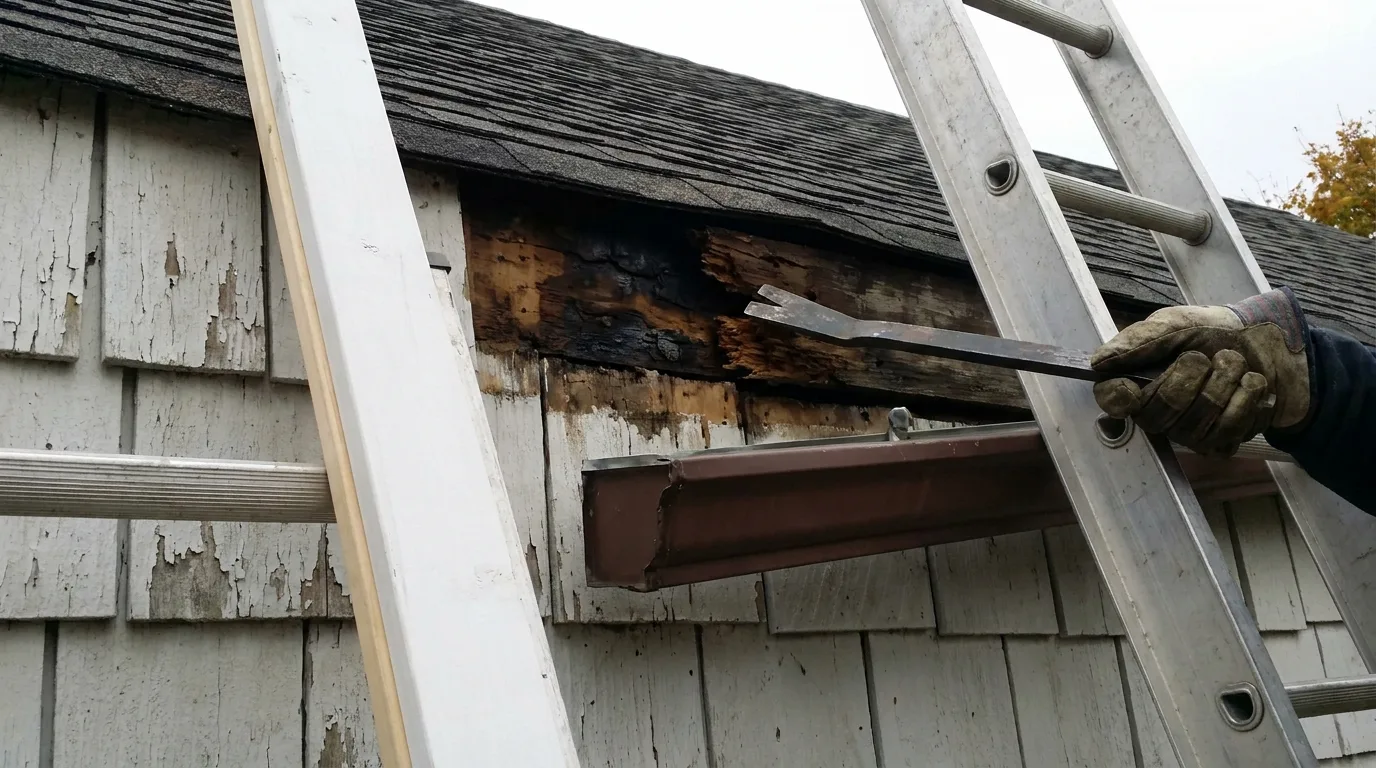
You notice it from the driveway before you notice anything else wrong with the house. A gutter on the second story, usually over the garage or a dormer, is hanging a few inches off the roofline, and every time it rains it dumps a sheet of water straight down the siding instead of into the downspout. On a one-story ranch that's an annoyance you can reach with a stepladder. On a two-story colonial or cape common across Nassau and Suffolk, it's a job that needs an extension ladder or scaffolding, and by the time it's visible from the ground, the wood behind it has usually been failing for a season or two already.
I've pulled gutters off houses in Islip, Smithtown, and Huntington where the fascia board crumbled like wet cardboard the second I backed the first spike out. That's not bad luck. That's what forty to fifty freeze-thaw cycles a winter, three sides of salt air, and a couple of nor'easters do to a strip of pine trim that was never primed on the back side when the house was built. The gutter didn't fail on its own. The board it's nailed to failed first, and the gutter just told you about it.
The reason this matters right now, in the fall, is timing. Once you get a hard freeze, any water sitting in a sagging gutter turns to ice, and ice doesn't just sit there, it expands and levers the gutter further off the fascia with every cycle. A repair that's a half day of work in October becomes a full fascia and gutter replacement in February, done in the cold, after the ice has already pulled trim boards and sometimes roof edge flashing away from the house.
What's Actually Pulling the Gutter Off
Three things cause this, and they're rarely working alone.
- Rotted fascia. The 1x6 or 1x8 board the gutter is fastened to has absorbed water for years, usually because the gutter itself was clogged and overflowing behind it, or because there was never adequate drip edge under the shingles to keep roof runoff off the board.
- Failed spikes. Old-school gutter spikes, the long nails driven straight through the gutter, through a ferrule, and into the fascia, back out over time. Wood expands and contracts with every freeze-thaw cycle, and each cycle loosens the spike's grip a little more. After a few hundred cycles the spike is barely holding.
- Ice weight and leaf load. Oak and pine are the two biggest culprits on Long Island. Oak drops leaves late and they mat down in the gutter through November. Pine needles wash down all fall and pack into a felt layer that holds water. A gutter full of wet leaves and then ice can weigh several hundred pounds per run, and that load goes straight into whatever is holding the gutter to the house.
Spikes Were Never a Long-Term Fix
If your house still has spike-and-ferrule gutters, and a lot of homes built or re-gutted here before the mid-2000s do, you're on borrowed time even without rot. Spikes rely on friction in the wood grain, and that friction weakens every single winter. I don't reinstall with spikes anymore, ever, even when the fascia looks fine. It's a callback waiting to happen, usually two or three years out, usually on the second story where you can't see it starting.
Hidden Hangers Are the Actual Fix
Hidden hangers, sometimes called gutter brackets, screw into the fascia every 24 inches or so with a heavy lag or self-tapping screw, and they cradle the gutter from the inside so there's no exposed fastener for water to sit on. They spread the load across a screw thread instead of a smooth nail shank, which is the difference between a fastener that backs out under freeze-thaw stress and one that doesn't. On a re-hang I'm also checking pitch, roughly a quarter inch of drop per 10 feet toward the downspout, because a flat-pitched gutter holds standing water all winter and that water is exactly what freezes and pries hangers loose the following year.
If your existing gutters are aluminum, straight, and not visibly bent or split, hanging them back up on hidden hangers is often enough, no gutter replacement needed. That's the least expensive path through this and I tell homeowners when it applies.
When the Fascia Board Has to Come Off
Here's the test I use on a ladder: I press a screwdriver into the fascia where the gutter was attached. If it sinks in or the wood is spongy, that board is coming off, full stop. You cannot screw a hidden hanger into rotted wood and expect it to hold through a Long Island winter. It'll pull loose again, usually worse, usually taking a chunk of the new gutter run with it.
Replacing fascia means pulling the drip edge and sometimes the first course of shingles, running new primed pine or, better on the south shore where salt air is worse, a PVC or composite board that doesn't absorb water at all. It's more work than a re-hang, but it's the only fix that actually holds. I've re-hung gutters on rotted fascia for homeowners who wanted the cheap route, and I've gone back the following spring to do it right. It doesn't save money, it just delays the real job by one winter.
If the rot has traveled past the fascia into the roof deck or the rafter tails, that's a roofing repair, not a gutter repair, and it usually means water has been getting behind the gutter for longer than one season.
Attic Moisture Makes This Worse
A lot of the second-story fascia rot I find isn't purely a gutter problem. If the attic is poorly ventilated, warm moist air condenses on the underside of the roof deck all winter, runs down to the eaves, and soaks the fascia and soffit from the inside while rain is soaking it from the outside. If you're already replacing fascia, it's worth having your attic ventilation checked at the same time, because re-hanging new gutters on a fascia board that's getting wet from two directions just buys you another few years, not a real fix.
Permits and Timing Across Nassau and Suffolk
Gutter and fascia repair on an existing structure is generally not a permitted job in Brookhaven, Islip, Smithtown, Huntington, Babylon, or Southampton, as long as you're not changing the roofline or footprint. Where it gets checked is if the work overlaps with siding or roof replacement, some towns want that filed, and East Patchogue through the South Shore towns with high water tables sometimes flag drainage changes if you're rerouting a downspout discharge point closer to a neighbor's property line. Before I start, I confirm with the town whether the job needs a permit, because that changes house to house depending on what else is happening on the exterior.
On timing, I book second-story gutter and fascia repairs through October specifically so the new fascia has a chance to be primed, painted, and fully cured before the first hard freeze. Wood that goes into a freeze cycle unsealed absorbs moisture at the cut ends immediately, and you've shortened the life of the repair before it's even seen a full winter.
What We Do
We inspect the fascia, not just the gutter, before we quote anything, because a re-hang on sound wood and a re-hang on rotted wood are two different jobs with two different outcomes. We re-hang on hidden hangers with correct pitch, replace fascia with primed or composite board when the wood won't hold a screw, and we'll flag attic ventilation or roofing issues if they're feeding the problem instead of just resetting the gutter and sending you a bill.
Call (631) 312-7441 or book a free walkthrough before the first freeze.
Frequently Asked Questions
Why is it always the second-story gutter that pulls away first?
Second-story runs carry more roof area and more water volume than a one-story section below them, so the load on the fasteners is higher. They're also harder to inspect and clean from the ground, so a clog or a loose hanger tends to go unnoticed longer before it becomes visible as sagging.
Can I just re-nail the gutter myself instead of calling someone?
You can, but a nail or spike driven back into the same worn-out fascia hole usually fails again within a season, because the wood fibers around that hole are already loosened. If the fascia is sound, hidden hangers placed in fresh wood next to the old holes hold far longer than reusing the original fastener points.
How do I know if it's the gutter or the fascia board that's actually failed?
Look at where the gutter has pulled away from. If the hangers or spikes are still attached to a piece of wood, and that wood has come away from the house with the gutter, the fascia has failed. If the gutter has simply popped its fasteners and the board behind it still looks solid and painted, it's likely a hardware problem, not a wood problem.
Does gutter guard or gutter covers prevent this from happening?
Guards reduce leaf and debris buildup, which helps with the weight and clog side of the problem, but they don't address rotted fascia or worn-out spikes, and a poorly fitted guard can actually direct water behind the gutter instead of into it. They're a maintenance aid, not a fix for a structural attachment problem.
Is this covered by homeowners insurance?
Gradual wear like rotted fascia or worn fasteners typically isn't a covered peril, since insurance is built around sudden, accidental damage. If a specific storm event, like a nor'easter with documented high winds, tore the gutter off a sound fascia board, that's worth a call to your adjuster, and we can document the damage either way.
How long does a second-story gutter and fascia repair take?
A straightforward re-hang on sound fascia is usually a half day per side of the house. If fascia replacement is needed, plan on a full day or more per run, plus time for primer and paint to cure before the first freeze, which is why we push to get these scheduled in September and October rather than December.
Related Guides
- Long Island Gutter Services
- Roofing Services Long Island
- Attic Ventilation Long Island
- Siding Services Long Island
Get a Free Estimate from Alec's Construction
Licensed and insured, working across Nassau and Suffolk County since 2018. We come out, look at the actual job, and put a written number in your hand — no pressure, no obligation.
Or call (631) 312-7441