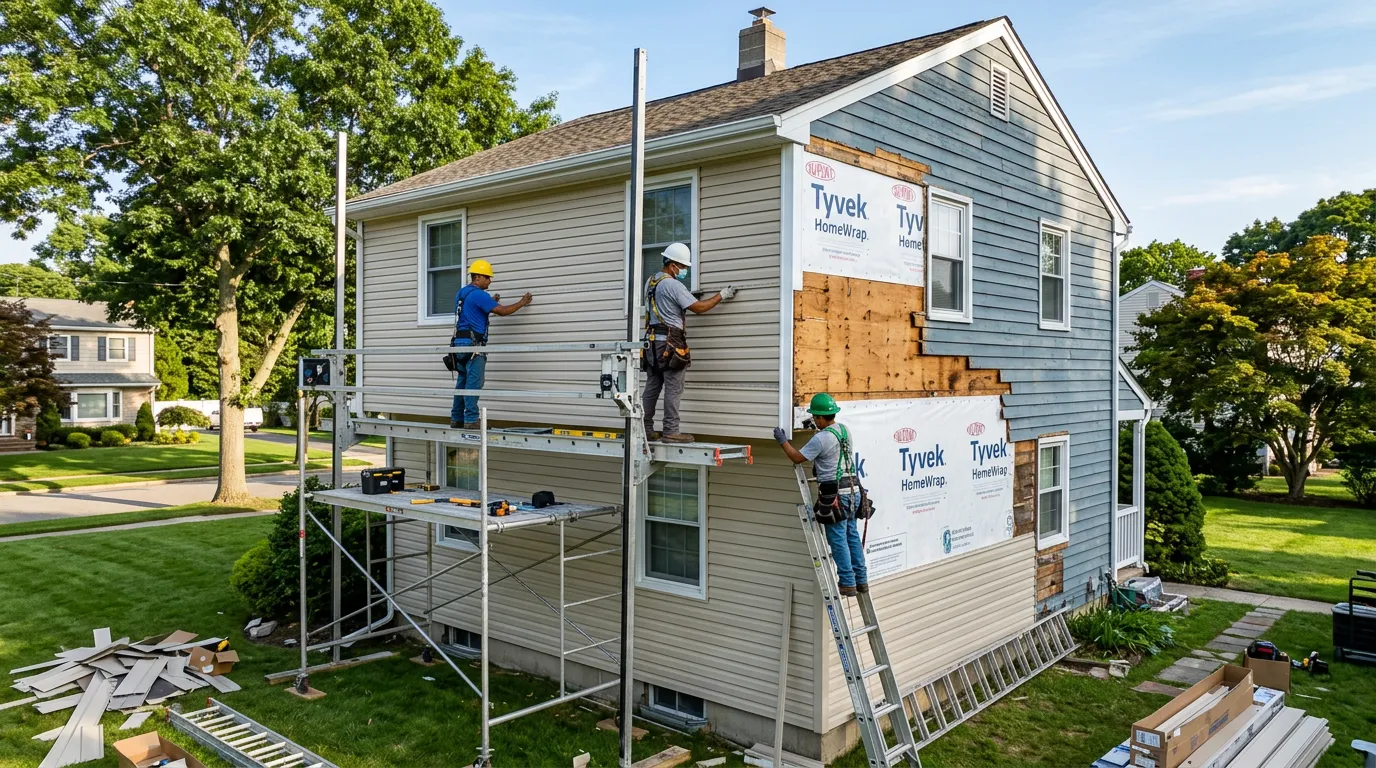
A nor'easter comes through, and the next morning you've got three or four cracked vinyl panels on the windward side of the house, maybe a whole section missing off the gable end. Your first instinct is to call around for a patch job and move on. That's the wrong question to start with. The right question is what happened behind those panels while wind was driving rain sideways into the gap, because that's the part you can't see from the driveway.
I've been doing exterior work on Long Island since 2018, from Babylon to Southampton, and storm-damaged siding calls follow the same pattern every fall. Homeowner wants the cheapest fix that gets through winter. Sometimes that's the right call. Sometimes a patch just seals moisture behind the wall for five more months of freeze-thaw, and you end up paying twice, once for the patch and once for the rot repair in spring.
The decision between patch and full re-side isn't really about the siding. It's about how much of the wall assembly got compromised, how old the rest of the siding already is, and whether you can get it done before the ground freezes and before another nor'easter lines up. Here's how I walk a homeowner through it.
What a Storm Actually Does to Siding
Wind doesn't just crack panels, it unlocks them. Vinyl siding hangs on a nail hem, and once wind gets under the bottom edge of a course, it can pop the whole piece off its lock without breaking anything. You'll find panels in the yard that look fine but won't re-hang cleanly because the nail hem is bent or the receiving lip on the course below is sprung. Fiber cement cracks differently, usually at a nail point or a butt joint where caulk failed first and water had already softened the edge.
The damage you can see is only part of it. Flying debris, branches, ice off the roof edge, all of it can crack panels in spots that look minor but telegraph a bigger problem. once one course is broken, every course below it on that wall is exposed to wind-driven rain until you fix it.
Patch or Re-side: How I Make the Call
I look at three things on every storm call before I quote anything.
- How much of the wall is affected. A handful of cracked panels on one elevation, especially if the siding is under 15 years old and the color still matches available stock, usually patches fine.
- Whether the siding is discontinued or sun-faded. Vinyl fades unevenly over time, and a patched panel from a new box can look noticeably different, especially on a south or west wall that takes full sun. If your siding is more than 10 to 12 years old, matching stock gets harder every year.
- What's underneath. If water got behind the wall for any length of time, the house wrap and sheathing matter more than the siding does.
If it's isolated damage on newer siding, I patch it and move on. If the siding is old, sun-faded, or damage is spread across two or more elevations, a full re-side gets you a uniform result and lets you deal with the house wrap at the same time instead of opening the wall up twice.
What's Behind the Siding Matters More Than the Siding
This is the part homeowners skip and it's the part that costs the most if you skip it. Behind your siding is a layer of house wrap or building paper that's doing the actual water management. Vinyl and fiber cement are both rain screens, not waterproofing. If panels were missing or loose for even a few days during a storm, wind-driven rain gets behind that wrap at the seams and nail penetrations.
When I pull panels for a patch or a re-side after storm damage, I'm checking the sheathing for soft spots, checking the wrap for tears, and checking the flashing at windows and corners. On older Long Island houses, especially anything built before the 2000s, I regularly find house wrap that's already brittle or taped seams that failed years ago and nobody knew because the siding hid it. If I find that, I tell the homeowner straight. patching the siding over compromised wrap is a bandage, and it's worth looking at attic ventilation and air sealing at the same time, since a wall that's wet on the outside often pairs with moisture issues on the inside. That's the same logic behind an attic air sealing check if your attic's been running damp.
The Freeze-Thaw Clock You're Working Against
Long Island runs somewhere around 40 to 50 freeze-thaw cycles a winter, and that number is brutal on any wall assembly that's holding moisture. Water gets behind a cracked panel, it sits in the sheathing, it freezes, expands, and works the wood fibers apart, then thaws and lets more water in. By March that gap behind your siding has done real damage even if the panel itself still looks okay from the street.
That's the real deadline here, not Thanksgiving, not a date on a calendar. Once overnight temps are consistently below freezing, caulk doesn't cure right, adhesives don't set, and vinyl itself gets brittle and harder to work without cracking it further during install. If you're on the fence, the push should be to get it closed up before you're fighting both the weather and the material.
Salt Air and Material Choice
If you're within a mile or two of the water on the South Shore or North Shore, salt air is already working on every exposed fastener and trim piece on your house, and it's part of why vinyl and fiber cement age differently here than they do inland. Vinyl handles salt air fine since it doesn't corrode, but it does get brittle faster in the UV and wind combination near open water. Fiber cement holds color and rigidity longer near the coast but needs the paint film maintained or you'll see the edges start to wick water. Neither one is wrong, but if you're replacing a whole elevation anyway, it's worth matching the choice to how close you actually are to salt water, not just what's already on the house.
Insurance and Permits
If the damage came from a named storm or straight-line wind event, it's worth a conversation with your insurance carrier before you commit to a full re-side, since wind damage to siding is often covered where a standard materials failure wouldn't be. We handle a lot of these claims directly and document the damage the way an adjuster needs to see it. more on that process is on our insurance restoration page.
On permits, most Long Island towns, Brookhaven, Islip, Smithtown, Huntington, and Babylon among them, generally treat like-for-like siding replacement as a minor permit item or sometimes no permit at all, but that can change if you're altering sheathing, adding insulation layers, or changing the wall assembly. Don't assume. confirm directly with your town's building department before work starts, since the requirement and fee structure is set by each town and can change year to year.
What We Do
We handle storm-damaged siding across Nassau and Suffolk the same way every time. pull the damaged panels, inspect the wrap and sheathing before quoting anything, and give you a straight answer on patch versus full re-side based on what we actually find, not what's easiest to sell. If backed-up gutters drove water into the wall during the storm, we'll flag that too, more on that on our gutters page, and our full siding page has the material options if you're already leaning toward a full re-side.
Call (631) 312-7441 or book a free walkthrough and we'll get eyes on it before the next system rolls through.
Frequently Asked Questions
Can cracked vinyl siding just be patched instead of replaced?
In a lot of cases, yes, especially if the damage is limited to one elevation and the siding is still under about 10 to 12 years old so the color matches. If the siding is older, sun-faded, or the damage is spread across multiple walls, a patch will stand out and a full re-side gives you a more even result.
How do I know if water got behind the siding during the storm?
Look for staining or dark spots on the sheathing once panels are pulled, and feel for any soft or spongy wood around window and door trim. A contractor doing the repair should check the house wrap and sheathing before closing the wall back up, not just swap the panel.
Does homeowners insurance cover storm-damaged siding?
Often yes, if the damage came from a named storm or documented wind event, but coverage depends on your policy and how the adjuster classifies the cause. It's worth getting the damage documented and talking to your carrier before you commit to a repair.
How long do I have before freeze-thaw makes this worse?
Once nighttime temperatures are consistently dropping below freezing, caulk and adhesives stop curing properly and vinyl gets more prone to cracking during install. Long Island typically sees 40 to 50 freeze-thaw cycles a winter, so any gap left open through that is doing damage even if you can't see it yet.
Do I need a permit to replace siding on Long Island?
Most towns generally treat like-for-like siding replacement as a minor permit item, but that changes if sheathing, insulation, or the wall assembly itself is being altered. Confirm directly with your town's building department before scheduling work, since requirements vary by town.
Is vinyl or fiber cement siding better for a house near the water?
Vinyl doesn't corrode and handles salt air fine, though it can get brittle faster in constant wind and UV near open water. Fiber cement holds its rigidity and color longer near the coast but needs the paint film maintained or the edges will start wicking water over time.
Related Guides
- Siding Services on Long Island
- Storm Damage Insurance Restoration
- Gutter Installation and Repair
- Attic Air Sealing on Long Island
Get a Free Estimate from Alec's Construction
Licensed and insured, working across Suffolk County since 2018. We come out, look at the actual job, and put a written number in your hand — no pressure, no obligation.
Or call (631) 312-7441