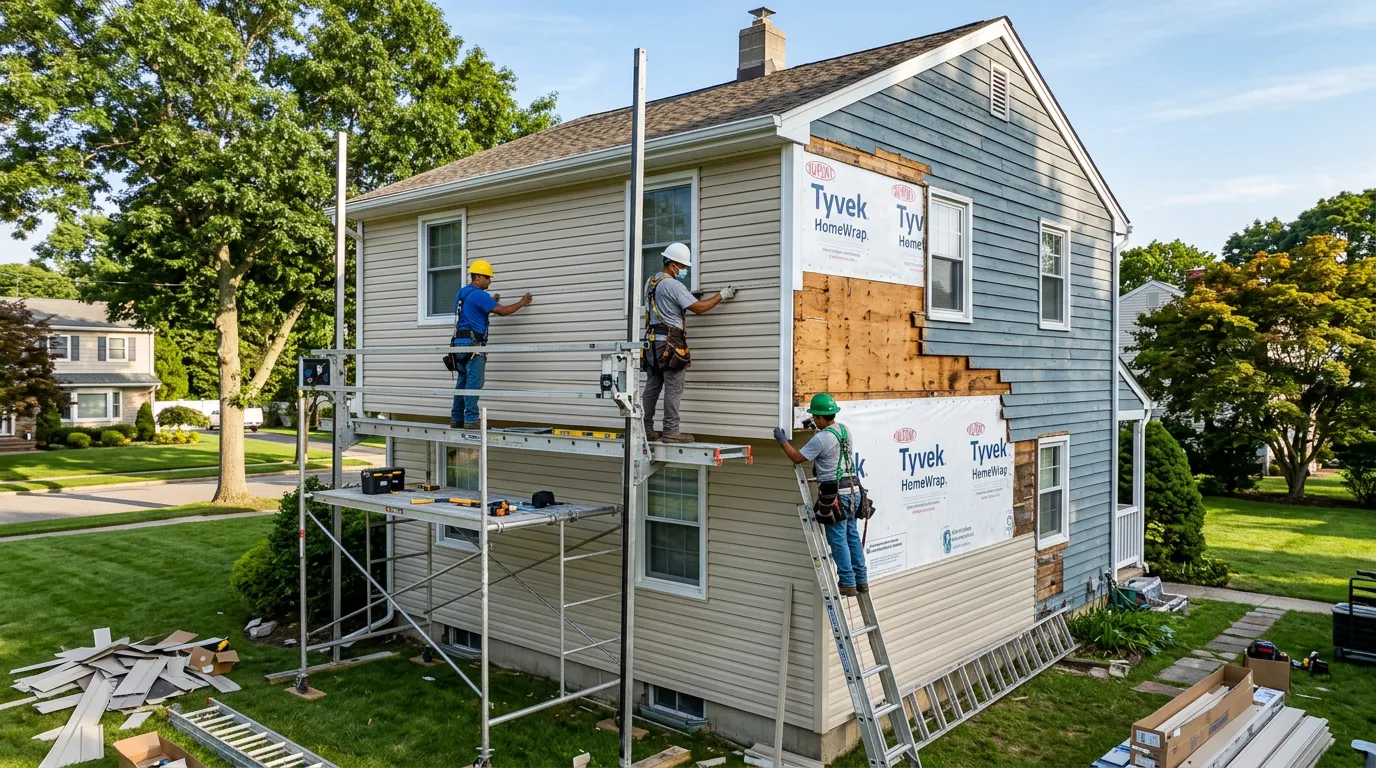
After the storms that rolled through this summer, you're probably standing in the driveway looking up at panels that are bowed, buckled, or cracked outright, trying to figure out if this is a weekend fix or the start of something behind the wall. I've pulled enough siding off Long Island houses to tell you the two don't look that different from the ground, and guessing wrong is how a cracked panel in October turns into rotted sheathing by March.
Siding has one job. It sheds water off the wall and lets the assembly behind it dry out between storms. Once a panel is punctured, pulled off the sheathing, or has lost its lap seal, it's not doing that job, it's just hanging there until somebody notices the wall underneath has gone soft. On a house exposed to salt air on three sides, out toward Babylon, Bay Shore, or anywhere near the South Shore, that clock runs faster than most homeowners expect.
Before you decide whether this is worth spending money on before winter, walk the house with a checklist instead of a gut feeling. Here's what I actually check on an inspection call.
Warped and Cracked Are Two Different Problems
Warped or buckled panels are almost always heat damage, not storm damage, even if you first noticed them after a July heat wave or a windy afternoon. Vinyl expands and contracts with temperature, and darker colors on south or west-facing walls take the worst of it. A buckled panel that's still sealed at the laps and nailed loose in its slots the way it should be is usually cosmetic. It looks bad, it is not feeding water into the wall.
Cracked panels are a different animal. That's impact damage, hail, a branch, a ladder, wind-driven debris, and a crack opens a direct path for water that wasn't there before. Cracks at the butt joints and around nail slots are the worst of it, because that's exactly where the panel overlaps the one below it and where water already wants to travel during a hard rain.
The Five-Minute Check Before You Call Anyone
- Press on the panel near the crack or warp. If it flexes and springs back with no give behind it, the sheathing is probably still sound. If it feels soft or spongy, water is already in the wall.
- Pull back the bottom edge of a suspect panel with a gloved hand and look at the back side. Dark staining, mildew smell, or a chalky white residue means moisture has been sitting there a while.
- Check the J-channel and corner posts near the damaged area. Salt air corrodes aluminum trim and rusts galvanized fasteners faster than people think, and a corner post that's pulled away is an open gap, not a cosmetic issue.
- Look at the seams in direct afternoon sun. A hairline gap that wasn't there when the house was built usually means the panel has crept out of its track from heat cycling.
- If you have access to the basement or attic on that wall, check for a damp smell or a water line on the sheathing from inside. That's the tiebreaker when the outside looks ambiguous.
Where Long Island Siding Fails First
Salt air is the biggest factor nobody budgets for. A house three miles from the Sound or the Atlantic takes corrosion on fasteners and trim on all three exposed sides, not just the ocean-facing wall, and that corrosion loosens the mechanical hold a panel has on the wall long before the vinyl itself fails. Nor'easters make it worse by driving rain sideways under laps that were never designed to take water from that angle, which is why South Shore houses with a high water table tend to show moisture problems at the base course first, sometimes from groundwater pushing up as much as from the siding itself.
Oak and pine leaf load is the quieter problem. Wet leaves pile against the bottom courses on the shaded side of the house, usually the north wall or wherever the gutters overflow, and they hold moisture against the siding for weeks at a time. If your gutters have been overflowing, check that wall first, it's almost always the worst one.
Why Fall Is the Real Deadline, Not Spring
Long Island runs somewhere around 40 to 50 freeze-thaw cycles a season. Any crack holding water right now will widen every single time the temperature swings below freezing and back, because water expands as it freezes and has nowhere to go but outward into the panel and the sheathing behind it. A cracked panel you patch or replace in October stays a cracked panel. The same crack ignored until spring is usually swollen, delaminated oriented strand board underneath, and that's a tear-off, not a patch.
Cosmetic Repair vs. Full Replacement
An isolated cracked panel with dry sheathing behind it, still sealed at the laps, is a spot repair. Matching the color on an older house can be the harder part of that job if the siding has faded or the run is discontinued, more than the labor itself.
Full replacement is the right call when you've got soft or spongy sheathing anywhere you pressed, rot or discoloration at the corners, warping spread across a whole elevation rather than one or two panels, or moisture showing up on the inside of that wall. At that point you're not buying siding, you're buying a dry wall assembly again, and patching over wet sheathing just traps the problem.
Permits and Town Rules
Most Long Island towns, Brookhaven, Islip, Smithtown, Huntington, Babylon, and the towns across Nassau, generally require a permit for a full siding replacement and generally do not for a small spot repair, but that line moves depending on square footage and whether you're touching the house wrap underneath. Confirm with your specific town's building department before you schedule the work, don't assume the rule from a neighbor's job applies to yours.
If the damage traces back to a specific storm date, that's worth documenting with photos and dates before you start any repair. It's the difference between an insurance restoration claim and an out-of-pocket repair, and that paperwork gets a lot harder to assemble after the panels are already off the wall.
What We Do
We inspect the wall assembly, not just the siding, check moisture content where we suspect it, and give you a straight answer on spot repair versus full replacement before anything comes off the house, coordinating with your insurer when the damage is storm-related.
Call (631) 312-7441 or book a free walkthrough.
Frequently Asked Questions
How do I know if my siding damage is just cosmetic?
Press on the panel and check behind it if you can access the bottom edge. If it's firm, still sealed at the seams, and the sheathing behind it is dry, it's almost always cosmetic. Soft or spongy panels, staining on the back side, or a damp smell from inside the wall mean water has already gotten in.
Can I replace just one or two siding panels instead of the whole wall?
Yes, if the sheathing behind those panels is dry and the damage didn't spread beyond them. The harder part is often matching the color, since vinyl fades and older runs can be discontinued, so expect some visible difference on an older house.
Does homeowners insurance cover storm-damaged siding?
It can, depending on your policy and whether the damage ties to a specific storm date rather than general wear. Document the damage with photos and dates as soon as you notice it, before any repair work starts, since that's what supports a claim.
What happens if I wait until spring to deal with cracked siding?
Any water sitting behind a cracked panel freezes and expands through our freeze-thaw cycles all winter, widening the opening and soaking the sheathing further each time. What's a spot repair in the fall can turn into a full tear-off with rotted sheathing by spring.
Will a few warped panels affect my home's energy efficiency?
Warping by itself usually doesn't, since it's a heat-expansion issue on the surface, not a wall-assembly gap. If the warping comes with separated seams or pulled trim that lets air move behind the siding, it can add to draftiness worth addressing alongside your insulation.
Do I need a permit to replace siding on Long Island?
Most towns generally require a permit for a full siding replacement and generally don't for a small spot repair, but the exact line depends on scope and whether house wrap underneath is being disturbed. Confirm directly with your town's building department before scheduling the work.
Related Guides
Get a Free Estimate from Alec's Construction
Licensed and insured, working across Nassau and Suffolk County since 2018. We come out, look at the actual job, and put a written number in your hand — no pressure, no obligation.
Or call (631) 312-7441