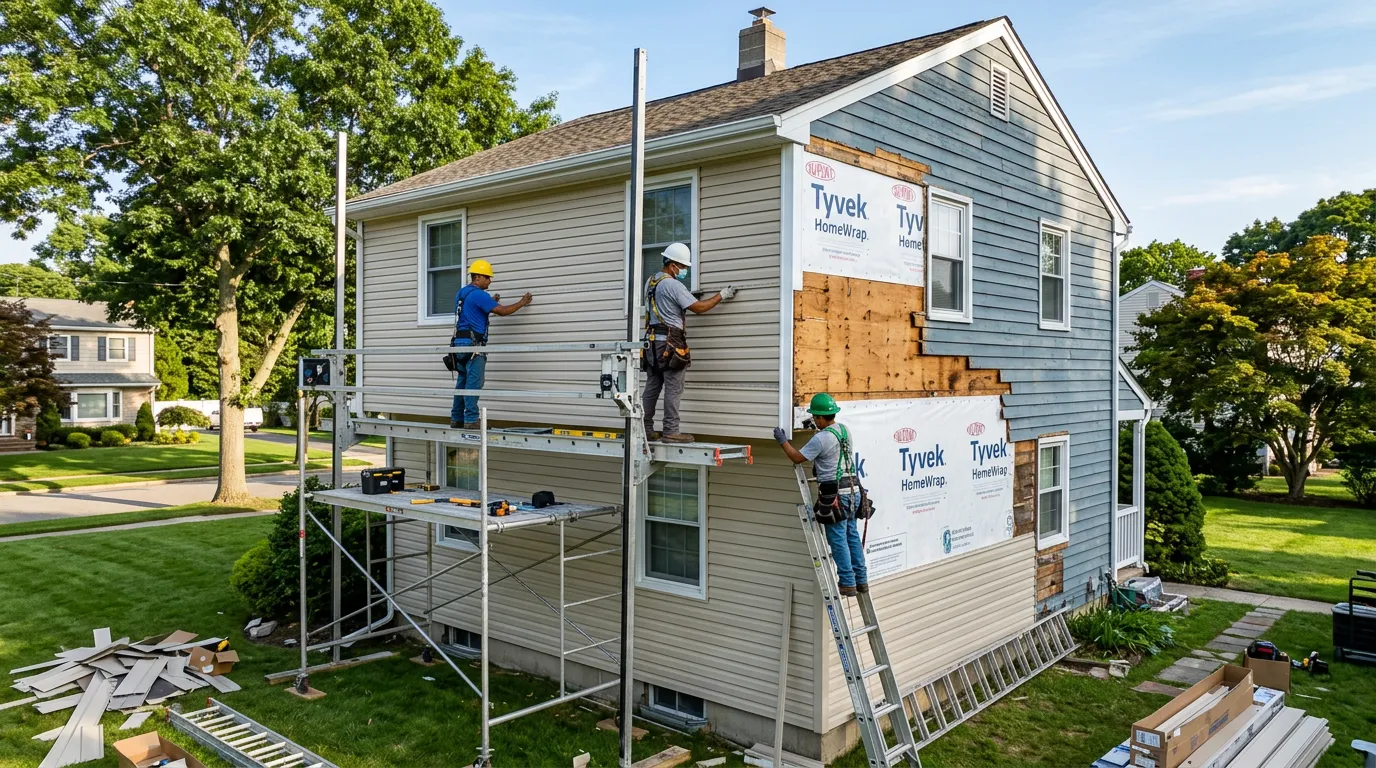
You walk the yard and see it on the north or west wall, a panel bowed out at the bottom, a crack running along the nail line, maybe a gap at the corner post you can fit two fingers into. That's not cosmetic. Once vinyl siding cracks or a panel warps loose from its lock, water gets behind it, and on Long Island, water sitting behind a wall in November doesn't just sit there. It freezes, expands, and pries the damage open wider by January.
The question I get every October is the same one: can this still get done before it's too cold, or do you ride it out until spring. The honest answer is yes, there's a real window left, but it's shorter than most homeowners think, and it closes faster for jobs that haven't been scheduled yet than for jobs already on a crew's calendar.
I've been doing exterior work across Suffolk and Nassau since 2018, out of East Patchogue, and the siding jobs that turn into a bad winter are almost always the ones that got put off past the first cold snap instead of booked while the ground was still workable and the material was still flexible.
How Cold Is Too Cold for the Install
Vinyl siding has a working temperature range, and once you're consistently under the low 40s, the panels get brittle. Nailing stiff vinyl tight enough to hold but loose enough to expand in summer heat is a judgment call that gets harder the colder it gets, and a crew rushing a brittle panel into place in a 38 degree wind is going to crack corners you don't see until spring. Fiber cement and engineered wood have their own cutoffs tied to caulking and paint cure times, not the panel itself. None of this means the job can't happen in November. It means the crew needs daylight hours warm enough to work the material correctly, and on Long Island that window gets unpredictable after Thanksgiving.
What Cracked and Warped Panels Are Telling You
A single cracked panel from a thrown branch is a repair. Cracking that shows up in a pattern along the same course, or warping concentrated on the south and west exposures, is a different story. That pattern usually means thermal cycling has been stressing panels that were nailed too tight to begin with, or the housewrap behind them failed years ago and the sheathing has been taking on moisture every time it rains. If you press on a wall near a crack and feel softness, you're not looking at a siding job anymore, you're looking at sheathing replacement under the new siding, which changes both the scope and the schedule. That's worth knowing before you get a number, not after.
Why Long Island's Freeze-Thaw Cycle Makes This Urgent
This region runs somewhere around 40 to 50 freeze-thaw cycles a season, and every one of them works on a crack that's already open. Water gets in during a thaw, freezes solid overnight, expands, and the crack is measurably bigger by the next thaw. A gap that's cosmetic in October can be a path into the wall cavity by February. On the South Shore, the high water table and sandy soil add a second problem: splash-back at the base of the wall stays damp longer after storms, and that moisture freezes right at the bottom courses first. If your cracked siding is near grade, that's the spot that fails fastest.
Salt Air, Nor'easters, and What Holds Up
Most homes out here take salt air from at least two directions, sometimes three if you're near the Sound or the bays, and that corrosion doesn't stop for winter. Standard galvanized fasteners pit and streak faster here than inland, which is why I spec stainless or coated fasteners on any siding job this close to the water, year round. A nor'easter with sideways rain is also the real stress test for any siding system, not a light summer shower. Seams, J-channels, and corner posts that look fine in dry weather are what a wind-driven storm finds the hard way, so I pay more attention to flashing and seam overlap than to panel brand on these jobs.
What's Actually Driving the Timeline Right Now
Material lead times tighten up every fall as everyone tries to get exterior work done before the ground freezes. Crews also need the oak and pine leaf drop cleared before housewrap goes on, because wet leaves packed against a wall hold moisture right where you don't want it during install. None of that is a reason to rush a bad decision, but it is a reason to call now instead of waiting for the first real cold week to decide. A job booked in mid-October with a flexible two-week window has options a job called in December doesn't.
Permits and Town Requirements
Siding replacement on the same footprint generally doesn't trigger a permit in most Long Island towns, but that changes if you're also replacing sheathing, changing the exterior material, or the work overlaps with a window or structural change. Brookhaven, Islip, Smithtown, Huntington, Babylon, Southampton, and the Nassau towns each handle this a little differently, and the rule can shift year to year. Confirm directly with your town's building department before work starts, don't assume last year's rule still applies. If your siding damage came from a specific storm and you're filing a claim, that's also worth sorting out before the crew starts, since insurance restoration work follows a different documentation trail than a straight replacement.
If the moisture problem traces back further than the siding, worth checking whether air leaks behind the wall assembly are part of it. We cover that in attic air sealing, and base-of-wall drainage usually ties back to how water's being managed off the roof in the first place, see gutters.
What We Do
We walk the exterior, tell you straight whether you're looking at a siding job or a siding-plus-sheathing job, and give you a real install window before the weather makes that decision for you. Full details on materials and process are on our siding page.
Call (631) 312-7441 or book a free walkthrough.
Frequently Asked Questions
Can siding actually be installed in cold weather on Long Island?
Yes, within limits. Vinyl gets brittle below the low 40s, so crews need workable daylight hours above that range to nail panels correctly. A job can run into November or even early December if the schedule allows for weather delays.
How do I know if my cracked siding is just cosmetic or a bigger problem?
Press on the wall near the crack. If it feels soft or gives slightly, moisture has likely reached the sheathing and you're looking at more than a panel swap. A contractor should check this before quoting the job, not after starting it.
Does cracked siding get worse over winter if I wait?
Usually yes. Long Island's freeze-thaw cycles mean any water that gets behind a cracked panel freezes, expands, and widens the opening. A small crack in October can be a real moisture path by February.
Will my town require a permit for a straight siding replacement?
Many Long Island towns don't require one for a like-for-like replacement on the same footprint, but this varies and can change. Always confirm with your specific town's building department before scheduling work.
Does salt air really affect siding fasteners that much?
On homes within a few miles of the Sound or the bays, yes. Standard galvanized fasteners corrode noticeably faster here than inland, which is why coated or stainless fasteners are worth specifying on any coastal-facing job.
Should I replace siding and gutters at the same time?
If your gutters are already failing or pushing water down the wall face, it's worth coordinating both, since poor drainage is one of the fastest ways to undo new siding at the base courses.
Related Guides
- Siding Services Overview
- Insurance Restoration After Storm Damage
- Gutter Systems and Water Management
- Attic Air Sealing on Long Island
Get a Free Estimate from Alec's Construction
Licensed and insured, working across Suffolk County since 2018. We come out, look at the actual job, and put a written number in your hand — no pressure, no obligation.
Or call (631) 312-7441