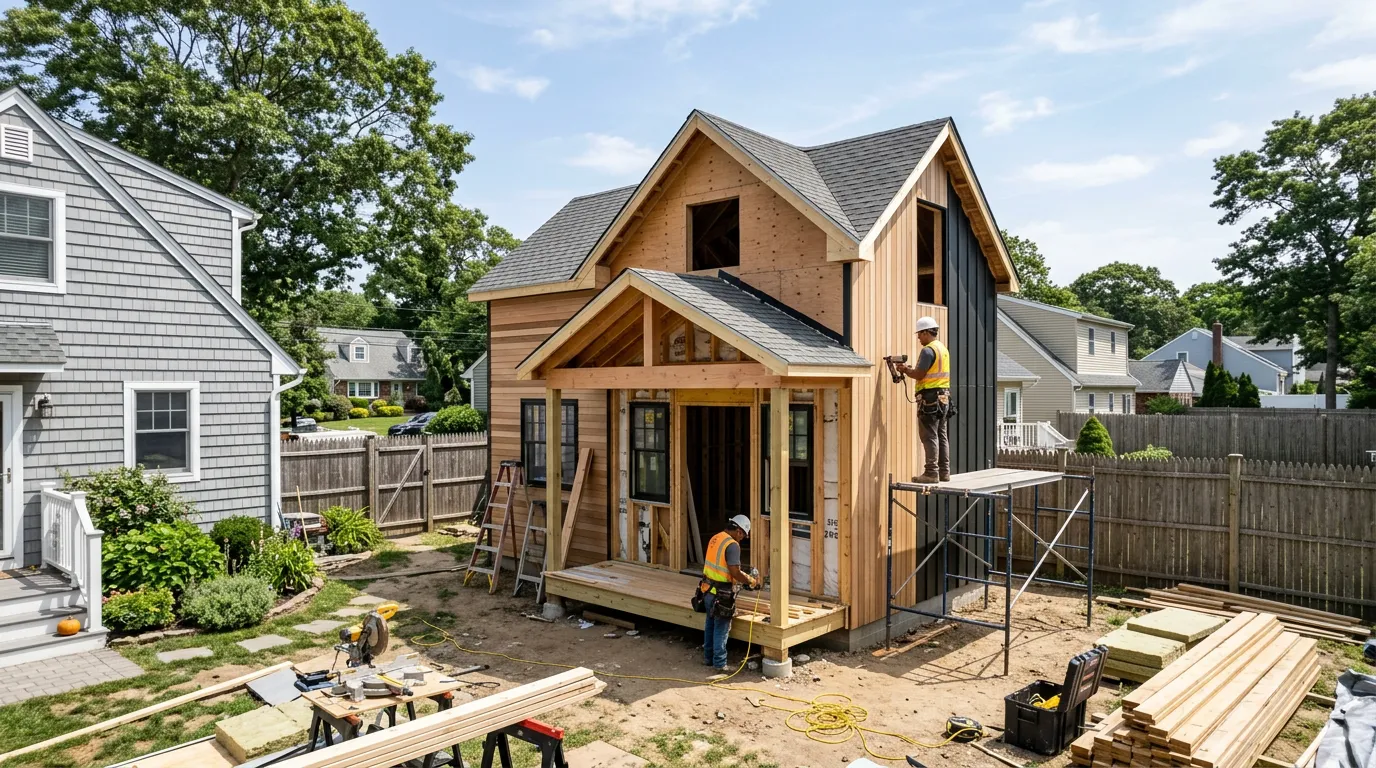
Accessory dwelling units — also known as ADUs, in-law suites, backyard cottages, or garage conversions — are the fastest-growing housing type on Long Island. New York State law changes combined with the Plus One ADU grant program (offering up to $125,000 in funding) have made ADU construction more accessible than at any point in the last decade. But the permit process on Long Island remains one of the most frequently misunderstood parts of the project. This guide explains exactly what is required, county by county, and how a licensed contractor makes the process manageable.
What Is an ADU and What Types Are Allowed on Long Island?
An accessory dwelling unit is a secondary residential unit on the same lot as a primary single-family home. On Long Island, approved ADU types include:
- Attached ADUs: An addition to the primary home with a separate entrance, kitchen, and bathroom — often a basement apartment or first-floor addition.
- Detached ADUs: A separate standalone structure on the property — a backyard cottage, converted garage, or new detached construction.
- Junior ADUs (JADUs): Smaller units (typically under 500 square feet) created within the existing footprint of the primary home, such as a converted bedroom suite with a kitchenette.
- Garage conversions: Converting an attached or detached garage into a habitable dwelling unit — one of the fastest and most cost-efficient ADU types on Long Island.
Under New York State's 2022 ADU law amendments (which took full effect for Long Island municipalities by 2024), local zoning authorities must allow at least one ADU on any lot with a single-family home. This overrode some of the more restrictive local zoning codes that previously blocked ADU construction in large parts of Nassau and Suffolk County.
Suffolk County ADU Permit Requirements
In Suffolk County, the permit process involves both county-level health department approval (for septic and water) and town-level building department approvals. The key requirements are:
- Building permit: Required from your town building department. Typical towns (Brookhaven, Islip, Huntington, Babylon, Southampton) have specific ADU application forms and review timelines.
- Suffolk County Department of Health Services (SCDHS) approval: Required if your ADU will be served by a septic system. This is the most complex and time-consuming part of most Suffolk County ADU projects. SCDHS requires septic system capacity calculations for the additional bedroom(s). In some cases, the existing system must be upgraded.
- Zoning compliance: Your lot must meet minimum area requirements (varies by town, typically 7,500–15,000 square feet for an ADU). Setbacks, lot coverage, and height restrictions also apply to detached ADUs.
- Utility connections: If the ADU will have a separate utility meter, electric service upgrade and PSEG Long Island coordination may be required.
In practice, the Suffolk County health department approval for septic is the step that most often adds 3–6 months to an ADU timeline for homeowners who do not work with an experienced contractor. We submit complete application packages from day one to avoid back-and-forth delays.
Check your Plus One ADU grant eligibility.
Free consultation — we verify your eligibility before you commit to anything.
Nassau County ADU Permit Requirements
Nassau County ADU permitting is handled at the village or town level, with the Nassau County Department of Health overseeing septic and well water matters. Nassau County is served by public water in most areas (unlike much of Suffolk), which eliminates one layer of the health department review for most projects.
The incorporated villages in Nassau (there are over 60) each have their own building departments with varying application processes. Some villages, like Garden City and Great Neck, have well-established ADU pathways. Others have been slower to update their processes to reflect the state law changes. An experienced contractor who has pulled permits in multiple Nassau villages is worth significantly more than a lower-cost option that has never navigated your specific jurisdiction.
The New York Plus One ADU Grant Program
The New York State Plus One ADU program provides grants up to $125,000 to eligible Long Island homeowners to offset the cost of ADU construction. Key eligibility criteria as of 2026:
- The property must be owner-occupied with a single-family primary residence.
- Household income must be at or below 80% of the Area Median Income (AMI) — this is approximately $93,000 for a family of four in Nassau County and $87,000 in Suffolk County as of 2025 limits.
- The completed ADU must be rented as affordable housing (at or below fair market rent) for a minimum period.
- The ADU must meet New York State Energy Code and local building code requirements.
The grant is administered through local program administrators and requires a qualified contractor to complete the work. We work with homeowners through the entire grant application process as part of our ADU service. For full details on the ADU construction process, see our Long Island ADU construction service page.
How Long Does the ADU Permit Process Take on Long Island?
Timeline varies significantly by town and project type, but here is a realistic range based on our experience:
- Junior ADU (interior conversion, no septic change): 6–10 weeks from permit application to approval in most towns.
- Attached ADU or garage conversion with existing septic: 3–5 months, depending on town and SCDHS backlog.
- Detached ADU with new or upgraded septic system: 6–12 months from application to groundbreaking. This is the most common timeline for new detached construction in Suffolk County.
The single largest variable is the septic system review. Properties in Suffolk County with older cesspools or undersized systems often require a full system upgrade before the health department will sign off on an additional bedroom. This adds both cost and time. We identify this early in the process so there are no surprises. For context on what the full ADU construction involves once permits are approved, see our garage conversion ADU guide.
Frequently Asked Questions
Can I build an ADU on any Long Island property?+
Does an ADU require a separate electric meter?+
What does an ADU typically cost to build on Long Island?+
Related Articles
Check Your ADU Eligibility — Free Consultation
We'll review your property, verify your Plus One grant eligibility, and outline the full permit timeline for your Long Island ADU project. No obligation.
Book Your Free ADU Consultation