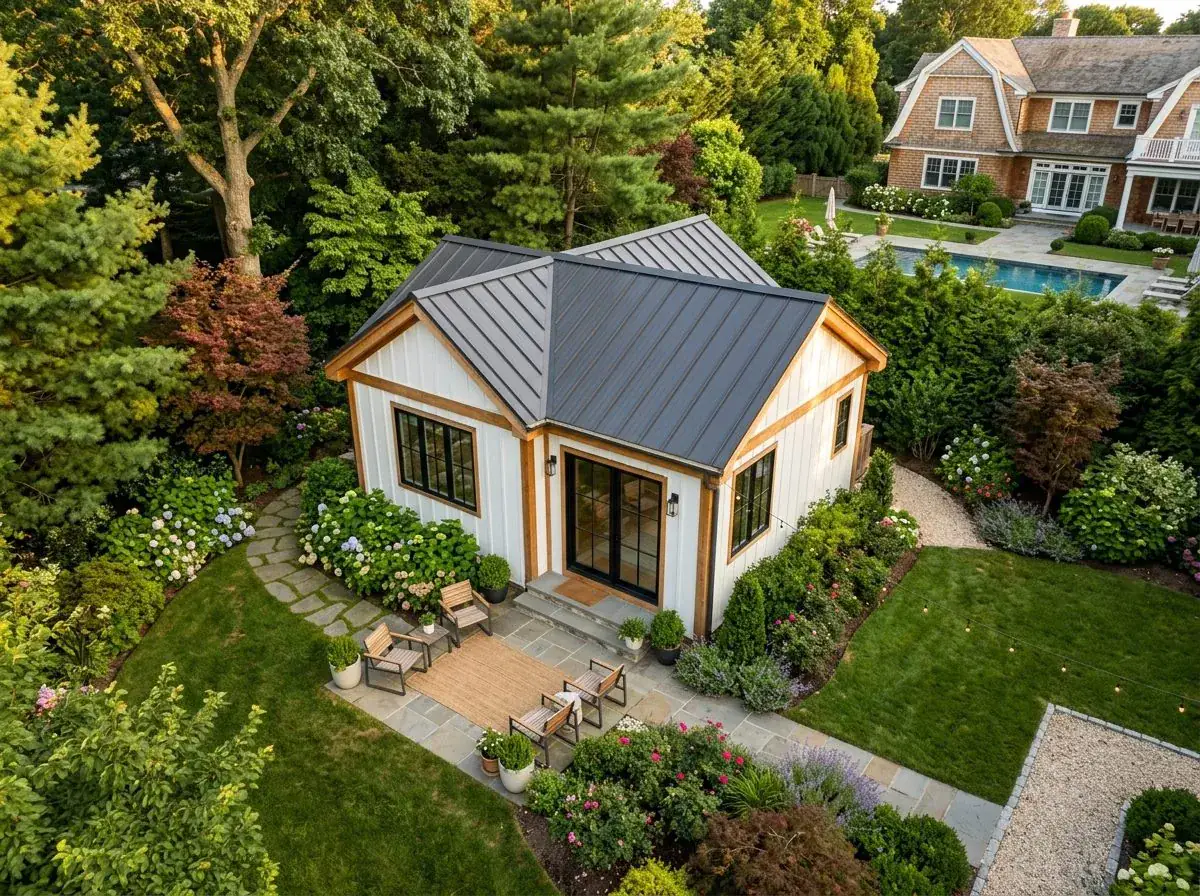
The most common question we hear from Long Island homeowners considering an ADU is straightforward: how much is this going to cost? The honest answer is that it depends. ADU costs on Long Island vary dramatically based on the type of unit, the condition of your existing property, site-specific challenges, and the level of finish you want. A basic garage conversion and a custom detached cottage are not even in the same pricing universe.
This guide gives you realistic, current pricing for every type of ADU project in Suffolk County, along with the factors that push costs up or down. No vague national averages. These are Long Island numbers based on what projects actually cost to build in 2026.
ADU Cost Breakdown by Type
The type of ADU you build is the single biggest factor in your total cost. Here is what each option typically runs on Long Island:
- Garage conversion: $50,000 to $100,000. Converting an existing attached or detached garage is typically the most affordable ADU option because the shell already exists. You are adding insulation, drywall, flooring, a bathroom, a kitchenette or full kitchen, electrical upgrades, plumbing, HVAC, and finishes. A basic one-car garage conversion with modest finishes sits near the $50,000 end, while a two-car garage with higher-end finishes, a full kitchen, and significant structural modifications pushes toward $100,000.
- Basement conversion: $50,000 to $100,000. Full basements are standard in Suffolk County homes, and many have the ceiling height needed for habitable space (minimum 7 feet in most jurisdictions). Costs include egress window installation ($3,000-$5,000 per window), waterproofing, a separate entrance, bathroom and kitchen plumbing, electrical panel upgrades, insulation, drywall, flooring, and finishes. If the basement already has good ceiling height and minimal moisture issues, costs stay lower. Extensive waterproofing or structural work pushes costs higher.
- Above-garage apartment: $80,000 to $150,000. Building a second story above an existing garage requires structural assessment and often reinforcement of the existing garage foundation and framing. The new space needs a staircase (interior or exterior), full utility connections, insulation, roofing modifications, and complete interior buildout. The structural work is what distinguishes this option's cost from a simple garage conversion.
- Detached new construction: $150,000 to $250,000+. A standalone ADU built from the ground up is the most expensive option but offers maximum design flexibility and privacy. Costs include site preparation, foundation, framing, roofing, siding, windows, doors, full plumbing and electrical systems, HVAC, and interior finishes. A 600-square-foot detached unit with mid-range finishes typically falls in the $175,000 to $225,000 range. Premium finishes, complex site conditions, or larger units push past $250,000.
- Bump-out addition: $75,000 to $125,000. Extending the footprint of your existing home to create a self-contained unit involves foundation work, framing, roofing tie-ins, and full interior buildout. Bump-outs are often used when the existing home layout allows for a separate entrance and independent living space on one side of the house. Costs depend heavily on the size of the addition and the complexity of tying into the existing structure.
Want an exact number for your project?
Free walkthrough and detailed estimate. No obligation.
What Drives ADU Costs on Long Island
Long Island construction costs are significantly higher than national averages, and several factors specific to the region affect what you will pay:
- Labor rates. Skilled tradespeople on Long Island command premium wages. Electricians, plumbers, carpenters, and HVAC technicians all cost more here than in most parts of the country. This is the single biggest reason why national ADU cost estimates do not apply to Suffolk County. Expect labor to account for 40 to 50 percent of your total project cost.
- Materials. While material costs are more uniform nationally, delivery and handling costs add up on Long Island. Lumber, drywall, insulation, roofing, and finish materials all need to be transported to the island, and tight residential lots can make material staging more challenging.
- Site conditions. Every property is different. A flat, accessible lot with good soil drainage costs less to build on than a sloped site with high water table, mature trees in the way, or limited access for equipment. Properties in flood zones may require elevated foundations, adding $10,000 to $20,000.
- Septic system upgrades. This is Suffolk County's unique cost driver. If your ADU adds bedrooms, the county health department may require a septic system upgrade. A conventional system repair or expansion runs $5,000 to $15,000. An innovative/alternative onsite wastewater treatment system (I/A-OWTS), which the county increasingly requires, costs $15,000 to $30,000. Read our complete guide to septic requirements for ADUs.
- Permit and engineering fees. Building permits, architectural plans, structural engineering, energy code compliance documentation, and health department applications add $5,000 to $15,000 to the total project cost. These are non-negotiable expenses that apply to every ADU project.
- Design and finish level. The difference between builder-grade and mid-range finishes can add 15 to 25 percent to costs. Quartz countertops versus laminate, hardwood versus vinyl plank, tile shower versus fiberglass surround, these choices add up quickly. Custom cabinetry, high-end appliances, and premium fixtures can push a project well above the standard range.
Licensed & Insured
Full coverage on every project
36+ Cities Served
Suffolk County & Long Island
Free Walkthrough
No obligation, no pressure
Hidden Costs to Watch For
Beyond the headline construction costs, several expenses catch homeowners off guard. Being aware of these upfront prevents budget surprises:
- Septic system upgrades ($5,000-$30,000). As mentioned above, this is the most significant hidden cost for Suffolk County ADU projects. If your existing system cannot handle the additional flow, you will need an upgrade before receiving a building permit. This cost does not show up in most national ADU cost guides because most of the country is on municipal sewer.
- Utility connections ($3,000-$10,000). Running water, sewer, gas, and electrical service to a detached ADU or extending service for a conversion adds costs. Electrical panel upgrades alone can run $2,000 to $4,000 if the existing panel does not have capacity for the ADU's load.
- Foundation work ($5,000-$20,000). Detached ADUs require new foundations. Even conversions may need foundation repairs or moisture barrier improvements. Frost-depth footings on Long Island must go at least 36 inches deep.
- Asbestos and lead abatement ($2,000-$8,000). Many Suffolk County homes were built in the 1950s through 1970s and may contain asbestos insulation, asbestos floor tiles, or lead paint. If your conversion involves disturbing these materials, licensed abatement is required before construction can proceed.
- Survey and engineering fees ($2,000-$5,000). An updated property survey is often required for permit applications. Structural engineering for above-garage apartments or additions adds another $1,500 to $3,000. Energy code compliance documentation is also required.
- Landscaping and site restoration ($2,000-$8,000). Construction equipment, material deliveries, and excavation damage the surrounding landscape. Budget for lawn restoration, driveway repairs, and any landscaping that needs to be replaced or reconfigured after construction.
Cost Comparison: ADU vs. Other Options
How does an ADU compare to other ways of getting more living space on Long Island?
- ADU (conversion): $50,000-$100,000. Creates an independent living unit with its own entrance, kitchen, and bathroom. Generates rental income. Adds significant property value. Permits are required but straightforward with a knowledgeable contractor.
- Standard home addition: $80,000-$200,000. Adds square footage to the primary home but does not create an independent unit. No rental income potential unless you create a separate apartment. Typically more expensive per square foot than a conversion because of foundation and roofing costs.
- Buying a second property: $400,000+. The median home price in Suffolk County exceeds $500,000. Even a small investment property requires a substantial down payment, closing costs, and ongoing mortgage payments. An ADU achieves similar rental income at a fraction of the cost.
- Moving to a larger home: $500,000+. Trading up to a home with a separate in-law suite or more bedrooms means selling your current home, paying closing costs on both transactions, moving expenses, and potentially a higher mortgage. An ADU adds the space without the disruption.
Get a Free Estimate
Tell us about your project — we respond within 24 hours.
No spam. No obligation.
How to Finance Your ADU
Most homeowners do not pay for an ADU entirely out of pocket. Here are the most common financing approaches on Long Island:
- Plus One ADU Program ($125,000 forgivable grant). New York State's grant program can cover the entire cost of a conversion or a substantial portion of new construction. If you live in a participating Suffolk County town, this should be your first financing option. Read our complete guide to the Plus One ADU grant.
- Home equity loan or HELOC. Borrow against the equity in your home at relatively low interest rates. A home equity loan provides a lump sum with fixed payments, while a HELOC gives you a revolving credit line you draw from as needed during construction.
- Construction loan. A short-term loan designed specifically for building projects. Funds are released in draws as work progresses. After completion, you either pay off the loan or convert it to a permanent mortgage.
- Cash-out refinance. Refinance your existing mortgage for more than you owe and use the difference to fund construction. This works best when current rates are close to or lower than your existing mortgage rate.
ROI: Does an ADU Pay for Itself?
An ADU is one of the highest-return-on-investment improvements you can make to a Long Island property. Here is the math:
- Rental income potential. A one-bedroom ADU in Suffolk County rents for $1,500 to $2,500 per month at market rates, depending on location, finish level, and size. That translates to $18,000 to $30,000 per year in gross rental income.
- Property value increase. Homes with legal, permitted ADUs sell for an estimated 15 to 35 percent more than comparable homes without them. On a $500,000 home, that is $75,000 to $175,000 in added value. The increase reflects both the additional living space and the income-generating potential.
- Payback period. For a $75,000 garage conversion generating $2,000 per month in rent, the payback period is approximately 3.5 years. For a $200,000 detached build generating $2,500 per month, the payback period is roughly 7 years. After that, the rental income is pure return. Factor in the property value increase, and the ROI is even stronger.
- Non-financial returns. Housing an aging parent close by, providing space for an adult child saving for their own home, or having a dedicated work-from-home space all deliver value that does not show up on a spreadsheet but significantly improves quality of life.
Get an accurate estimate for your ADU.
Free on-site walkthrough. Detailed written quote within 48 hours.
How to Get an Accurate Estimate
Online cost calculators and national averages are useful starting points, but they do not account for the realities of building on Long Island. Your actual cost depends on your specific property, your town's requirements, your septic situation, and your design preferences. The only way to get a number you can budget around is a professional on-site assessment.
At Alec's Construction, every ADU project starts with a free walkthrough. We visit your property, assess the existing conditions, discuss your goals and budget, and provide a detailed written estimate within 48 hours. The estimate includes every line item: design, permits, construction, materials, and finishes. No hidden fees, no surprise costs later.
We also help you understand the zoning requirements for your specific town and property, so you know exactly what is required before you commit to the project.
Need it legalized, not just built?
Most calls we get on this are not really construction questions — they are permit questions. An unpermitted apartment, an expired C of O, a stop-work order, a rental you cannot legally advertise. We are a licensed general contractor, and we work alongside permit expediters, architects, and engineers who file this work on Long Island every week. Talk to us first: we tell you which of the two problems you actually have, and who needs to touch it in what order.
Frequently Asked Questions
What is the cheapest type of ADU to build?+
Why are ADU costs higher on Long Island than national averages?+
Can I build an ADU for under $50,000?+
Does a septic upgrade add to my ADU cost?+
Related Articles
ADU Guides by Town
Accessory dwelling rules change from town to town, and inside Nassau County they change again from village to village. These town-by-town guides cover the zoning, permit process and costs where you actually live.
Program status — verified September 2026
Plus One ADU is a New York State program (an $85 million allocation through the Housing Trust Fund Corporation) but it is run town by town, and each town's intake opens and closes on its own schedule. As of September 2026 on Long Island: Huntington and Riverhead are accepting applications; Brookhaven, Islip and Southold are closed. Babylon, East Hampton, Shelter Island and Southampton run their programs through Community Development Long Island rather than the Long Island Housing Partnership.
The $125,000 is a cap, not an amount every applicant receives, and it is awarded as a grant. Huntington's published guidelines cap household income at 100% of Nassau/Suffolk area median income (2023 HUD limits: $109,400 for a one-person household, $156,300 for four) and require that you have owned and lived in the home for at least one year. Applications go on a first-come waitlist and are then re-ranked on priority points, including whether the unit will be affordable at or below 80% AMI and whether it can be permitted without a zoning variance. Municipal code always overrides the program guidelines. Verify your town's status before you budget around a grant: LIHP (631) 435-4710. We also check it for you on the walkthrough — see our Plus One ADU grant page for the eligibility checklist and what the build costs if your town's round is closed.
Suffolk County: Amagansett · Babylon · Bay Shore · Bridgehampton · Brookhaven · Cold Spring Harbor · East Hampton · Huntington · Islip · Medford · Montauk · Northport · Patchogue · Port Jefferson · Quogue · Riverhead · Sag Harbor · Sayville · Shelter Island · Smithtown · Southampton · Southold · Water Mill · Westhampton Beach
Nassau County: Hempstead · North Hempstead · Oyster Bay
Frequently Asked Questions
How much does an ADU cost on Long Island? Garage and basement conversions run $50,000–$100,000, above-garage apartments $80,000–$150,000, bump-out additions $75,000–$125,000, and detached new construction $150,000–$250,000+.
What hidden ADU costs should I budget for? Septic system upgrades ($5,000–$30,000 — Suffolk County's biggest surprise cost), utility connections ($3,000–$10,000), foundation work ($5,000–$20,000), asbestos or lead abatement in older homes ($2,000–$8,000), and survey and engineering fees ($2,000–$5,000).
Does an ADU pay for itself? A one-bedroom ADU in Suffolk County rents for $1,500–$2,500 per month. A $75,000 garage conversion generating $2,000 per month pays back in roughly 3.5 years, and homes with legal, permitted ADUs sell for an estimated 15–35 percent more.
How do Long Island homeowners finance an ADU? The Plus One ADU Program (a forgivable grant up to $125,000 for eligible households), home equity loans or HELOCs, construction loans released in draws, or a cash-out refinance.
Work With Alec's Construction
This guide is written by the crew that does the work. See Alec's ADUs service — accessory apartments, garage conversions and grant paperwork. Licensed and insured on Long Island, one crew start to finish, free walkthrough and a written estimate inside 48 hours.
Booking the cold months now: we also handle Additions & New Construction and Bathroom Remodeling.
We pull the permits on our own jobs — if you need the building department for your town, we keep a current directory of all 23 Long Island permit offices.
Also Serving Cost Long Island
- Basement Finishing in Cost Long Island — egress, ceiling height and moisture
- Bathroom Remodeling in Cost Long Island — full gut renovations
- Chimney Repair in Cost Long Island — repointing, crowns, caps and flashing
- Gutter Installation in Cost Long Island — seamless gutters, fascia and drainage
Ready to Get Your ADU Estimate?
Contact Alec's Construction for a free on-site walkthrough. We will assess your property, discuss your goals, and provide a detailed written estimate with no surprises.
Get a Free Consultation