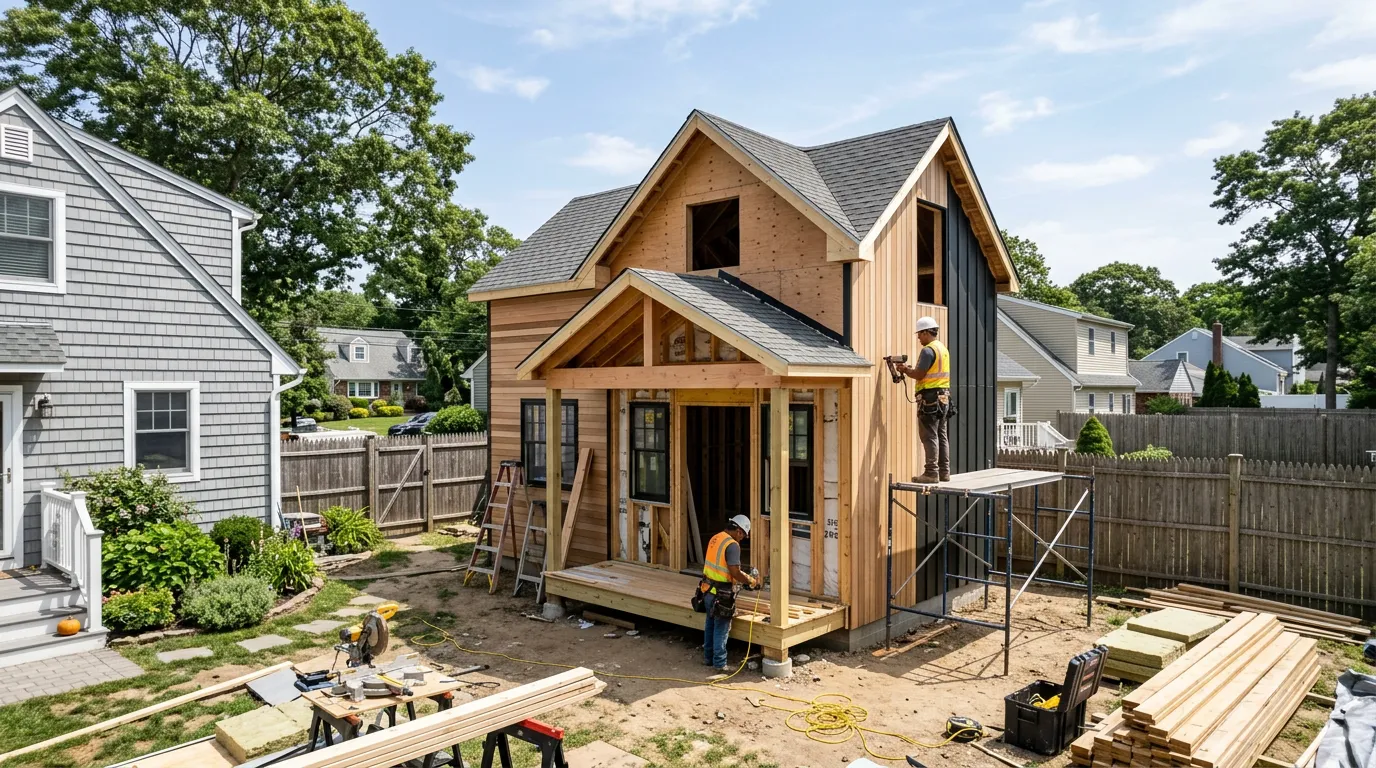
Long Island has always been a place where families stay close. Grandparents down the street, cousins around the corner, Sunday dinners at Mom's house. But staying close has gotten harder. Housing costs have risen, assisted living facilities charge $10,000 or more per month, and the idea of putting a parent in a nursing home does not sit well with most Long Island families. There is a better option: an in-law suite ADU on your own property.
An accessory dwelling unit designed for aging parents gives your family the best of both worlds. Your parents maintain their independence, privacy, and dignity in their own fully equipped apartment. You have peace of mind knowing they are just steps away. And instead of sending $120,000 or more per year to an assisted living facility, you invest in a permanent asset on your own property that increases its value.
This guide covers everything Suffolk County homeowners need to know about building an in-law suite ADU, from ADA-accessible design features and costs to permits and planning for the future.
Why Long Island Families Are Choosing In-Law Suites
The shift toward in-law suite ADUs on Long Island is driven by real financial pressures and deeply held family values.
- The cost of assisted living is staggering. On Long Island, assisted living facilities charge $8,000 to $15,000 per month, with the average around $10,000. That is $120,000 per year. A nursing home with skilled care runs even higher. For most families, these costs are simply unsustainable over multiple years.
- Families want to stay together. Long Island has a strong tradition of multigenerational living, particularly in Italian, Latino, Irish, and Asian communities that make up a large portion of Suffolk County's population. Sending a parent to a facility feels wrong when there is a better option available.
- Independence with proximity. An in-law suite is not a spare bedroom in your house. It is a fully independent apartment with its own entrance, kitchen, bathroom, and living space. Your parent has privacy and autonomy. You are next door, not 24/7 caregiving. That balance is critical for the mental health of both generations.
- It is a financial investment, not an expense. Unlike assisted living payments that disappear the moment you stop paying, an ADU is a permanent improvement to your property. If circumstances change, you can rent it out for $1,500 to $2,500 per month. The investment stays in your family.
Need an in-law suite for your family?
Free walkthrough — we'll help you design the perfect space for your parent.
Types of In-Law Suite ADUs
The right type of in-law suite depends on your property, your parent's mobility, and your budget. Here are the most common options we build across Suffolk County.
- Basement conversion. This is the most common in-law suite on Long Island because most homes already have full basements. A basement conversion provides a ground-level or below-grade apartment with its own entrance. For aging parents with good mobility, this is often the most cost-effective option at $60,000 to $120,000. The key challenge is ensuring adequate natural light, egress, and moisture control.
- Garage conversion. Converting an attached garage puts the in-law suite on the same level as the main house, which is ideal for accessibility. An attached garage conversion at $50,000 to $100,000 creates a living space that is physically connected to the main home but has its own separate entrance. This proximity is comforting for families concerned about emergency situations.
- Backyard cottage. A standalone structure in the backyard provides the most privacy and independence. Backyard cottages can be designed from scratch with full ADA accessibility, optimal natural light, and thoughtful layouts. They cost more ($150,000 to $300,000) but offer complete design freedom and the strongest long-term value as a potential rental unit.
- Attached addition. Building an addition onto your home creates a connected but independent living space. This option works well when the parent needs to be physically close, such as for those with dementia or significant mobility issues, because you can install a connecting door between the main home and the suite. Costs range from $100,000 to $200,000.
- Above-garage apartment. If your parent has good mobility, an above-garage apartment provides excellent privacy and separation. However, this is the least suitable option for aging-in-place because stairs are a significant fall risk. We generally recommend ground-level options for in-law suites.
ADA-Accessible Design Features
Designing an in-law suite for an aging parent requires thoughtful attention to accessibility. Even if your parent is healthy and mobile today, building with accessibility in mind is far less expensive than retrofitting later. Here are the key design features we incorporate.
- Zero-threshold entries. No step-ups or step-downs at any entrance. The transition from outside to inside should be completely flush. This accommodates walkers, wheelchairs, and anyone with balance concerns. It also prevents trip hazards, which are the leading cause of injury in older adults.
- Wider doorways. Standard interior doorways are 30 to 32 inches wide. For accessibility, all doorways should be a minimum of 36 inches clear. This allows comfortable passage with a walker or wheelchair. We use 3-foot doors throughout the suite as standard practice for in-law builds.
- Roll-in shower. A curbless, roll-in shower with a built-in bench seat, handheld shower head, and grab bars is the most important accessibility feature in the bathroom. No step over a tub wall, no shower curtain to fight with, and a seat for stability. The shower floor slopes gently to a linear drain.
- Grab bars. Strategically placed grab bars in the bathroom at the toilet, in the shower, and next to the vanity. We install blocking in the walls during construction so grab bars can be securely mounted now or added later without having to open up walls.
- Lever-style handles. Door handles, faucets, and cabinet hardware should all be lever-style rather than knob-style. Levers are easier to operate for anyone with arthritis, reduced grip strength, or limited hand dexterity.
- Single-floor living. Everything the occupant needs should be on one level: bedroom, bathroom, kitchen, and living area. No stairs. No split-levels. This is fundamental to aging-in-place design.
- Adequate lighting. Older eyes need more light. We install brighter fixtures, under-cabinet lighting in the kitchen, illuminated light switches, and motion-sensor lighting in hallways and the bathroom for nighttime navigation.
- Non-slip flooring. Luxury vinyl plank (LVP) is the preferred flooring material for in-law suites. It provides a warm, wood-like appearance with excellent slip resistance, cushion underfoot, and easy maintenance. We avoid tile (slippery when wet), hardwood (requires more maintenance), and carpet (trip hazard with walkers).
Licensed & Insured
Full coverage on every project
36+ Cities Served
Suffolk County & Long Island
Free Walkthrough
No obligation, no pressure
Safety Features
Beyond ADA accessibility, an in-law suite for aging parents should include specific safety features that go beyond standard ADU construction.
- Emergency alert system. A medical alert system with pull cords or wearable pendants in the bedroom and bathroom gives your parent a way to call for help if they fall or have a medical emergency. We pre-wire for these systems during construction.
- Fire separation. A one-hour fire-rated assembly between the in-law suite and the main dwelling is required by code. This gives both households critical extra minutes to evacuate in the event of a fire.
- Independent HVAC. A dedicated mini-split system allows the occupant to control their own temperature without affecting the main house. Many older adults prefer warmer temperatures, and having independent climate control avoids thermostat conflicts.
- Well-lit exterior pathways. The path from the in-law suite entrance to the driveway, main house entrance, and any shared outdoor areas should be well-lit with exterior fixtures and motion-sensor lighting. Dark walkways are a serious fall risk.
- Motion-sensor interior lighting. Night lights and motion-sensor lights in the bathroom and hallway activate automatically, so your parent never has to navigate in the dark to find a light switch.
- Hardwired smoke and CO detectors. Interconnected, hardwired detectors in every room ensure that alarms are heard throughout the suite and, ideally, in the main house as well.
Get a Free Estimate
Tell us about your project — we respond within 24 hours.
No spam. No obligation.
Costs for an In-Law Suite ADU
The cost of an in-law suite ADU on Long Island ranges from $60,000 to $150,000, depending on the type of conversion and the level of accessibility features included.
- Garage conversion with ADA features: $60,000 to $110,000. The existing structure keeps costs manageable, and single-floor access makes it naturally suited for aging-in-place design.
- Basement conversion with ADA features: $70,000 to $130,000. Costs run slightly higher than a standard basement ADU because of the accessibility modifications, particularly for ensuring a zero-threshold entry and adequate egress.
- Attached addition: $100,000 to $200,000. New construction costs more but allows complete design customization and the option for a connecting door to the main home.
- Detached backyard cottage: $150,000 to $300,000. The premium option, with complete design freedom and maximum privacy.
ADA-accessible features typically add $5,000 to $15,000 to the base cost of any ADU type. This includes wider doors, roll-in shower, grab bar blocking, lever hardware, zero-threshold entries, and enhanced lighting. This is a small premium that provides enormous long-term value.
The Emotional and Financial Benefits
An in-law suite is one of those rare projects where the emotional and financial cases are equally compelling.
- Avoid $120,000+ per year in assisted living costs. Even a high-end in-law suite ADU at $150,000 costs less than 15 months of assisted living on Long Island. If your parent lives in the suite for five years, you have saved your family over $450,000 compared to a facility.
- Family bonding. Grandchildren grow up knowing their grandparents. Sunday dinners happen naturally. Your parent is part of daily life, not someone you visit on weekends in a facility 20 miles away.
- Peace of mind. You know your parent is safe, comfortable, and close by. If they need help, you are steps away. If they want privacy, they have their own front door. That balance reduces stress for everyone.
- Property value increase. A legal, permitted ADU adds 15 to 35 percent to your property value. When circumstances eventually change, the suite can be rented for $1,500 to $2,500 per month, creating an ongoing income stream.
- Future flexibility. An in-law suite designed today for your parent can serve other purposes in the future. It can become a rental unit, a home office, a guest suite, or a space for your own adult children as they transition into independence. The investment adapts to your family's evolving needs.
Let us help you keep your family close.
Free walkthrough — we'll design a space that works for everyone.
Planning for the Future
The smartest approach to an in-law suite is to design it for where your parent will be in five or ten years, not just where they are today. This is called aging-in-place design, and it saves you from costly renovations down the road.
- Universal design principles. Universal design creates spaces that work for people of all ages and abilities. Features like lever handles, rocker light switches, varied counter heights, and open floor plans are not just for seniors. They make the space comfortable for everyone and do not look institutional.
- Visitability standards. At a minimum, the suite should meet visitability standards: at least one zero-step entrance, 36-inch doorways on the main level, and one accessible bathroom on the main level. Even if your parent does not need these features today, building them now costs a fraction of retrofitting later.
- Pre-wiring for medical equipment. If your parent may eventually need medical equipment such as a hospital bed, oxygen concentrator, or CPAP machine, we install additional electrical circuits and dedicated outlets in the bedroom area. These devices draw significant power and need reliable, properly sized circuits.
- Reinforced walls for future grab bars. Even if you do not install grab bars on day one, we add wood blocking inside the walls at all likely grab bar locations. When the time comes to add bars, the installation takes minutes rather than requiring wall demolition.
- Transition-friendly layout. Design the layout so that furniture can be rearranged as needs change. A bedroom that can accommodate a hospital bed, a living room that can serve as a caregiver rest area, and a bathroom that can fit a shower chair all contribute to a space that adapts over time.
Permit Considerations
An in-law suite ADU follows the same permit process as any other accessory dwelling unit on Long Island. You need a building permit from your town, zoning compliance, and Suffolk County Health Department approval if your property uses a septic system.
There are a few additional considerations specific to in-law suites:
- Owner-occupancy requirements. Most Suffolk County towns require that the homeowner live in either the main house or the ADU. This is typically satisfied when your parent lives in the suite and you live in the main house.
- Medical equipment power needs. If you know your parent will use medical equipment, discuss this with your contractor during the design phase. Additional electrical capacity may be needed, and it is much easier to plan for this during construction than to add it after the fact.
- Family member provisions. Some towns have specific provisions for accessory apartments occupied by family members, which may have different or simplified requirements compared to rental ADUs. Your contractor should be familiar with your specific town's regulations.
Alec's Construction handles the complete permit process for every in-law suite we build. We prepare the plans, submit to the building department, coordinate with the health department, and manage all inspections through Certificate of Occupancy.
Frequently Asked Questions
Does an in-law suite need a separate kitchen?+
Can my parent live there without it being a legal ADU?+
What about medical equipment power requirements?+
Will an in-law suite affect my property taxes?+
For a comprehensive overview of all ADU options on Long Island, read our complete ADU construction guide. If you are considering a garage conversion for your in-law suite, our garage conversion guide covers costs and timelines in detail. And to understand the financial return if you eventually rent the suite, check out our ADU rental income analysis.
Work With Alec's Construction
This guide is written by the crew that does the work. See Alec's ADUs service — accessory apartments, garage conversions and grant paperwork. Licensed and insured on Long Island, one crew start to finish, free walkthrough and a written estimate inside 48 hours.
Booking the cold months now: we also handle Additions & New Construction and Bathroom Remodeling.
Every town here has villages inside it running their own building department. Our directory sorts out which counter your address actually files at.
Ready to Build an In-Law Suite for Your Family?
Contact Alec's Construction for a free consultation. We will visit your property, discuss your parent's needs, and design a safe, comfortable, and accessible living space that keeps your family close.
Get a Free Consultation