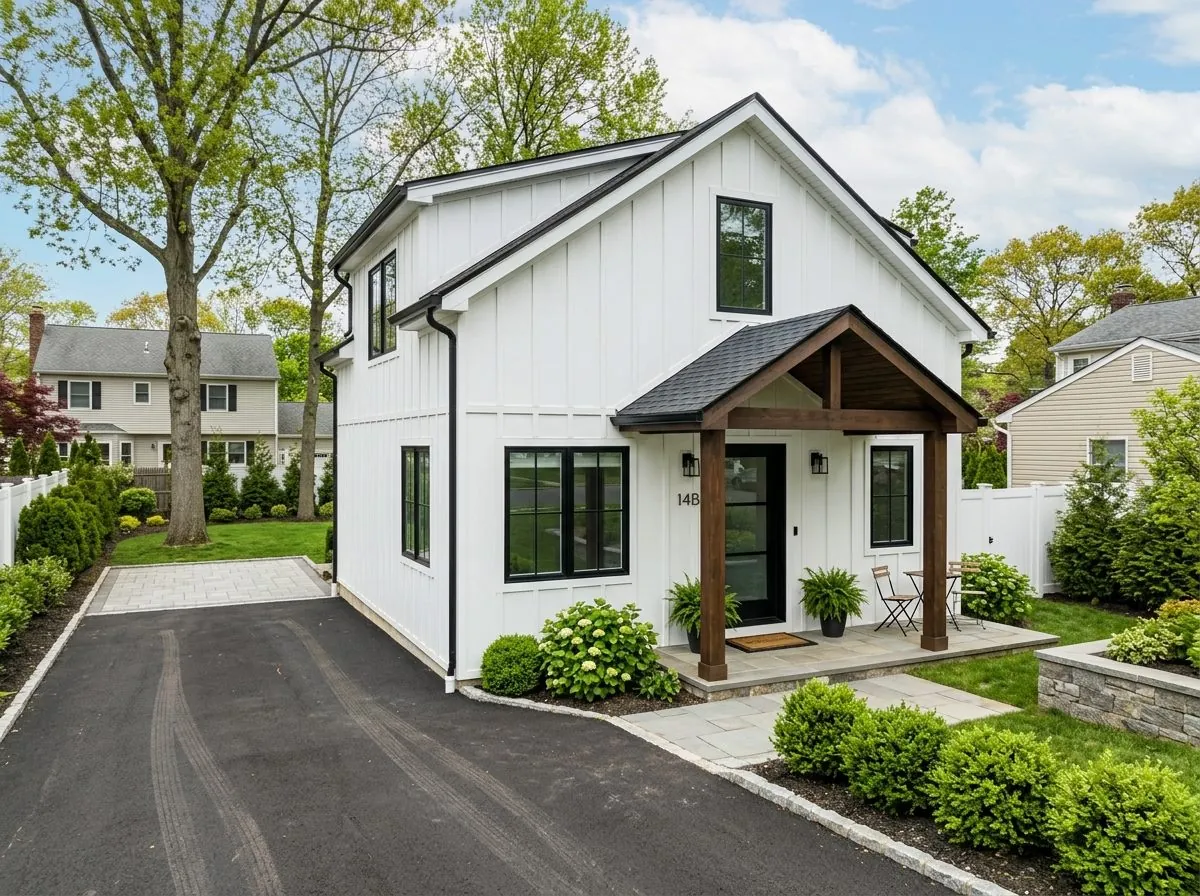
An accessory dwelling unit is not just extra living space on your property. It is an income-generating asset. For Long Island homeowners dealing with rising property taxes, high mortgage payments, and the general cost of living in Suffolk County, a legal ADU can bring in $18,000 to $30,000 per year in rental income. That is real money that goes directly toward your household expenses, retirement savings, or mortgage payoff.
This guide breaks down exactly how much rental income you can expect from an ADU on Long Island, how to calculate your return on investment, and what factors determine whether your unit commands top-of-market rent.
Rental Market Rates for ADUs on Long Island
Long Island's rental market is tight, and ADUs benefit directly from that demand. Here are current market rates for accessory apartments across Suffolk County in 2026.
- Studio apartment (300-450 sq ft): $1,200 to $1,800 per month. Studios attract single professionals, students, and downsizers. They are the most affordable to build and the easiest to fill, but they command the lowest per-unit rent.
- One-bedroom apartment (450-650 sq ft): $1,500 to $2,500 per month. This is the sweet spot for Long Island ADUs. One-bedrooms attract couples, young professionals, and retirees. They offer the best balance of construction cost to rental income.
- Two-bedroom apartment (650-1,000 sq ft): $2,000 to $3,000 per month. Two-bedroom ADUs are less common because they require more space, but they command premium rent and attract small families and roommate pairs.
Rates vary by location within Suffolk County. The Hamptons and East End communities command the highest rents, with even small studios fetching $2,000 or more per month during peak season. Central Suffolk areas like Patchogue, Medford, and Bay Shore fall in the mid-range. North Shore towns like Huntington and Port Jefferson tend to be on the higher end due to proximity to the train and desirable school districts.
Annual Income Potential
Let us look at what these monthly rates translate to on an annual basis, using conservative estimates for a typical one-bedroom ADU in central Suffolk County.
- Monthly rent: $2,000 (mid-range for a quality one-bedroom)
- Annual gross income: $24,000
- Vacancy allowance (5%): -$1,200 (accounting for turnover between tenants)
- Annual net rental income: $22,800
For a higher-end unit in a desirable area, those numbers climb to $2,500 per month, or $28,500 per year after vacancy. For a more modest studio, you might see $1,500 per month, or $17,100 per year after vacancy.
To put that in perspective, $22,800 per year in rental income is roughly equivalent to the annual return on a $380,000 stock portfolio earning 6 percent. But unlike a stock portfolio, your ADU is a tangible asset attached to your property that also increases your home's value.
Want to know what your property could earn?
Free walkthrough — we'll assess your property and estimate rental potential.
ROI Calculation: Does Your ADU Pay for Itself?
This is the question every homeowner asks, and the math is straightforward. Let us walk through a real-world example.
Scenario: Two-car garage conversion in Patchogue
- Construction cost: $75,000 (mid-range garage conversion with quality finishes)
- Monthly rent: $2,000
- Annual net income (after 5% vacancy): $22,800
- Payback period: $75,000 / $22,800 = 3.3 years
In just over three years, the ADU has paid for itself entirely through rental income. Every dollar of rent collected after that point is profit. Over a 10-year period, that $75,000 investment generates $228,000 in gross rental income, a return of over 300 percent.
Compare that to other home improvement ROI:
- Kitchen remodel: 50-80% ROI at resale, zero ongoing income
- Bathroom remodel: 50-70% ROI at resale, zero ongoing income
- New deck: 60-80% ROI at resale, zero ongoing income
- ADU: 15-35% property value increase PLUS $18,000-$30,000/year in ongoing income
No other home improvement pays you back in monthly cash while simultaneously increasing your property value.
Licensed & Insured
Full coverage on every project
36+ Cities Served
Suffolk County & Long Island
Free Walkthrough
No obligation, no pressure
Factors That Affect Your ADU Rental Rate
Not all ADUs are created equal, and the details determine whether you command top-of-market rent or leave money on the table. Here is what matters most to tenants on Long Island.
- Location. Proximity to the LIRR, downtown areas, beaches, and quality school districts all drive rents higher. A one-bedroom ADU in Huntington or Patchogue Village will rent for more than the same unit in a more rural part of Suffolk County.
- Size and layout. A one-bedroom with a separate living area commands more than an open studio of the same square footage. Tenants pay a premium for a dedicated bedroom with a door.
- Finish quality. Modern finishes, quartz countertops, tile bathrooms, stainless appliances, and quality flooring attract higher-paying tenants. The difference between builder-grade and mid-range finishes might cost $5,000 to $10,000 more to build but can add $200 to $300 per month to the rent, paying for itself in under three years.
- Separate entrance. This is required by code for a legal ADU, but the quality of the entrance matters. A well-designed front door with a small porch or landing feels like a real apartment. A side door into a dark corridor does not.
- Parking. Dedicated off-street parking for the tenant is highly valued on Long Island, where almost everyone drives. If you can provide a designated parking spot, you can charge $50 to $100 more per month.
- In-unit laundry. A compact washer/dryer unit adds significant tenant appeal. Many competing rentals on Long Island lack in-unit laundry, so this is a strong differentiator.
- Outdoor space. A small patio, deck, or fenced area that the tenant can use exclusively adds value. Even a 6-by-8-foot patio with room for a chair and small table makes the unit feel like a home rather than just a room.
Get a Free Estimate
Tell us about your project — we respond within 24 hours.
No spam. No obligation.
Property Value Impact
Beyond monthly rental income, a legal ADU increases the value of your property. This is equity you build that you realize when you sell or refinance.
- 15 to 35 percent increase. Studies consistently show that homes with legal, permitted ADUs sell for 15 to 35 percent more than comparable homes without them. On a $500,000 Long Island home, that means $75,000 to $175,000 in additional value.
- Appraisal approach. Appraisers evaluate ADUs using a combination of the income approach (capitalizing the rental income stream) and the comparable sales approach (looking at what similar properties with ADUs have sold for). As more legal ADUs are built on Long Island, comparable sales data is improving, which strengthens appraisals.
- Buyer appeal. Homes with legal ADUs sell faster because buyers see the income potential. A home that comes with a built-in $2,000-per-month revenue stream is significantly more attractive than an equivalent home without one.
Tax Implications
Rental income from an ADU is taxable, but it also creates valuable tax deductions. Here is what you need to know. (Always consult a qualified CPA for tax advice specific to your situation.)
- Rental income is taxable. You must report all rental income on your federal and New York State tax returns. This is true whether the tenant pays by check, cash, Venmo, or any other method.
- Deductible expenses. You can deduct a wide range of expenses related to the ADU, including mortgage interest allocated to the rental portion, property tax allocated to the rental portion, insurance, repairs and maintenance, utilities you pay for the unit, and property management fees if applicable.
- Depreciation. You can depreciate the cost of the ADU construction over 27.5 years (the IRS depreciation schedule for residential rental property). On a $75,000 garage conversion, that is roughly $2,727 per year in depreciation deductions, reducing your taxable rental income.
- Net effect. After deducting expenses and depreciation, many ADU owners pay significantly less tax on their rental income than you might expect. The cash flow benefit is real and substantial.
Short-Term vs. Long-Term Rentals
Some homeowners wonder about using their ADU as a short-term rental through platforms like Airbnb or VRBO instead of a traditional long-term lease. Here is the reality on Long Island.
- Short-term rental restrictions. Many Suffolk County towns have enacted regulations limiting or prohibiting short-term rentals (stays under 30 days). Brookhaven, Islip, Babylon, and several other towns have specific ordinances that may restrict your ability to operate a short-term rental. Penalties for violations can be steep.
- Higher potential income, but also higher costs. Where permitted, a well-located ADU could generate more income on a nightly basis than through a monthly lease. However, short-term rentals come with higher costs: furnishing the unit, cleaning between guests, higher turnover, higher utility costs, platform fees (Airbnb takes 3-5%), and more intensive management.
- Long-term is typically the safer bet. For most Long Island homeowners, a long-term tenant provides steady, predictable income with minimal management. You collect rent once a month, and a quality tenant takes care of the unit. There is no turnover every few days, no cleaning between guests, and no regulatory risk.
Ready to start earning rental income?
Free walkthrough — we'll help you choose the ADU that maximizes your ROI.
How to Maximize Your ADU's Earning Potential
Building a profitable ADU is not just about creating a legal living space. It is about making smart design and finish decisions that maximize rental value relative to construction cost. Here is what we recommend to our Suffolk County clients.
- Invest in quality finishes where it counts. Spend money on the kitchen and bathroom. These two rooms drive tenant decisions. Quartz countertops, modern tile backsplash, stainless appliances, and a clean modern bathroom cost $5,000 to $10,000 more than builder-grade, but they allow you to charge significantly higher rent and attract better tenants.
- Design a smart layout. Prioritize an open living/kitchen area with a separate bedroom. Avoid wasted space in hallways and closets. Every square foot should serve a purpose. A well-designed 500-square-foot apartment feels spacious; a poorly designed 600-square-foot apartment feels cramped.
- Include in-unit laundry. A compact ventless washer/dryer combo or a stacked washer/dryer adds $1,500 to $2,500 to construction costs but adds $100 to $200 per month to achievable rent. It also dramatically reduces tenant turnover because people hate giving up in-unit laundry.
- Provide dedicated parking. If possible, give the tenant their own parking spot. On Long Island, this is not just a convenience, it is a necessity. A designated spot adds $50 to $100 per month to the rent.
- Create some outdoor space. Even a small patio or deck area outside the unit's entrance makes the apartment significantly more appealing. A few hundred dollars of concrete or pavers and a simple railing create a huge upgrade in perceived value.
- Maximize natural light. Tenants equate natural light with quality. Wherever possible, include generous windows. In a garage conversion, the wall where the garage door was removed is the perfect place for a large window or sliding glass door.
Frequently Asked Questions
How quickly will my ADU pay for itself?+
Do I need to charge market rate rent to family members?+
Will an ADU increase my property taxes?+
Can I finance an ADU construction project?+
For a comprehensive overview of ADU types and construction on Long Island, read our complete ADU construction guide. If you are interested in the most cost-effective ADU option, explore our garage conversion guide. And if your ADU is for aging parents rather than rental income, our in-law suite guide covers everything you need to know about multigenerational living.
Work With Alec's Construction
This guide is written by the crew that does the work. See Alec's ADUs service — accessory apartments, garage conversions and grant paperwork. Licensed and insured on Long Island, one crew start to finish, free walkthrough and a written estimate inside 48 hours.
Booking the cold months now: we also handle Additions & New Construction and Bathroom Remodeling.
We keep a permit office directory for Nassau and Suffolk, checked against each jurisdiction's own site, because we file in these counters constantly.
Ready to Build Your Income-Generating ADU?
Contact Alec's Construction for a free property assessment. We will evaluate your options, estimate your rental income potential, and provide a detailed construction estimate.
Get a Free Consultation