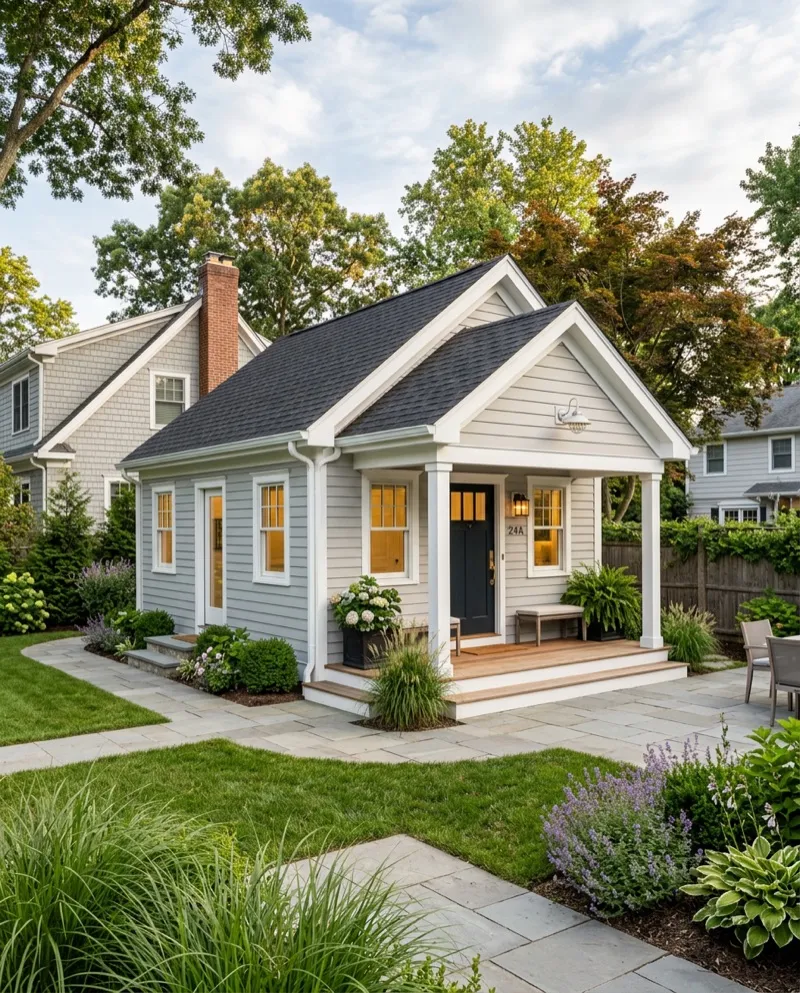
If you have been researching housing options, real estate investment, or home improvement on Long Island, you have probably encountered the term ADU. It appears in news articles about housing shortages, in real estate listings, in local government meetings, and in conversations with contractors. But what exactly is an ADU, and why has it become one of the most important concepts in Long Island housing?
This guide explains everything Long Island homeowners need to know about ADUs — what the term means, the different types you can build, how much they cost, what New York law says, what grants are available, and how to get started on your own ADU project.
What Does ADU Stand For?
ADU stands for Accessory Dwelling Unit. It is a self-contained residential unit located on the same property as a primary single-family home. An ADU has its own entrance, kitchen, bathroom, and living/sleeping space, making it a complete, independent dwelling — but it is secondary to and smaller than the main house on the lot.
You may also hear ADUs referred to by other names depending on the context and the community:
- In-law suite or in-law apartment — when the unit is intended for family members
- Granny flat — an informal term for a small unit built for an aging parent
- Guest house or guest cottage — common on larger properties, especially in the Hamptons and North Shore
- Carriage house — a converted outbuilding, often historic, repurposed as a dwelling
- Backyard cottage — a detached ADU built in the rear yard
- Secondary suite or accessory apartment — terms used in zoning codes and real estate
- Mother-daughter house — a Long Island-specific term for a house with a separate apartment, usually for a parent
Regardless of the name, the defining feature of an ADU is that it is a complete, self-contained living unit on a property that also has a primary residence. It is not a room within the main house — it is a separate home, even if it shares a wall or is in the same building.
Types of ADUs
ADUs come in several configurations. The best choice for your property depends on your lot size, existing structures, budget, local zoning regulations, and what you want to use the unit for. Here are the main types:
1. Detached ADU (Backyard Cottage)
A detached ADU is a standalone structure built separately from the main house. It has its own foundation, walls, roof, and entrance. This type provides the most privacy for both the homeowner and the ADU occupant because there are no shared walls or common spaces.
Detached ADUs range from compact studios of 400 square feet to spacious two-bedroom units of 1,000 square feet or more. They are ideal for properties with generous lot sizes where there is room to build without crowding the primary residence. On Long Island, detached ADUs are particularly common on larger properties in the Hamptons, North Shore, and eastern Suffolk County.
2. Attached ADU (Home Addition)
An attached ADU is built as an addition to the existing house but has its own separate entrance, kitchen, bathroom, and living area. It shares one or more walls with the main house but functions as an independent unit.
This type works well when lot size is limited and a detached structure would not fit within setback requirements. It is also the most common configuration for in-law suites because the shared wall provides easy access between the main house and the ADU when needed, while the separate entrance maintains the occupant's independence.
3. Garage Conversion
A garage conversion transforms an existing garage — usually a detached two-car garage — into a living space. The garage shell provides the structure, and the interior is built out with insulation, drywall, flooring, plumbing, electrical, HVAC, a kitchen, and a bathroom.
Garage conversions are typically the most cost-effective type of ADU because the exterior structure already exists. The primary costs are interior buildout and utility connections. They are also faster to complete than new construction. On Long Island, detached garages are extremely common, making this option available to a large number of homeowners.
4. Basement Conversion
A basement conversion turns an existing below-grade or partially below-grade basement into a legal dwelling unit. This requires meeting building code standards for ceiling height (typically a minimum of 7 feet), natural light, egress (emergency exit windows or doors), ventilation, moisture control, and a separate entrance.
Walkout basements — where one or more walls are at ground level — are the best candidates for conversion because they already have natural light and a potential separate entrance. Full basements below grade require more work to meet egress and light requirements but can still be converted successfully in many cases.
5. Above-Garage Apartment
An above-garage apartment adds a second story on top of an existing garage. The garage remains functional on the ground level, and the living space is built above it. Access is typically via an exterior staircase, creating a completely separate entrance from both the garage and the main house.
This type is space-efficient because it does not consume additional yard area — it builds upward on an existing footprint. The existing garage structure may need structural reinforcement to support the second story, which adds to the cost compared to a simple conversion.
Benefits of Building an ADU
ADUs have gained popularity across the country, and on Long Island in particular, because they address multiple needs simultaneously. Here are the primary benefits:
- Rental income. A well-built ADU on Long Island can generate $1,200 to $2,500+ per month in rental income, depending on location, size, and quality. This income can cover mortgage payments, property taxes, or retirement expenses.
- Multi-generational housing. ADUs allow families to keep aging parents, adult children, or other family members close while maintaining everyone's privacy and independence. This is the most common motivation for ADU construction on Long Island.
- Property value increase. A legal, permitted ADU adds significant value to your property. Homes with ADUs sell at a premium because buyers recognize the income potential and flexibility the extra unit provides.
- Housing supply. ADUs help address Long Island's housing shortage by creating new units within existing residential neighborhoods, without requiring new subdivisions or large-scale apartment development.
- Flexibility. An ADU can serve different purposes over time — a rental unit today, a home for your college graduate next year, an in-law suite when parents need support, or a home office when work needs change.
- Aging in place. Homeowners can build an ADU and move into it themselves, renting the larger main house for income while living in a more manageable, single-floor unit designed for accessibility.
Want to learn what ADU options fit your property?
Free walkthrough and ADU feasibility assessment — no obligation.
How Much Does an ADU Cost on Long Island?
ADU costs on Long Island vary significantly depending on the type of project, location, materials, and finishes. Long Island's construction costs are higher than national averages due to labor rates, material costs, and regulatory requirements. Here are realistic cost ranges for 2026:
- Garage conversion: $50,000 to $130,000. The most affordable option, leveraging existing structure.
- Basement conversion: $55,000 to $150,000. Cost depends heavily on existing conditions — ceiling height, moisture, and egress requirements.
- Above-garage apartment: $85,000 to $185,000. Includes structural reinforcement, second-story construction, and full interior buildout.
- Attached addition (in-law suite): $120,000 to $250,000. A new wing or section with foundation, walls, roof, and complete interior.
- Detached new construction: $150,000 to $375,000+. A standalone cottage or house built from the ground up. The Hamptons and North Shore command the higher end of this range.
These costs include design, permits, construction, and standard finishes. High-end finishes, complex sites, or properties in premium areas like the Hamptons will push costs toward or beyond the upper ranges. Conversely, straightforward conversions on well-prepared properties can come in at the lower end.
ADU Grants and Financial Incentives on Long Island
One of the most significant developments for Long Island ADU construction is the availability of grant funding through the Plus One Accessory Dwelling Unit Program. This program provides grants of up to $125,000 to help homeowners offset the cost of building an ADU.
Program status — verified September 2026
Plus One ADU is a New York State program (an $85 million allocation through the Housing Trust Fund Corporation) but it is run town by town, and each town's intake opens and closes on its own schedule. As of September 2026 on Long Island: Huntington and Riverhead are accepting applications; Brookhaven, Islip and Southold are closed. Babylon, East Hampton, Shelter Island and Southampton run their programs through Community Development Long Island rather than the Long Island Housing Partnership.
The $125,000 is a cap, not an amount every applicant receives, and it is awarded as a grant. Huntington's published guidelines cap household income at 100% of Nassau/Suffolk area median income (2023 HUD limits: $109,400 for a one-person household, $156,300 for four) and require that you have owned and lived in the home for at least one year. Applications go on a first-come waitlist and are then re-ranked on priority points, including whether the unit will be affordable at or below 80% AMI and whether it can be permitted without a zoning variance. Municipal code always overrides the program guidelines. Verify your town's status before you budget around a grant: LIHP (631) 435-4710. We also check it for you on the walkthrough — see our Plus One ADU grant page for the eligibility checklist and what the build costs if your town's round is closed.
- Grant amount: Up to $125,000 toward eligible construction costs.
- Requirement: The completed ADU must be rented to tenants earning at or below 80% of the Area Median Income (AMI) for a specified period, typically 10 years.
- Eligible projects: New construction, garage conversions, basement conversions, above-garage apartments, and other ADU types qualify.
- Impact: For many conversion projects, the grant covers most or all of the construction cost, making ADU construction essentially free to the homeowner.
Beyond the Plus One program, ADU construction costs may also qualify for home equity loans, home improvement loans, or construction financing. The rental income from the completed ADU typically provides a strong return on investment regardless of the funding method.
Licensed & Insured
Full coverage on every project
36+ Cities Served
Suffolk County & Long Island
Free Walkthrough
No obligation, no pressure
Get a Free Estimate
Tell us about your project — we respond within 24 hours.
No spam. No obligation.
New York State ADU Laws and Long Island Regulations
ADU regulations in New York vary by municipality. On Long Island, each town — Brookhaven, Islip, Babylon, Huntington, Smithtown, Southampton, East Hampton, Riverhead, Shelter Island, and Southold in Suffolk County, plus the towns in Nassau County — has its own zoning code that governs whether, where, and how ADUs can be built.
New York State has been pushing for broader ADU legalization as part of its response to the statewide housing shortage. Key developments include:
- State-level ADU legislation. New York has considered and advanced legislation that would require municipalities to permit ADUs in residential zones. While the specifics continue to evolve, the direction is clear: the state wants more ADU-friendly policies at the local level.
- Town-by-town variation. Currently, each Long Island town sets its own ADU rules. Some towns, like East Hampton, actively promote ADUs with streamlined processes and grant programs. Others have more restrictive policies that are gradually loosening under state pressure and housing demand.
- Common requirements. Across most Long Island jurisdictions, ADU regulations typically include owner-occupancy requirements, size limits relative to the primary dwelling, parking minimums, setback compliance, and Health Department approval for properties on septic systems.
- Suffolk County Health Department. Any ADU that adds dwelling capacity to a property with a private septic system must receive Health Department approval. This is a Suffolk County-wide requirement that applies regardless of the town's own zoning rules.
The regulatory landscape is shifting in favor of ADU construction. Towns that were previously hostile to accessory apartments are revising their codes, and state-level support for ADUs continues to grow. For homeowners who build now, the investment benefits from both current incentive programs and the long-term trend toward broader ADU acceptance.
ADU Meaning in Real Estate
In real estate, an ADU represents both additional living space and income potential. When a property is listed with a legal ADU, it commands a higher sale price because the buyer is purchasing two income streams — the primary residence and the rental unit — on a single parcel.
Real estate agents on Long Island increasingly highlight ADU potential in their listings, even when the ADU has not yet been built. A property description might note "ADU potential" or "room for accessory apartment" as a selling point. This reflects the market's recognition that ADUs add tangible value.
For appraisal purposes, a legal, permitted ADU with a certificate of occupancy is treated as additional living area that contributes to the property's market value. Illegal or unpermitted units, by contrast, can create liability issues and are not counted in official appraisals. This is why building a properly permitted ADU is essential — it protects your investment and maximizes its value at resale.
How to Get Started with an ADU on Long Island
If you are considering building an ADU on your Long Island property, here is the step-by-step process:
- Determine your goals. Are you building for family (in-law suite, adult child housing), rental income, property value, or a combination? Your goals shape the design, size, and type of ADU that makes sense.
- Check your zoning. Your town's zoning code determines whether ADUs are permitted on your property and under what conditions. We verify this for every client during our initial assessment.
- Assess your property. Lot size, existing structures, setback distances, septic capacity, and utility connections all affect what is feasible. A professional site assessment identifies your best options and any constraints.
- Explore funding. The Plus One program offers up to $125,000 in grant funding. Home equity loans, construction loans, and personal savings are other common funding sources. We help clients evaluate the financial options that make sense for their situation.
- Design the unit. Work with a contractor and architect to design an ADU that meets code requirements, fits your property, and achieves your goals. Good design maximizes the unit's functionality and value while minimizing construction costs.
- Obtain permits. Submit plans to your local building department and, if applicable, the Suffolk County Health Department. A licensed contractor handles this process and ensures all requirements are met.
- Build. Construction begins once permits are issued. Timelines range from 8 weeks for a simple conversion to 20+ weeks for new detached construction.
- Occupy or rent. Once the certificate of occupancy is issued, the ADU is ready for a family member, tenant, or whatever use you have planned.
Ready to explore ADU options for your property?
Free walkthrough, zoning check, and estimate — no strings attached.
Frequently Asked Questions About ADUs
What does ADU stand for?+
Are ADUs legal on Long Island?+
How much does it cost to build an ADU on Long Island?+
What is the Plus One ADU grant?+
Does an ADU increase property value?+
How long does it take to build an ADU?+
Related Articles
Work With Alec's Construction
This guide is written by the crew that does the work. See Alec's ADUs service — accessory apartments, garage conversions and grant paperwork. Licensed and insured on Long Island, one crew start to finish, free walkthrough and a written estimate inside 48 hours.
Booking the cold months now: we also handle Additions & New Construction and Bathroom Remodeling.
We pull the permits on our own jobs — if you need the building department for your town, we keep a current directory of all 23 Long Island permit offices.
Ready to Build an ADU on Long Island?
Alec's Construction builds every type of ADU across Suffolk County — garage conversions, basement apartments, above-garage units, in-law suites, and detached cottages. Contact us for a free property walkthrough and find out what is possible on your lot.
Get a Free Consultation