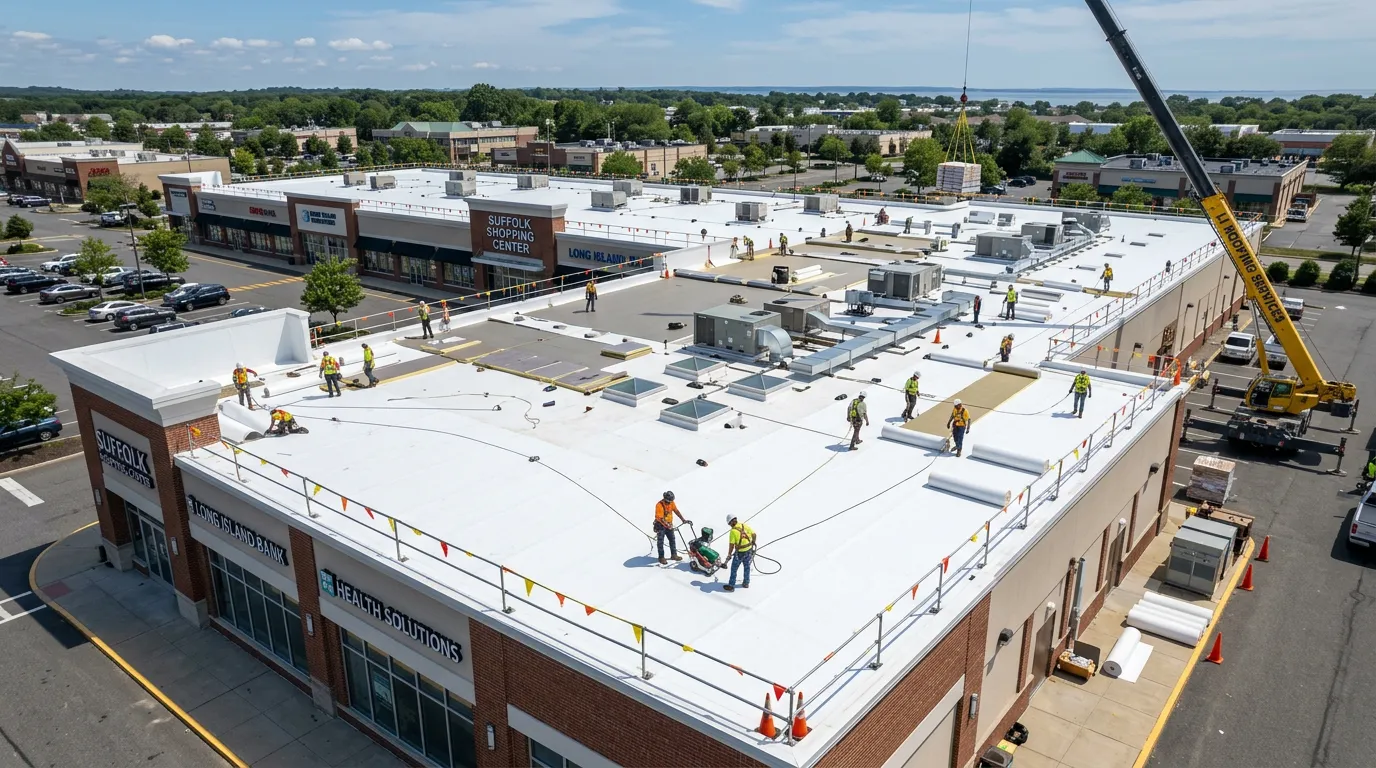
You walk the building Monday morning after a nor'easter blew through Suffolk County over the weekend, and there it is: a brown ring spreading across a drop ceiling tile near the back office, or a bubble forming in the sheetrock above the break room. Your first instinct is to call maintenance and have someone pop a tile and look. Your second instinct should be to stop and think about the insurance claim you're about to need, because the next 48 hours determine whether that claim gets paid in full or gets fought for six months.
I've walked commercial roofs across Brookhaven, Islip, Smithtown, and Babylon the week after a storm more times than I can count, and the pattern is always the same. The property manager who documents fast and calls a roofer before calling the insurance company gets a clean claim. The one who waits, patches it themselves, or lets a handyman caulk over the symptom ends up fighting an adjuster who's looking for any reason to call it "wear and tear" instead of storm damage.
This isn't a homeowner roof leak where you can take your time deciding. Commercial buildings have tenants, inventory, and liability exposure, and insurers know that pressure works in their favor if you move too fast or too slow. Here's how to handle it the right way, before winter makes the damage worse.
The Stain Is Rarely Where the Leak Is
Water travels along roof deck seams, structural members, and insulation layers before it ever shows up as a stain on your ceiling tile. On a flat or low-slope commercial roof, which is most of what we see on Long Island strip retail, medical offices, and light industrial buildings, the entry point can be twenty or thirty feet from where the stain appears. This matters for your claim because an adjuster who can't find obvious storm damage near the stain will sometimes conclude the leak is old and unrelated to the recent weather event.
Don't let anyone open the roof to chase the leak before it's been documented and, ideally, before an adjuster has had a chance to see the original condition. If the building is actively leaking and causing more damage, you have the right to make emergency repairs, but photograph everything first and keep every receipt.
Document Before You Touch Anything
The morning you spot the stain, before you call anyone:
- Photograph the stain from multiple angles with a visible date stamp or timestamped phone photo
- Note the exact location relative to a fixed point, like "12 feet from the east wall, above the second row of ceiling tiles"
- Check your weather app or NOAA records for the storm date and wind speeds, and save that information
- Pull your most recent roof inspection or maintenance report if one exists
- Do not caulk, patch, or seal anything yourself before a contractor has seen and photographed it
Insurers lean on a documented timeline connecting a specific storm event to specific damage. Without that chain, they default to the position that it's gradual deterioration, which most commercial policies exclude.
Why Commercial Claims Get Denied on Long Island
The three denial reasons I see most often on commercial jobs here aren't complicated. First, "maintenance issue," where the adjuster argues ponding water or membrane seams that have been failing for years, not storm damage, caused the leak. Second, missing wind speed documentation, since many commercial policies have a named-storm or wind-speed deductible or exclusion threshold, and you need to prove the actual sustained winds at your location, not just that it was windy. Third, a gap between the storm date and when you reported it, because insurers use that gap to argue the damage happened some other time.
Salt air off the Sound and the Atlantic accelerates corrosion on rooftop units, flashing, and fasteners on buildings within a few miles of either shore, and adjusters know it. If your roof is older and already showing coastal wear, get ahead of the "maintenance" argument by having a contractor document the storm-specific damage, like a lifted membrane edge or a punctured flashing, separately from the general aging of the system.
Nor'easters, Freeze-Thaw, and the Timing Problem
Long Island runs through roughly 40 to 50 freeze-thaw cycles in a typical season, and every one of them works water further into whatever opening a storm created. A seam that was a slow drip in October becomes a saturated insulation board and a sagging deck by January if the claim sits unresolved and the repair gets delayed.
That's the real urgency here, not the insurance paperwork itself but what happens underneath your roof while the paperwork drags on. Wet rigid insulation on a commercial flat roof doesn't dry out on its own, and once it's saturated it stops insulating and starts holding water against the deck. If you're waiting on claim approval going into November, ask your contractor about a documented temporary repair that protects the building without compromising the evidence an adjuster needs to see.
Working With an Adjuster vs Working With Your Contractor
The adjuster works for the insurance company. Their job is to verify the claim and estimate the covered scope, and a fair number of them are genuinely trying to get it right. But they are not roofers, and they typically see a property for twenty minutes before writing an estimate for a system they'll never maintain.
Your contractor should be on-site for that inspection, or at minimum should do their own inspection within a day or two and produce a separate scope of damage. When the adjuster's estimate and the contractor's scope don't match, which happens on most larger claims, you want your contractor's documentation ready to support a supplement request. This is standard, not combative, and any commercial roofer who's handled claims before will know the process.
What a Contractor Should Document With You
A contractor who knows commercial claims will show up with a moisture meter, not just a camera. They should check the insulation around the leak for saturation, pull a core sample if the roof type allows it, photograph the membrane condition at the suspected entry point, and measure any ponding depth if it's a flat roof, since ponding over 48 hours after a rain event is itself a maintenance red flag insurers look for.
Ask for a written scope that separates storm-caused damage from any pre-existing conditions. That separation protects you if the claim gets challenged, and it protects the contractor from being accused of inflating the scope.
Permits and Code on a Commercial Reroof
If the claim covers more than a patch, your Long Island town will generally require a permit for commercial roofing work, and many towns treat tear-offs or structural repairs differently than a straightforward overlay. Fire separation, insulation R-value upgrades on reroofs, and rooftop equipment curb work can all trigger additional review depending on the building's use and the town's current code adoption. Confirm requirements with your specific town's building department, since Brookhaven, Islip, Smithtown, Huntington, Babylon, and the Nassau towns each run their own permit process and timelines.
If your building sits in a flood zone or near the South Shore's high water table, ask your contractor whether drainage or scupper modifications are part of the scope, since standing water problems often get worse, not better, after a reroof if the original drainage design wasn't addressed.
For related reading on how storm damage claims work on the residential side, see our guide on storm-damaged siding insurance claims, and if gutters or drainage are feeding water back under your roofline, our commercial gutter page covers what we check.
What We Do
We handle commercial roof insurance claims from the first walkthrough through the final supplement, documenting damage the way adjusters need to see it and keeping you covered through the repair so winter doesn't turn a fixable leak into a deck replacement. Our roofing and siding teams work the same claims process on both systems when a storm hits more than one part of the building.
Call (631) 312-7441 or book a free walkthrough.
Frequently Asked Questions
How fast do I need to report a commercial roof leak to my insurance company?
Report it within a few days of discovering it, and sooner if the leak is active. Most commercial policies require prompt notice, and a gap between the storm date and your report date gives the insurer an opening to question whether the damage is actually storm-related.
Should I let my contractor patch the leak before the adjuster sees it?
Only if the leak is causing ongoing damage and you've photographed the area thoroughly first. Otherwise wait, because an adjuster who sees the original damage has a much easier time approving the full scope than one working from photos alone.
What's the difference between a maintenance issue and storm damage on a flat roof?
Maintenance issues are gradual, like membrane seams that have been failing for years or insulation that's been wet for multiple seasons. Storm damage has a specific point of entry tied to a dated weather event, like a lifted membrane edge or a punctured flashing from wind-driven debris.
Does my contractor need to be present during the adjuster's inspection?
It's not required, but it helps significantly. A contractor who inspects alongside the adjuster can point out damage the adjuster might miss and head off disagreements about scope before they turn into a drawn-out supplement fight.
Why does freeze-thaw matter if my claim is still being processed?
Long Island gets roughly 40 to 50 freeze-thaw cycles a season, and each one pushes water further into saturated insulation and the roof deck. A claim that sits unresolved into winter often means more damage by the time repairs start, even though the insurance paperwork hasn't changed.
Do I need a permit for a commercial reroof after an insurance claim?
Generally yes for anything beyond a minor patch, but requirements vary by town and by the scope of work. Confirm with your building department before work starts, since some towns review insulation upgrades or structural changes differently than a straight overlay.
Related Guides
- Storm-Damaged Siding and Your Insurance Coverage
- Commercial Gutter Drainage on a Flat Roof
- Roof Leak After Fall Rain on Long Island
- Commercial Flat Roof Replacement Cost
Get a Free Estimate from Alec's Construction
Licensed and insured, working across Suffolk County since 2018. We come out, look at the actual job, and put a written number in your hand — no pressure, no obligation.
Or call (631) 312-7441