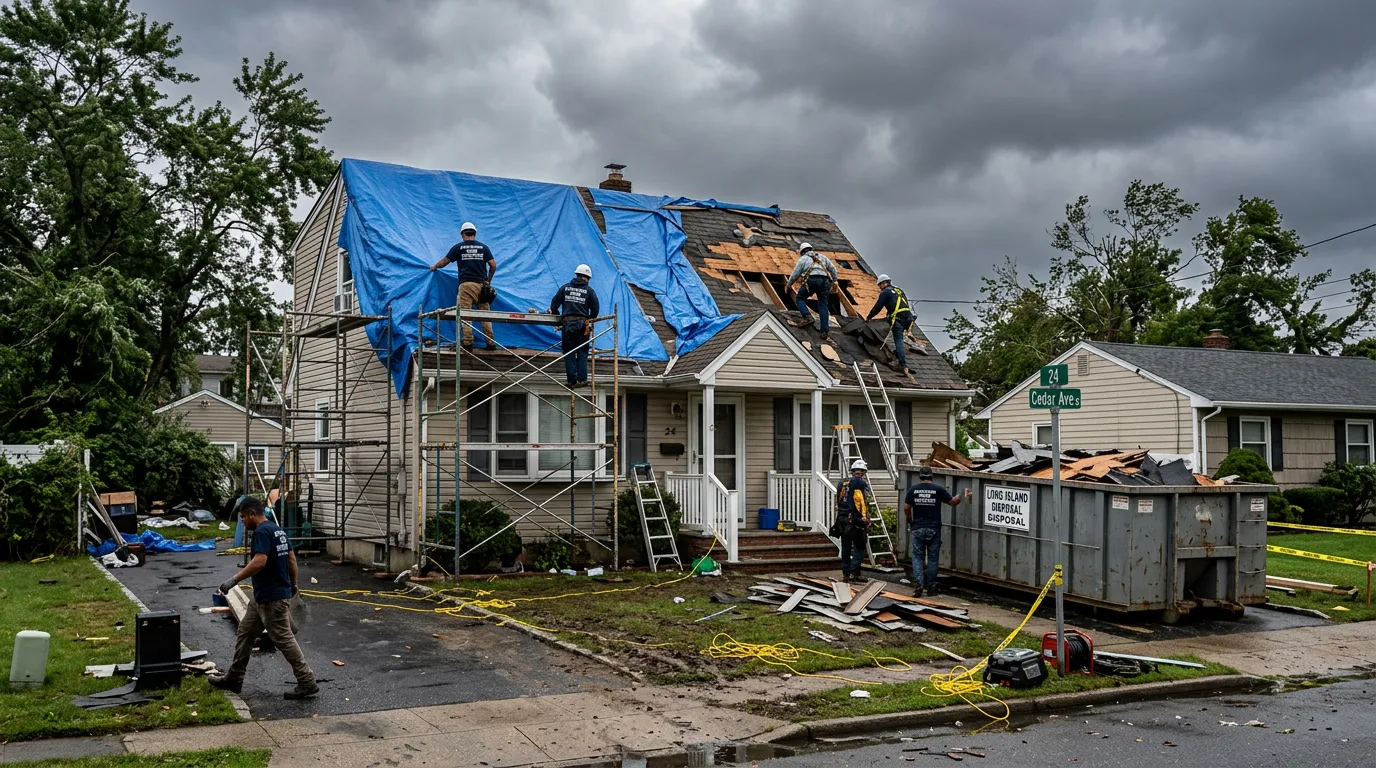
Long Island's weather is among the most severe in the Northeast — nor'easters, tropical storm remnants, severe hail events, and ice storms routinely damage roofs and siding across Nassau and Suffolk County every year. If your property has been affected by storm damage, the insurance claim process is your primary tool for getting the repair or replacement funded. But the way you approach it matters enormously. Poorly documented claims get denied. Claims filed too late lose coverage. And claims made without contractor support often settle for far less than the full replacement cost.
At Alec's Construction, we have worked alongside homeowners and their adjusters on hundreds of Long Island storm damage claims. This guide walks you through the process step by step so you know exactly what to do — and what not to do — from the moment a storm passes until you receive your settlement check.
Step 1: Inspect for Damage Within 48–72 Hours of the Storm
Do not wait for a leak to appear before checking for damage. Hail damage, wind-lifted shingles, and impact damage from falling debris can compromise your roof structurally before any interior water intrusion shows up. After any significant storm on Long Island, call a licensed roofing contractor for a damage inspection within the first 48–72 hours.
This timing matters for two reasons. First, your insurance policy may require you to take reasonable steps to prevent further damage after a covered event. Waiting two weeks to discover damage — and having it get worse in the meantime — can affect your claim. Second, adjusters are trained to distinguish between fresh storm damage and pre-existing wear. An early inspection creates a documented record of the damage tied to the specific storm event.
What to look for without going on the roof yourself:
- Granule accumulation in your gutters or at the base of downspouts (sign of shingle impact damage)
- Missing shingles visible from the ground or street
- Dented or cracked gutters, fascia, or soffit panels (often indicates hail)
- Dented aluminum window trim or HVAC unit fins (the most reliable indicator of hail size)
- Damaged siding, particularly on north and west exposures where wind-driven debris typically hits
Step 2: Call a Contractor Before You Call Your Insurance Company
This is the step most Long Island homeowners get backwards. The instinct is to call the insurance company first and report the damage. But if you do that without a contractor's damage assessment in hand, you have no leverage when the adjuster argues the damage is minor or pre-existing.
Call us first. We will inspect the roof and exterior, photograph every area of damage, document the storm event, and prepare a scope of work before your adjuster arrives. When the adjuster comes out, we meet them on site and walk the roof together. Our job is to make sure every damaged area is documented on the adjuster's report — not just the obvious visible damage, but also damaged underlayment, flashing, ridge cap, and secondary protection systems that adjusters frequently overlook.
Storm damage? We respond within 24 hours.
Free damage inspection. We work directly with your adjuster. Nassau & Suffolk County.
Step 3: File Your Claim Within the Policy Window
Most New York homeowners insurance policies require you to report a loss promptly after it occurs. The definition of "promptly" varies — some policies specify 30 days, others leave it to a general standard of reasonableness. For storm damage specifically, New York Insurance Law limits how insurers can enforce late-filing clauses, but the safest approach is to file within 30 days of the storm event.
To file, call your insurer's claims line or log in to your online account. You will need:
- Your policy number
- The date and type of storm event
- A description of the damage (your contractor's initial assessment helps here)
- Photos of the damage (we provide these from our inspection)
The insurer will assign a claim number and schedule an adjuster visit, usually within 7–14 business days. For major storm events that affect many properties — which is common after Long Island nor'easters and tropical events — adjuster scheduling can take 3–4 weeks.
Step 4: Understand Your Settlement — ACV vs. RCV
This is where many Long Island homeowners lose thousands of dollars without realizing it. Insurance policies pay storm damage claims on one of two bases:
- Actual Cash Value (ACV): The depreciated value of the damaged material. If your 12-year-old roof had a 20-year expected life, ACV pays approximately 40% of the replacement cost. For a $15,000 roof replacement, that is $6,000 — not enough to do the work.
- Replacement Cost Value (RCV): The full cost to replace damaged material with equivalent new material, regardless of age. RCV policies pay the ACV upfront and release the remaining "recoverable depreciation" after the work is completed and receipts are submitted.
Check your policy before the adjuster visit. If you have an RCV policy, make sure you understand the holdback process and the deadline to submit completion proof — typically 12–24 months from the date of loss. Our insurance restoration team tracks these deadlines for every client and ensures the recoverable depreciation is released before it expires.
Step 5: Challenge a Partial Denial or Low Settlement
If your adjuster approves repairs rather than full replacement, or misses significant areas of damage, you have the right to challenge the settlement. Your options include:
- Requesting a re-inspection with your contractor present
- Submitting a contractor's written scope of work that conflicts with the adjuster's report
- Filing a formal dispute through the New York State Department of Financial Services (DFS)
- Hiring a public adjuster to negotiate on your behalf (public adjusters typically charge 10–15% of the settlement increase)
In our experience, a contractor-provided scope letter that specifically addresses each line item the adjuster omitted resolves most disputes without escalation. We write these letters for our clients as part of our standard claim support process. For a broader view of storm damage types we handle, see our full insurance restoration service page. And for roofing-specific guidance, see our complete Long Island roof replacement guide.
Frequently Asked Questions
Will filing a roof insurance claim raise my rates in New York?+
How much do I pay out of pocket if the claim is approved?+
Can you waive my deductible?+
Related Articles
Work With Alec's Construction
This guide is written by the crew that does the work. See Alec's Storm Damage & Insurance Restoration service — emergency tarping, documentation and the claim itself. Licensed and insured on Long Island, one crew start to finish, free walkthrough and a written estimate inside 48 hours.
Booking the cold months now: we also handle Roofing and Siding.
Every town here has villages inside it running their own building department. Our directory sorts out which counter your address actually files at.
Storm Damage? Get a Free Inspection Today.
We document your damage, meet your adjuster on site, and fight for the full replacement scope you are entitled to. Licensed and insured across Nassau and Suffolk County.
Request Free Storm Inspection