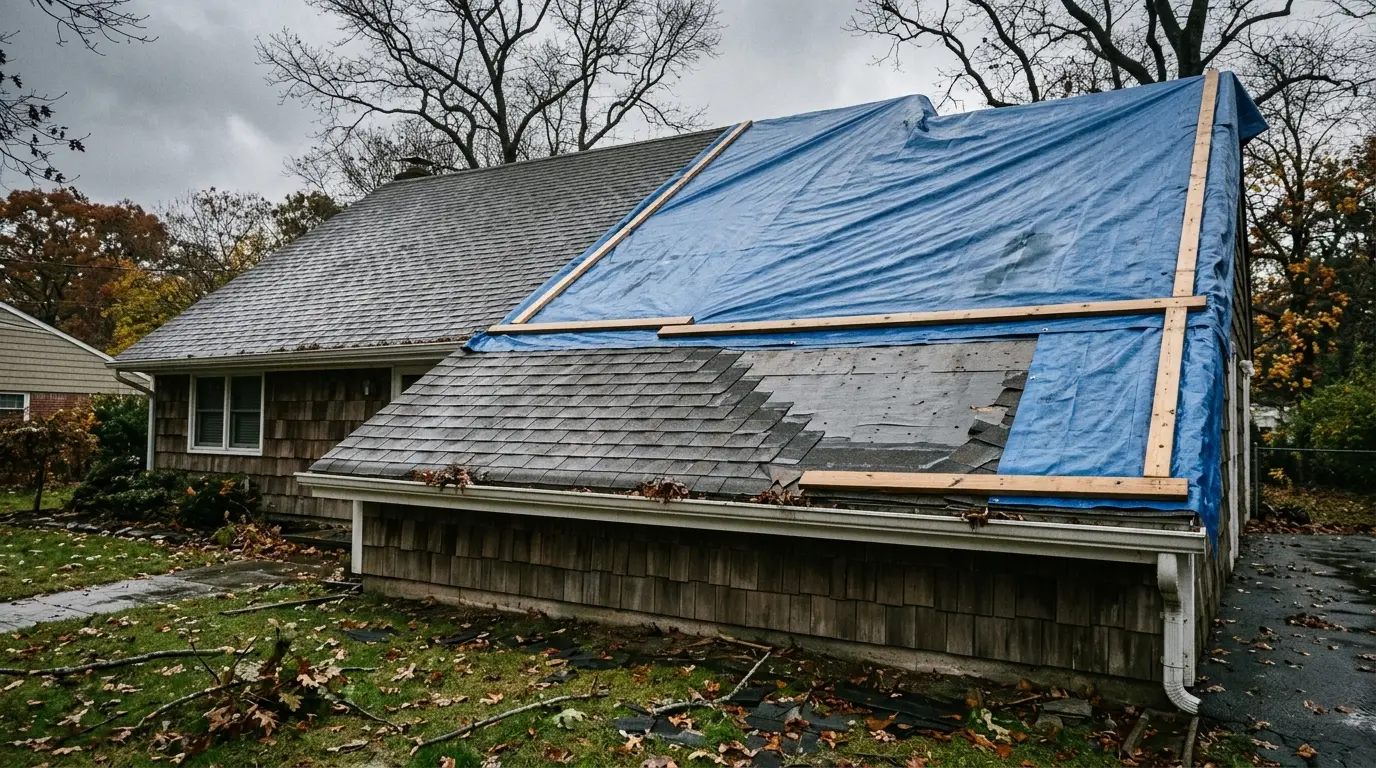
You've got a bucket under a brown stain that wasn't there last week, and the system that just blew through is already stacking up a second one behind it. That's the call I get most during nor'easter season, and underneath the panic it's almost always the same question: can you just tarp this and wait, or do you need someone on the roof before the next rain hits.
The honest answer depends on what's actually failing up there, not on how bad the stain looks from the kitchen table. I've gone out to a small brown ring that turned out to be a full flashing failure at a chimney, and I've gone out to a stain the size of a dinner plate that was a one-hour fix at a pipe boot. The stain tells you water got in. It doesn't tell you how big the opening is or how fast it's growing.
On Long Island, the clock on that decision runs faster than it does almost anywhere else. We see somewhere around 40 to 50 freeze-thaw cycles a season out here, and every one of those cycles works on whatever gap let the water in to begin with. A leak that's a slow drip in October can be a widened, ice-packed path by January. Wait too long between the storm and the fix, and you're not repairing a leak anymore, you're repairing a leak plus rotted sheathing plus wet insulation plus a ceiling that needs drywall work.
What a Tarp Actually Buys You
A proper tarp job is triage, not a repair. Done right, it's a heavy taped poly or silicone tarp run over the ridge and down past the damaged area on both sides, battened down with furring strips or 2x4s screwed into the roof deck or fascia, not bricks and cinder blocks just sitting on top. Nor'easter wind will peel a tarp that's only weighted down, and a tarp that fails mid-storm is worse than no tarp at all, because now water is funneling exactly where you didn't want it instead of sheeting off a slope.
A tarp set up correctly buys you days to a couple of weeks. It does not buy you a season, and it definitely doesn't buy you until spring. It's a bridge to get the roof covered until a crew can get up there and do the actual repair, not a substitute for the repair itself. If a contractor tells you a tarp is a long-term fix, that's the wrong answer.
When a Tarp Is the Wrong Call
If the active leak is at a valley, a chimney, or around a skylight, a tarp over that geometry almost never seals completely. Those are areas with multiple roof planes and flashing details underneath, and water will find the gap at the tarp's edge and keep tracking exactly like it was before. You're better off getting a targeted repair done at the actual failure point than relying on a flat tarp to cover complex flashing it was never shaped for.
If water is already tracking down framing members, soaking attic insulation, or you can see the ceiling starting to sag or bubble, you're past the point where a tarp alone is the right call. Wet insulation loses most of its R-value and needs to come out, and framing that stays wet starts growing mold inside of 48 hours in most conditions. At that point you need someone opening the ceiling and drying the cavity out, not just stopping new water from getting in. If the attic side of your house is already a mess from past leaks, our attic air sealing guide covers what wet insulation actually costs you in heating performance once the cold settles in.
What's Really Leaking After a Storm
Nine times out of ten after a wind event, it's one of these:
- Shingles lifted or torn off along the ridge or a rake edge
- Exposed or backed-out nail heads that wind-driven rain can now get under
- Chimney flashing or counterflashing separated from the masonry
- A cracked or dried-out pipe boot around a vent
- A gutter that overflowed during the storm and pushed water back up under the drip edge
Clogged valleys from oak and pine leaf drop make that last one worse every fall, since a valley packed with wet leaves holds water against the shingles instead of letting it shed off the roof. If your gutters were part of the problem, it's worth having them checked while a crew is already up there. Our gutter services page covers the drainage side of this, and if the leak traces back to the chimney specifically, see our chimney repair page.
Why Long Island Weather Doesn't Give You Time
Being surrounded by salt water on three sides means the air out here carries salt that corrodes exposed fasteners and metal flashing faster than homes see further inland. Combine that with 40 to 50 freeze-thaw cycles and the wind-driven rain a typical nor'easter brings, and a small gap doesn't stay small. Ice that forms in a crack expands it. The next thaw lets more water in. The next freeze expands it further. By the third or fourth cycle, what started as a loose shingle tab is a hole you can see daylight through from the attic.
South Shore towns with a high water table add another wrinkle. Homes in low-lying parts of Babylon, Islip, and Southampton already run damper attics and crawlspaces than homes further north, and that ambient moisture slows down how fast wet insulation and framing actually dry out between storms. A leak that would dry out in three days in a drier attic can stay wet for a week or more in those conditions, which is more time for rot and mold to take hold.
What a Real Emergency Repair Looks Like
A real repair starts with finding the actual entry point, not just patching where the stain shows up inside. Water travels along framing and roofing felt before it drips, so the spot on your ceiling is rarely directly under the hole. We trace it from the underside of the roof deck or the attic when we can get up there safely, pull back the shingles around the failure, replace the damaged underlayment and flashing, and reset shingles with proper nailing and sealant at the exposed edges.
That's a different scope than a full roof replacement, and it's usually a same-visit or next-day fix once we know what we're dealing with. It's also the kind of work that's weather-dependent. If another storm is rolling in behind the one that caused the damage, we'll get the tarp up first and schedule the permanent fix for the first dry window, rather than trying to shingle a wet or windy roof.
Insurance and the Storm Clock
If this leak followed a named storm or a documented high-wind event, you may have a legitimate claim, but most policies expect you to mitigate further damage once you're aware of it, meaning the insurer wants to see that you tarped or otherwise stopped the water before more damage piled up. Photograph the ceiling stain, the attic side if you can safely get up there, and the exterior damage before you tarp, not after. Our insurance restoration page walks through how we document storm damage for a claim and work directly with adjusters.
The Permit Question
Tarping doesn't trigger a permit anywhere on Long Island. A full roof section replacement generally can, depending on the scope and the town, whether that's Brookhaven, Islip, Smithtown, Huntington, Babylon, Southampton, or one of the Nassau towns. Requirements and timelines vary by municipality, so confirm the specifics with your town's building department before work starts instead of assuming based on what a neighbor's project needed.
What We Do
We come out, get on the roof, and tell you straight whether you're looking at a flashing repair, a section of shingles, or something bigger, then we tarp it properly the same visit if the permanent repair has to wait for materials or a dry window.
Call (631) 312-7441 or book a free walkthrough.
Frequently Asked Questions
How long will a tarp actually hold up on my roof?
A properly installed tarp, battened with wood strips screwed into the deck rather than just weighted down, can usually hold through a couple of weeks of normal weather. It will not reliably survive a second nor'easter or sustained high wind. Treat it as a bridge to the real repair, not a long-term fix.
Can I just wait until spring to fix a small leak?
Long Island runs through roughly 40 to 50 freeze-thaw cycles a season, and each one works on whatever gap let water in. A small leak left through winter typically grows into a bigger repair involving wet insulation, stained drywall, or rotted sheathing. If the leak is active now, it needs attention before the ground freezes, not after.
How do I know if it's a roof leak or a condensation problem?
Roof leaks usually show up during or right after rain and track along a ceiling joist or down a wall from one direction. Condensation tends to show up on calm, cold days without rain and often appears near bathroom or kitchen exhaust vents. If you're not sure, get it looked at, since the fix for each is completely different.
Will my homeowners insurance cover this?
If the damage followed a documented storm with high wind, it may qualify as a covered loss, but most policies expect you to mitigate further damage once you know about it. Photograph the damage before tarping, keep records if you hire the tarp work out, and talk to your adjuster early. We can help document the damage for a claim.
Do I need a permit to get my roof leak repaired?
Tarping never requires a permit. A targeted flashing or shingle repair generally doesn't either in most Long Island towns, but a full roof section replacement can depending on scope. Check with your specific town's building department, since requirements differ between Brookhaven, Islip, Smithtown, Huntington, Babylon, Southampton, and the Nassau towns.
What should I do right now while I'm waiting for a contractor?
Move anything valuable out from under the leak, set a bucket or container to catch the drip, and if you can safely see the attic, note where the water is actually coming through. Don't climb on a wet or icy roof yourself to tarp it. If wind is still active, wait for a lull or let a crew handle the tarp.
Related Guides
- Roof Repair & Replacement
- Insurance Restoration Services
- Gutter Installation & Repair
- Chimney Repair Services
Get a Free Estimate from Alec's Construction
Licensed and insured, working across Suffolk County since 2018. We come out, look at the actual job, and put a written number in your hand — no pressure, no obligation.
Or call (631) 312-7441