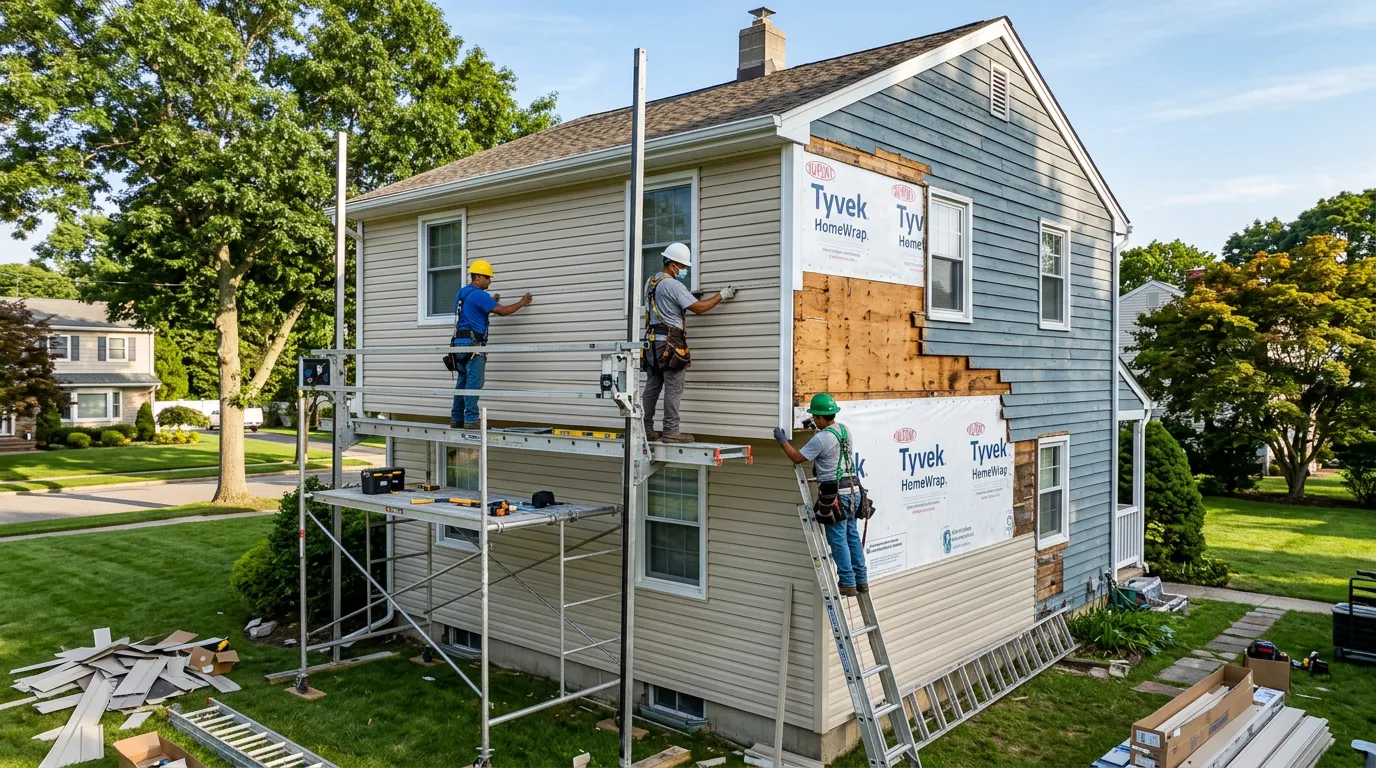
Vinyl siding doesn't fail in July. It fails in January, when a kid's snowball or a sled runner catches a panel wrong and it shatters like glass instead of denting like plastic. Below 40°F, the PVC resin in every panel on your house stiffens up and loses the flex that lets it shrug off a baseball-sized impact in August without a mark.
That changes what "repair" means between November and March here. A cracked panel, a popped J-channel, a corner post ripped loose in a nor'easter, these are real problems and some of them need attention now. But the work itself gets riskier in the cold, and a rushed fix can crack two more panels trying to save one. I've watched a guy snap three replacement pieces trying to snap-lock them into a course at 28°F because nobody warmed the vinyl first.
So the real question for a Long Island homeowner right now isn't whether a siding crew will show up in December. It's which problems are actually urgent and worth doing now, and which ones you patch temporarily and put on the spring schedule, when the material behaves like vinyl again instead of like a cracker.
Why Vinyl Turns Brittle Below 40°F
Vinyl siding is extruded PVC with plasticizers mixed in to keep it flexible. Cold pulls that flexibility out of it. At 70°F a panel will flex two inches under hand pressure and snap back. At 30°F the same panel cracks at a quarter of that flex, and it cracks clean, not with a warning bend. That's why every manufacturer installation guide tells installers to keep panels above 40°F before snapping them into a J-channel, and why a crew that ignores that spec on a cold call ends up breaking more material than they install.
Long Island adds its own wrinkle. We run somewhere around 40 to 50 freeze-thaw cycles a season between Montauk and the Nassau border, which means the siding isn't just cold, it's cycling through expansion and contraction constantly. Panels are engineered to float in their channels for exactly this reason. Nails driven too tight, a common shortcut on cheap installs, don't let that float happen, and the panel cracks at the fastener slot the first hard freeze after a mild stretch.
What You Can Still Fix This Winter
Not everything has to wait. Some jobs are low-risk in cold weather because they don't require flexing large sections of vinyl:
- Re-securing a loose panel that's rattling in the wind, as long as the nail slot isn't already cracked
- Resealing trim and corner posts where caulk has pulled away, exposing sheathing to wind-driven rain
- Replacing a single small panel section using a heat gun to warm the vinyl before it gets handled
- Fixing soffit and fascia damage that's letting cold air or moisture into the attic
- Tarping or temporarily capping storm damage so water doesn't get behind the wall before a proper fix
That heat gun step matters more than most homeowners realize. A contractor who shows up in January and starts snapping panels cold, with no warming step, is going to leave you with more cracked material than you started with. Ask what the plan is for keeping the vinyl workable before you approve a winter call.
What Should Wait for Spring
Full elevation replacement, reclading a whole wall, or any job that requires flexing long, unsupported runs of panel is a spring job on Long Island, not a winter one. You lose working window every time the temperature drops below 40°F mid-install, and a job that should take three days stretches into two weeks of weather delays, with panels sitting half-installed and exposed to whatever the next storm brings.
Color-matching is also harder in winter light, and vinyl that's been sitting in a cold truck bed doesn't seat into J-channel the same way it does off a warm delivery. If your siding is old enough that a full job is coming anyway, get the estimate now, lock the color and material, and schedule the install for April or May when the crew can actually flex panels without babying every cut.
The Nor'easter Test: Wind-Driven Rain and Loose Panels
A nor'easter doesn't just rattle siding, it drives rain sideways under laps that were never designed to handle horizontal water. Once a panel's bottom lock disengages in 50 mph gusts, wind-driven rain gets behind the weather barrier and soaks the sheathing. You won't see it from the street. You'll see it eighteen months later as soft trim or a stain bleeding through drywall on an interior wall.
After any named storm, walk your exterior and look for panels that are sitting slightly open at the bottom edge, not fully locked into the course below. That's the detail that separates cosmetic damage from a moisture problem. If you're dealing with storm damage significant enough to involve your insurance carrier, our insurance restoration team documents it the way adjusters actually want to see it, before you patch anything.
Salt Air, Freeze-Thaw, and the South Shore Problem
Long Island siding takes salt air from three directions, the Sound, the Atlantic, and the Bay, and salt accelerates every failure mode vinyl has. It works into nail slots and J-channels, it speeds up UV breakdown on the south-facing wall, and it combines with freeze-thaw cycling to pop fasteners loose faster than it would happen in an inland climate. Houses in Babylon, Islip, and along the Southampton coastline see this more than homes set back in Smithtown or Huntington, but nobody on the Island is fully exempt from it.
Sandy soil and a high water table on the South Shore also mean more foundation settling over time, which shows up as siding that's slightly out of square at the corners. That's not a winter fix, it's a sign the whole wall assembly needs a look in warmer weather.
Ice Dams, Gutters, and the Siding Connection
Most homeowners don't connect gutter performance to siding damage, but ice dams backing up over a clogged gutter send water directly behind the top course of siding, not just over the edge of the roof. Oak and pine leaf load clogs gutters every fall on this Island, and if nobody cleared them before the first hard freeze, that ice dam is going to find the path of least resistance, which is usually behind your fascia and into the top of your siding. Clearing and checking gutters before winter is cheaper insurance than any siding repair you'll make after the fact.
Permits and Town Rules Before You Touch a Wall
Most single-elevation siding repairs on Long Island don't trigger a permit, but full reclad jobs do in most towns, including Brookhaven, Islip, and the Nassau municipalities, especially if you're changing material type or adding insulated backing. A contractor who tells you no permit is ever needed for a full re-side is cutting a corner you'll pay for at resale, when the buyer's attorney asks for closed permits and there's nothing on file. Ask before you sign anything for a winter repair that might turn into a bigger spring job.
What We Do
We handle both sides of this: the winter-safe spot repairs that stop water intrusion right now, and the full siding replacement scheduled for when the material can actually be worked the way it's supposed to be. We'll tell you straight which one your house needs.
Call (631) 312-7441 or book a free walkthrough.
Frequently Asked Questions
Can vinyl siding be repaired in freezing temperatures on Long Island?
Small repairs can be done in winter if the crew warms the vinyl with a heat gun before handling it, since cold panels crack instead of flexing. Full wall sections or long runs of panel are riskier in the cold and usually better scheduled for spring. Ask any contractor who offers winter siding work exactly how they plan to keep the material workable before you approve the job.
Why did my siding crack after a cold snap with no storm involved?
Vinyl loses most of its flexibility below 40°F, so a panel that was fine all fall can crack from something as minor as a bumped ladder or a kid leaning a bike against the wall. It's also common at nail slots where the panel was fastened too tightly and couldn't float during a freeze-thaw cycle. Either way, a cracked panel should get covered or replaced before wind-driven rain gets behind it.
How do I know if storm damage to my siding is an insurance claim?
If a nor'easter or high wind event knocked panels loose, cracked multiple sections, or exposed sheathing, that's generally worth documenting for your carrier before you touch anything. Photograph the damage immediately and avoid patching it yourself until it's been assessed, since repairs done before documentation can complicate a claim. Our insurance restoration team can walk the damage with you and document it the way adjusters expect.
Does a Long Island town require a permit for siding repair?
Spot repairs and panel replacements generally don't require a permit in most Suffolk and Nassau towns. A full reclad of the house, especially one that changes siding material or adds insulated backing, typically does require one. Check with your specific town, since Brookhaven, Islip, Smithtown, Huntington, Babylon, and the Nassau municipalities each handle this slightly differently.
Why does siding near the water fail faster on Long Island?
Salt air off the Sound, the Atlantic, or the Bay accelerates corrosion on fasteners and speeds up UV breakdown on sun-facing walls, so homes in Babylon, Islip, or along the Southampton coastline tend to show siding wear sooner than homes set further inland. Combined with 40 to 50 freeze-thaw cycles a season, fasteners and J-channels loosen faster near the coast. Regular fastener checks catch this before it turns into cracked panels.
Should I fix my gutters or my siding first this winter?
Clear and secure your gutters first if leaf load from oak and pine trees has them clogged, since a backed-up gutter is what sends ice dam water behind your top siding course in the first place. Fixing siding damage without addressing the gutter problem just means you'll be back out there repairing the same wall next winter. Handle both together when you can, since they're directly connected on most Long Island roof lines.
Related Guides
- Siding Services
- Gutter Services
- Insurance Restoration Services
- Chimney Flashing Leak Repair Long Island
Get a Free Estimate from Alec's Construction
Licensed and insured, working across Nassau and Suffolk County since 2018. We come out, look at the actual job, and put a written number in your hand — no pressure, no obligation.
Book a Free WalkthroughOr call (631) 312-7441