You climb into the attic in late October with a flashlight because there's a brown ring spreading across the ceiling under the skylight, and your first thought is the unit itself is broken. Half the time it isn't. I get calls every fall from homeowners in Bellport, Sayville, and Ronkonkoma convinced their skylight has failed, and when I get up there with a moisture meter, what I find is condensation dripping off the frame, not a break in the flashing.
The other half of the time it's a real leak, and getting the diagnosis wrong costs you either way. Reflash a condensation problem and you've spent money on a roof that was never leaking. Treat a true leak like a humidity issue and you'll have soaked, rotted decking by January. Long Island runs through roughly 40 to 50 freeze-thaw cycles a season, and water that gets under a skylight curb in November has all winter to expand as ice and turn a small gap into a sheathing replacement.
This is the piece I wish every homeowner read before calling a roofer in a panic. How to tell condensation from a true leak, what a proper curb-mount reflash actually involves, and when I tell a client to stop repairing and replace the unit outright.
Condensation or a True Leak? Look at the Pattern
Condensation shows up as a ring or a slow drip directly under the skylight, usually worse on cold, clear mornings after a mild, humid night. It has no relationship to rain or wind. It's common over kitchens and bathrooms, and it's worse where the skylight shaft runs through unfinished attic space with exposed fiberglass batts instead of a sealed, insulated chase.
A true leak follows storms. The stain grows or gets darker during or right after a nor'easter, and it usually starts at a corner of the flashing rather than the center of the glass, because that's where wind-driven rain gets forced sideways under a lapped seam. If your stain lines up with wind direction more than with outdoor temperature, you've got a flashing problem, not a humidity problem.
When I can't tell from the pattern alone, I run a hose test on a still day, starting low at the flashing corners and working up, holding each spot for several minutes before moving on. If nothing shows after ten minutes at the top of the head flashing, the leak isn't there.
Why Long Island Skylights Fail Faster
A skylight on a house in Medford or Holbrook is dealing with more than the skylight itself. Salt air off both the Sound and the Atlantic corrodes aluminum step flashing and pits exposed fasteners faster than you'd see fifty miles inland. Those 40 to 50 freeze-thaw cycles work sealant loose at the curb-to-roof transition every single winter, so a bead of caulk that looked fine in October is cracked by March.
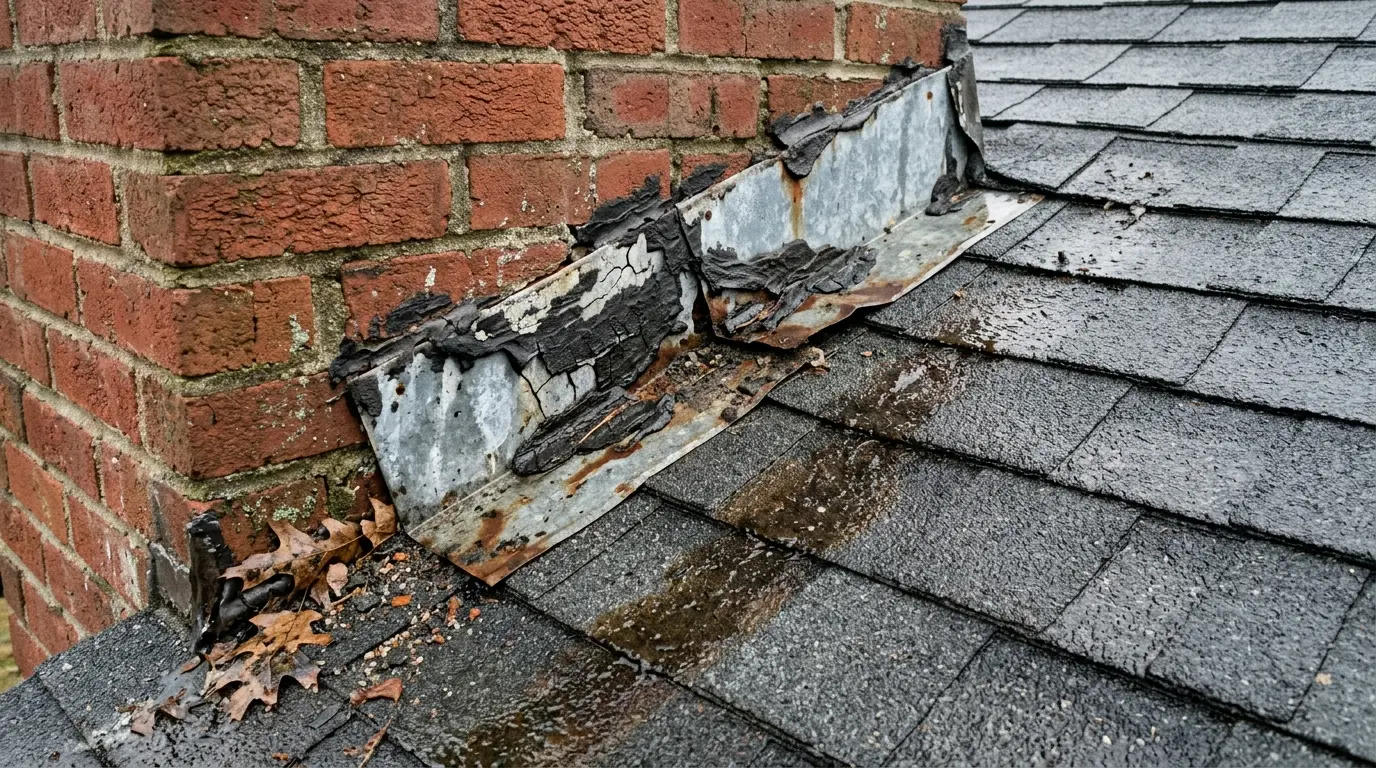
Add oak and pine leaf and needle load in wooded lots around Smithtown and Huntington, and you get debris damming water against the upslope side of the curb instead of letting it shed. That trapped water sits, freezes, and works flashing loose from behind, which is exactly how chimney flashing fails on the same roofs, just a different penetration.
The Curb-Mount Reflash: What Actually Fixes a Leak
A correct curb-mount reflash pulls the surrounding shingles back, installs new ice and water shield membrane up the curb sides and across the head, and rebuilds step flashing and counter flashing in the correct shingle-lap order, not just a bead of sealant over the old metal. I still see prior "repairs" that were a previous contractor running caulk along every seam they could find. That buys a season, maybe two, before the caulk shrinks and cracks and the leak comes back worse because now there's trapped moisture behind hardened sealant that can't dry out.
Done right, this is a half-day to full-day job depending on how the original flashing was tied into the roof deck, and it should include new fasteners since salt-air corrosion is usually why the old ones backed out in the first place.
Deck-Mounted Units and When Reflashing Isn't Enough
Most deck-mounted skylights, the common factory units like Velux, use an integrated flashing kit rather than site-built step flashing. When those leak at the 12 to 15 year mark, it's often not the roof flashing at all, it's the seal between the glass and the frame failing, or the argon seal between panes breaking down and letting the unit fog from the inside. That fogging looks identical to condensation on the surface, but no amount of reflashing touches it, because the moisture is inside a sealed glass unit that has to be replaced.
If you press a probe into the wood curb around a deck-mounted unit and it's soft, that's a different problem again, and it usually means the unit needs to come out entirely so the curb can be rebuilt.
The Attic Side of Condensation
Most condensation calls trace back to warm, moist household air finding the coldest surface in the house, which is the underside of the skylight glass in winter. A bathroom exhaust fan that dumps into the attic instead of outside, a missing vapor barrier around the skylight shaft framing, or general attic air leakage around can lights and top plates all feed humid air up into that shaft. Proper attic air sealing around the shaft and mechanical penetrations solves more "skylight leaks" than any amount of roof work, and it's a fraction of the cost of chasing a leak that was never on the roof.
When Replacement Beats Repair
I stop recommending repair and start recommending replacement when a unit is past 15 to 20 years old and showing fogged glass, when the wood curb has gone soft in more than one spot, when a skylight has already been reflashed twice in under ten years, or when you're already planning a roof replacement, since tying the new skylight flashing into a fresh roof system is far more durable than flashing a new unit into old, brittle shingles around it. If the rough opening needs to grow or shrink to fit a new unit size, that's also a replacement job, not a repair.
Permits and Towns: What to Expect
Across Brookhaven, Islip, Smithtown, Babylon, and the Nassau towns, a straight reflash with no change to the rough opening generally doesn't trigger a permit, but swapping in a new skylight, especially a larger one, does, since you're altering a structural roof opening. In Southampton and other South Shore coastal overlay districts, expect the building department to ask about wind load and water resistance ratings given the proximity to open water and nor'easter exposure. None of this should land on you to sort out. Pulling the right permit for the town is the contractor's job, and if a roofer tells you a full skylight swap doesn't need one, get that in writing before you sign anything.
What We Do
We diagnose the actual cause before we touch a shingle, whether that means a moisture meter and a hose test or a look at your attic ventilation, then we reflash, rebuild a curb, or replace the unit based on what we actually find, not what's easiest to sell. We've been doing this across Nassau and Suffolk since 2018 and we stand behind the work through the winter that follows.
Call (631) 312-7441 or book a free walkthrough.
Frequently Asked Questions
How can I tell if my skylight leak is just condensation?
Condensation shows up on cold, clear mornings regardless of whether it rained, and it's usually worst directly under the glass rather than at a corner. A true leak tracks with storms, especially wind-driven nor'easters, and tends to start at a corner of the flashing. If the stain gets worse during or right after rain, treat it as a leak, not humidity.
Why does my skylight only leak during nor'easters?
Nor'easters push rain sideways instead of straight down, which forces water up under lapped flashing seams that shed water fine in a normal rain. If leaking correlates with wind direction more than rainfall amount, the flashing on the upwind side is the first place to check.
Can I just caulk the flashing myself to stop a leak?
Caulk over failing step flashing usually buys one season at most on Long Island because 40 to 50 freeze-thaw cycles crack sealant faster than it can cure properly. It also traps moisture behind the bead where it can't dry, which often makes the underlying flashing corrode faster than if you'd left it alone.
Do I need a permit to replace a skylight on Long Island?
A straight reflash with no change to the roof opening generally doesn't require a permit in most Suffolk and Nassau towns. Replacing the unit with a different size, or any work that changes the structural opening, typically does, and coastal towns like Southampton may also ask for wind and water resistance documentation.
How long does a curb-mount reflash take?
A properly done reflash, including pulling back surrounding shingles, installing new ice and water shield, and rebuilding step and counter flashing, usually runs a half day to a full day per skylight, depending on how the original flashing was tied into the deck.
Is it better to replace my skylight when I replace my roof?
Yes, if the skylight is already older or has been reflashed more than once. Tying new skylight flashing into a fresh roof system is far more durable than flashing an aging or replacement unit into shingles that are years away from their own replacement.
Related Guides
- Chimney Flashing Leak Repair
- Attic Air Sealing on Long Island
- Roofing Services
- Chimney Repair Cost Guide
Get a Free Estimate from Alec's Construction
Licensed and insured, working across Nassau and Suffolk County since 2018. We come out, look at the actual job, and put a written number in your hand — no pressure, no obligation.
Book a Free WalkthroughOr call (631) 312-7441