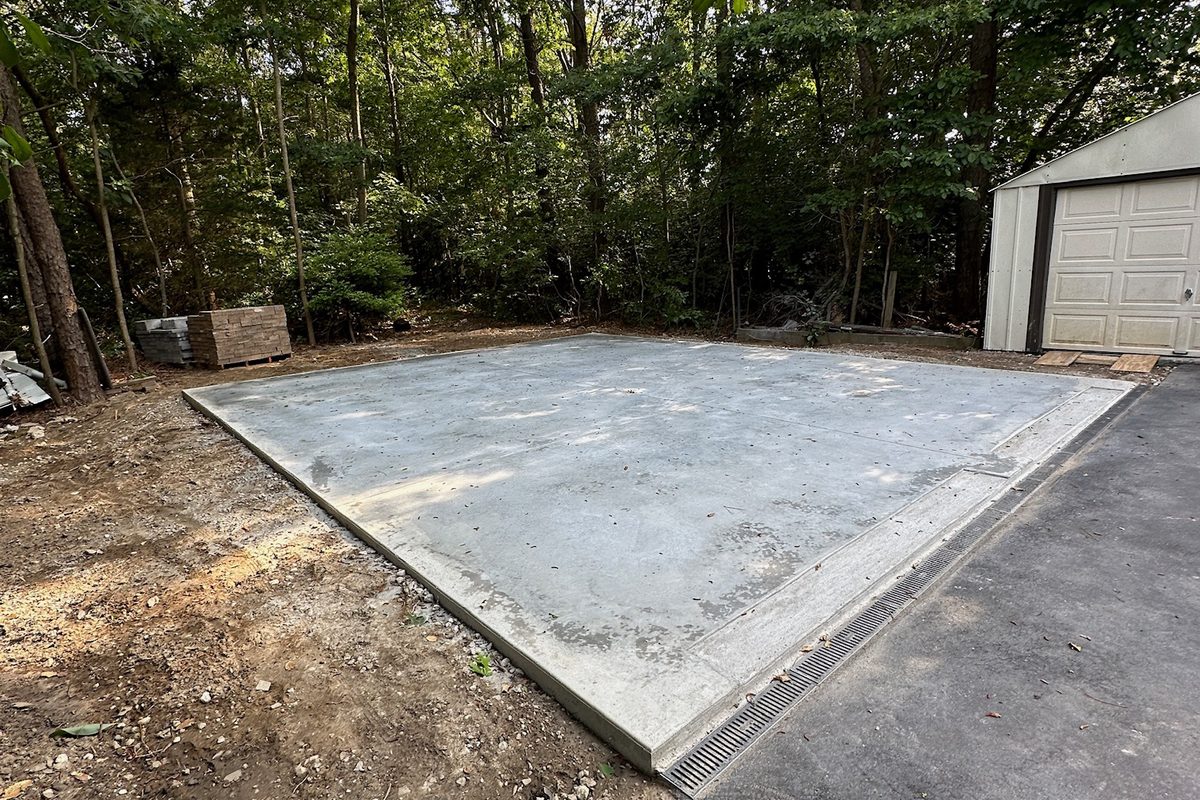
You finally got the go-ahead on a new concrete driveway, a front walk, or a set of steps, and now it is November. The days are still decent, but the nights are dropping into the 30s. The question every homeowner asks at this time of year is a fair one: is it too late to pour?
The honest answer is that concrete can be poured in cold weather, and it is done all the time. What changes is how much care the pour needs, and how much the schedule has to bend around the forecast. A late-fall pour done right lasts as long as a spring pour. A late-fall pour done carelessly can look fine in December and start flaking or cracking by March.
Here is what actually matters, so you can judge whether your project should go now or wait for spring.
What Cold Does to Fresh Concrete
Concrete does not dry, it cures. Water in the mix reacts with the cement and that chemical reaction is what makes it hard. Cold slows that reaction down a lot. A slab that would be firm enough to walk on by the next morning in June can stay soft and weak for much longer in November.
The real danger is freezing. If the water in young concrete freezes before the slab has gained enough early strength, the ice expands inside the paste and damages it. The surface may never reach the strength or durability it should have. That is the slab that scales, pops and powders after its first winter of salt and freeze-thaw.
The industry guideline is simple: once the slab has reached its early strength, it can handle a freeze. Until then, it has to be kept warm. That window is usually measured in days, not hours, and it gets longer the colder it is.
The Ground Matters as Much as the Air
You cannot pour on frozen ground, and you should not pour on a base that is soaked and near freezing. Frozen subgrade thaws later, settles, and leaves the slab bridging a soft spot. On Long Island that is usually less of a problem in November than in January, because our sandy soils drain fast and the ground rarely freezes deep this early. But after a cold snap, the top few inches can still be frozen in shady spots along the north side of a house or under trees.
A good crew checks the base the morning of the pour, not the week before. If there is frost in it, the pour moves.
How a Careful Crew Pours in Cold Weather
None of this is exotic. It is a checklist, and the difference between a good late-season job and a bad one is whether someone actually follows it.
- The right mix. Exterior flatwork on Long Island should be air-entrained, which means tiny air bubbles are built into the concrete so freezing water has room to expand. A cold-weather pour may also use warm mix water or a set accelerator. If the slab has wire mesh or rebar, the accelerator should be a non-chloride type.
- Watching the forecast, not just today. What matters is the next several nights after the pour. A sunny 50 degree day followed by a hard freeze is a worse pour day than a cool, steady week.
- Insulated blankets. Once the finishing is done and the surface can take it, the slab gets covered with curing or insulated blankets to hold in the heat the concrete makes on its own as it cures.
- No water on a cold slab. Finishers should never sprinkle water on the surface to make it easier to work. In cold weather that weakens the top layer, which is exactly the layer that has to survive salt and freeze-thaw.
- Patience before traffic. Foot traffic comes later than it would in summer, and cars come later still. Your contractor should give you specific dates, not a guess.
No Salt, No Sealer Rush
The first winter is the hardest one a slab will ever have. Brand-new concrete should not see rock salt or chemical de-icers during its first season. Use sand for traction instead. Any product containing ammonium nitrate or ammonium sulfate should never touch concrete at any age, because it attacks the concrete chemically.
Sealing is worth doing, but a penetrating sealer generally needs the slab to cure for about a month first, and it has to go on in dry weather above freezing. On a late-November pour that window may not come until spring. That is fine. A properly made, air-entrained slab can go through one winter unsealed if you keep the salt off it. For more on winter care, see our guide to winterizing your patio and driveway.
When It Makes Sense to Wait
Pouring in late fall is a good call when the forecast gives a stable stretch, the job is small enough to finish in one day, and you need it done, for example a walkway to a new door, steps that are unsafe now, or a driveway torn up by another project.
Waiting for spring makes more sense when the job is large, when the site is shaded and wet, or when the forecast keeps flipping. A big driveway poured in a rush between cold fronts is not a bargain. Many homeowners use the winter to settle the design and get on the spring schedule early instead. We wrote about that in how to plan a spring driveway over the winter.
If you are still deciding on material, asphalt vs. concrete on Long Island covers the tradeoffs. Keep in mind that blacktop has its own cutoff, because the hot-mix plants that supply it slow down or close as winter sets in.
What to Ask Before You Sign for a Late-Season Pour
- Will the mix be air-entrained, and what will you do if the nights drop below freezing after the pour?
- Will the slab be covered with blankets, and for how long?
- How will you check the base for frost on pour day?
- When can we walk on it, and when can we drive on it?
- What is the plan if the forecast changes the day before?
A contractor who has clear answers to these is one who has poured in November before.
What We Do
Alec's Construction pours concrete driveways, walkways, patios and steps across Long Island, and we schedule late-season pours around the forecast, not around a calendar. If the weather will not give us a safe window, we will tell you and hold your spot for spring.
Call (631) 312-7441 or book a free walkthrough.
Frequently Asked Questions
What is the lowest temperature you can pour concrete on Long Island?
There is no single cutoff, because what matters is the temperature over the next several days, not just pour day. Concrete can be poured when it is cold as long as the base is not frozen and the slab is protected with blankets and the right mix until it gains early strength. If a hard freeze is forecast right after the pour, it is better to wait.
What happens if fresh concrete freezes?
If the water in young concrete freezes before it has gained early strength, the expanding ice damages the paste from the inside. The slab can end up weaker and more likely to scale or flake at the surface after salt and freeze-thaw. Once it has cured past that early stage, normal freezing does not hurt properly made exterior concrete.
Can I use rock salt on my new concrete driveway this winter?
Not in the first winter. Use sand for traction and shovel early so snow does not pack into ice. Never use de-icers that contain ammonium nitrate or ammonium sulfate on concrete of any age.
Should a new concrete slab be sealed before winter?
A penetrating sealer helps, but the slab generally needs about a month of curing and dry weather above freezing to apply it. On a late-fall pour, sealing usually waits until spring, and a properly air-entrained slab can get through one winter unsealed if salt is kept off it.
How long before I can drive on a concrete driveway poured in November?
Longer than in summer, because cold slows curing. Your contractor should give you specific dates for foot traffic and vehicle traffic based on the mix and the weather after the pour, and those dates can shift if it turns colder than expected.
Is it better to wait until spring for a new driveway?
For a large driveway, a shady wet site, or an unsettled forecast, usually yes. For smaller jobs like a walkway or unsafe steps, a well-protected late-fall pour is fine. A walkthrough now also gets you on the spring schedule early.
Related Guides
- Asphalt vs. Concrete Driveway on Long Island
- Winterize Your Patio and Driveway
- Best Time to Pave a Driveway on Long Island
- Concrete Driveways and Walkways
- Driveways and Concrete Services
Get a Free Estimate from Alec's Construction
Serving homeowners across Long Island. We come out, look at the actual job, and put a written number in your hand — no pressure, no obligation.
Or call (631) 312-7441