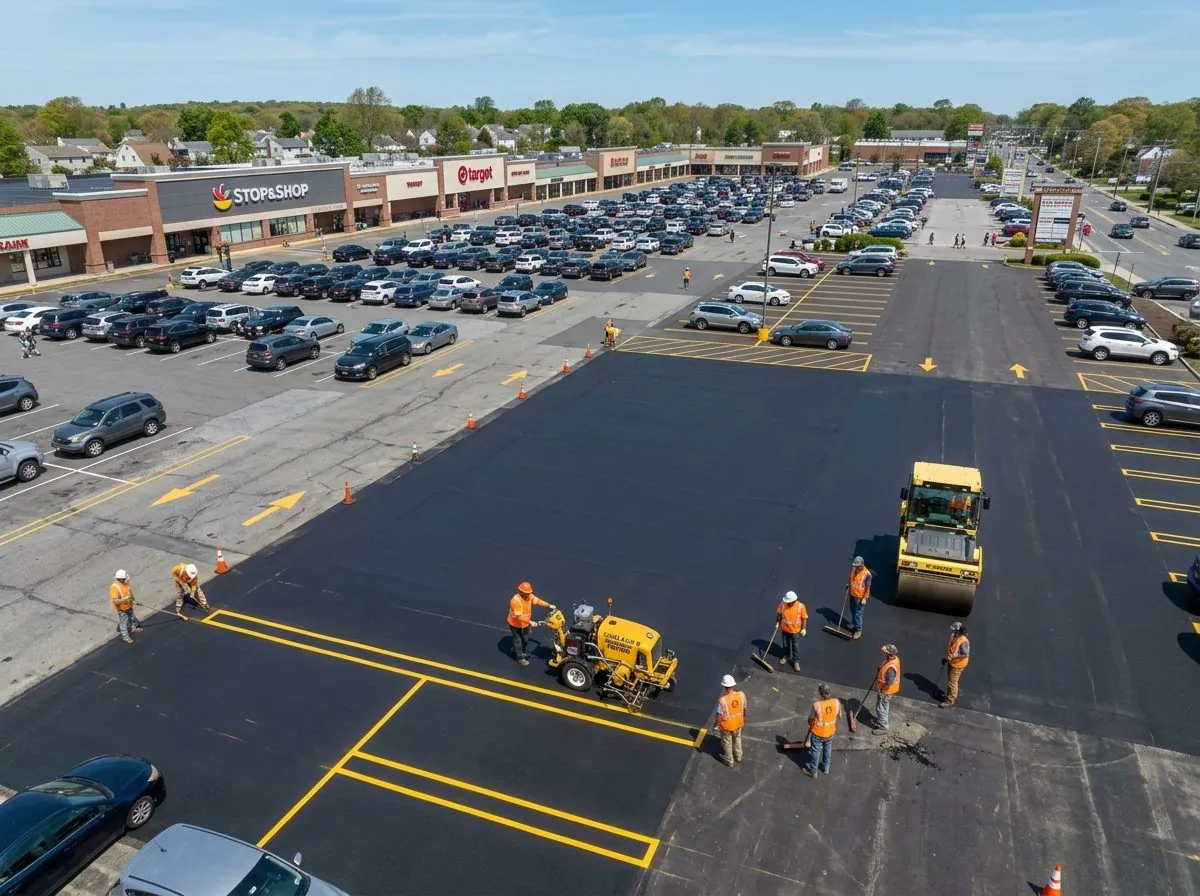
Water is asphalt's worst enemy. When drainage isn't addressed during driveway installation — or when an existing driveway develops drainage problems — the results range from unsightly pooling to accelerated pavement failure to water intrusion near your foundation. Long Island's mix of clay soils, flat terrain in many neighborhoods, and seasonal heavy rainfall makes drainage a genuine concern for homeowners across Nassau and Suffolk County.
Why Drainage Problems Develop on Long Island Driveways
Several factors contribute to driveway drainage issues specific to Long Island. In areas with clay-heavy subsoil — common in parts of Nassau County and northern Suffolk — water doesn't percolate quickly. After heavy rain, it sits. If the driveway wasn't graded with adequate slope to direct runoff away from the structure, water pools on the surface and eventually infiltrates through cracks.
Flat lots compound the problem. Many Long Island neighborhoods were developed on relatively flat terrain, giving water nowhere natural to go. When a driveway is installed without accounting for this, the paved surface can actually funnel water toward the house rather than away from it.
Older driveways that have settled unevenly over time also develop low spots that collect water. What started as a properly graded surface can develop depressions as the base compacts differently under load over the years.
Drainage Solutions That Work
Proper grading during installation. The most effective drainage solution is addressed before the first shovel of asphalt goes down. A properly graded driveway has a 1–2% cross-slope (about 1/8 inch per foot) that directs water to the edges and away from the house. This costs nothing extra when done as part of a new installation; fixing it after the fact is expensive.
Channel drains. A channel drain (also called a trench drain) is a linear drain installed across the width of the driveway, typically at the base near the garage or at the street edge. It captures surface runoff and redirects it to a discharge point. These are especially effective for driveways that slope toward the garage. Channel drains add $500–2,000 to a paving project depending on size and outlet complexity.
Catch basins. For larger driveways or properties with more significant drainage issues, catch basins at low points collect water and direct it to underground drainage pipes. These are more involved to install but provide lasting solutions for serious drainage problems.
Permeable pavers or gravel borders. Adding permeable gravel strips along the edges of an asphalt driveway allows water that reaches the edge to percolate rather than run off. This is increasingly popular in Suffolk County towns with impervious surface restrictions.
If your existing driveway pools water after rain, address drainage before repaving — otherwise you're just laying new asphalt over the same problem.
Related Reading
- Permeable Pavers — infiltrating runoff instead of redirecting it
- Paver Driveways — base depth and drainage design
- Retaining Walls — drainage behind structural walls
Work With Alec's Construction
This guide is written by the crew that does the work. See Alec's Driveways & Blacktop service — asphalt paving, resurfacing and sealcoating. Licensed and insured on Long Island, one crew start to finish, free walkthrough and a written estimate inside 48 hours.
Booking the cold months now: we also handle Masonry & Pavers and Roofing.
We keep a permit office directory for Nassau and Suffolk, checked against each jurisdiction's own site, because we file in these counters constantly.
Ready to Get Started?
Ready to pave? Call Alec's Construction at (631) 312-7441 for a free estimate. We assess drainage as part of every driveway project — Nassau and Suffolk County.
Get a Free Consultation