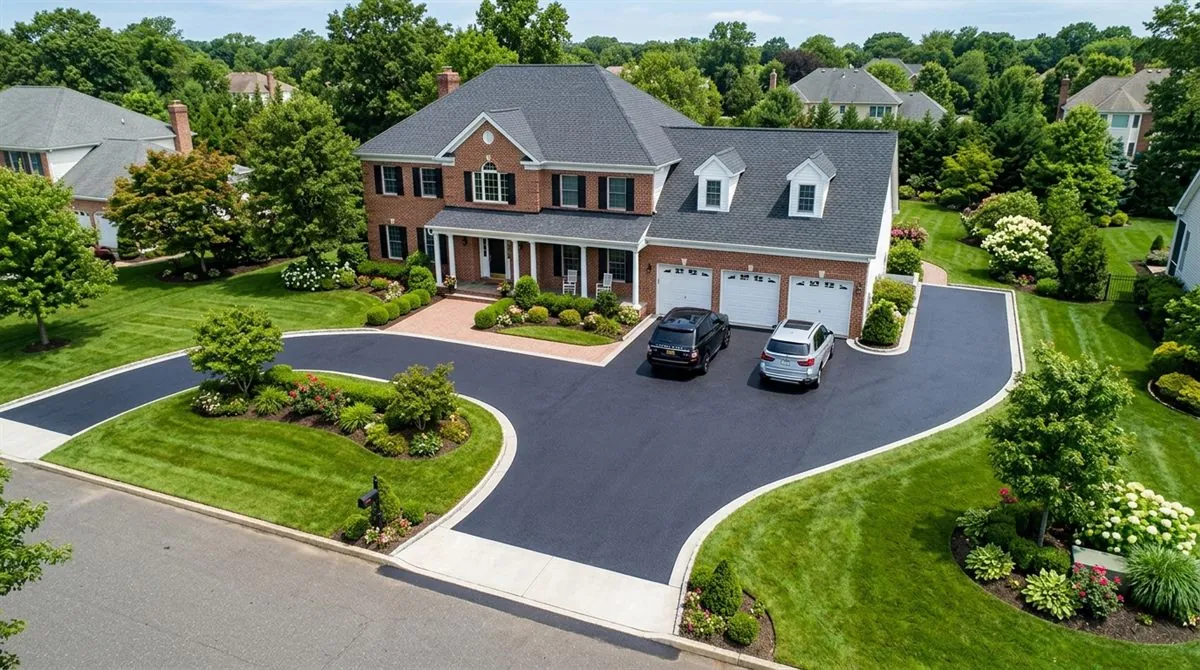
A paver driveway is the most expensive way to surface a driveway on Long Island and, done correctly, the longest lasting and best looking. Whether that trade is worth it depends almost entirely on how long you plan to own the house.
Cost Against the Alternatives
- Asphalt: roughly $6–12 per square foot installed
- Poured concrete: roughly $12–20 per square foot installed
- Pavers: roughly $22–45 per square foot installed
On a typical 800 square foot Long Island driveway: asphalt lands around $5,000–9,500, concrete around $9,500–16,000, pavers around $17,500–36,000. That is a real gap and there is no point pretending otherwise.
Where the Money Comes Back
Lifespan. Asphalt on Long Island typically gives 15 to 20 years with sealing every few years, and it needs resurfacing or replacement at the end of that. A properly built paver driveway should give 30 to 50 years. Over a 40-year horizon you replace the asphalt twice.
Repairability. This is the strongest argument. A settled or stained section of paver driveway gets lifted, corrected and reset with the same units, and the repair is invisible. Asphalt patches are always visible and never match. Concrete cracks are permanent.
Utility access. Long Island homes on cesspools and older water and gas services get dug up eventually. Lifting pavers and putting them back is straightforward. Saw-cutting asphalt or concrete leaves a permanent scar.
Resale presentation. A paver driveway reads as a premium property feature in this market in a way asphalt does not.
Base Depth: Not Optional
This is where paver driveways go wrong. A patio carries people. A driveway carries a vehicle that may weigh 5,000 pounds, concentrated on four contact patches, repeatedly, in the same tracks.
A patio base of six to eight inches of compacted stone is not adequate for a driveway. A driveway needs roughly 10 to 12 inches of compacted crushed stone base in well-draining soil, and more where subsoil is clay-heavy or poorly drained. It should go in and be compacted in lifts, and geotextile fabric between subgrade and base is worth the small cost on most Long Island sites.
The paver units matter as well. Driveway applications call for units of adequate thickness — typically 80mm rather than the 60mm commonly used for patios — and an interlocking pattern. Herringbone is the correct pattern for a driveway, not because it looks better but because the interlock resists the rotational forces of turning tires far better than a running bond does. A running-bond driveway develops creep and ruts in the wheel tracks.
What to Put in the Contract
- Excavation depth and base depth, in inches, written out
- Number of compaction lifts
- Paver thickness — 80mm for driveway areas
- Pattern — herringbone in the drive lanes
- Edge restraint type and how it is secured
- Polymeric jointing sand
- Drainage plan — where water goes, including any channel drain at the garage
- Apron detail at the street and the transition to the town road
The Honest Case Against
Pavers are not right for everyone. If you are selling within five years, you will not recover the premium. If your budget is tight, a properly built asphalt driveway with a good base outperforms a paver driveway on a cheap base every time — do the good version of the cheaper thing rather than the cheap version of the expensive thing.
Snow removal is a fair concern, though usually overstated. Plowing works fine on pavers with the blade shoe set slightly high or with rubber edge protection. Aggressive metal plowing at speed can catch edges. Most Long Island homeowners find it a non-issue.
And permeable interlocking pavers, worth knowing about, can help where a town regulates impervious surface coverage — several Suffolk County jurisdictions do. That can turn a code constraint into an argument for pavers.
Frequently Asked Questions
How long does a paver driveway last on Long Island?
30 to 50 years with an adequate base, versus roughly 15 to 20 for asphalt. Early failures are almost always insufficient base depth rather than the pavers themselves.
Can you plow snow on a paver driveway?
Yes. Set the plow shoe slightly high or use a rubber-edged blade. Properly installed pavers with correct edge restraint handle plowing without issue.
Do paver driveways get weeds?
Polymeric jointing sand largely prevents it. Weeds that do appear are typically seeds landing on the surface rather than growing up through the base, and they pull out easily.
Are paver driveways worth the extra cost?
If you plan to stay 10 years or more, generally yes on lifespan and repairability. If you are selling soon, asphalt is the rational choice.
Related Reading
- How Pavers Are Installed — the base work step by step
- Asphalt vs. Concrete — comparing the two cheaper options
- Permeable Pavers — managing impervious surface limits
- Driveway Drainage — solving water before you pave
- Paver Patterns — why herringbone matters in a driveway
- Driveways and Home Value — what it returns at resale
- Brick Driveway Pavers — clay versus concrete brick, and what each costs
Work With Alec's Construction
This guide is written by the crew that does the work. See Alec's Driveways & Blacktop service — asphalt paving, resurfacing and sealcoating. Licensed and insured on Long Island, one crew start to finish, free walkthrough and a written estimate inside 48 hours.
Booking the cold months now: we also handle Masonry & Pavers and Roofing.
We pull the permits on our own jobs — if you need the building department for your town, we keep a current directory of all 23 Long Island permit offices.
Ready to Get Started?
Comparing driveway options? Call Alec's Construction at (631) 312-7441. We install asphalt and pavers, so we will give you a straight comparison — Nassau and Suffolk County.