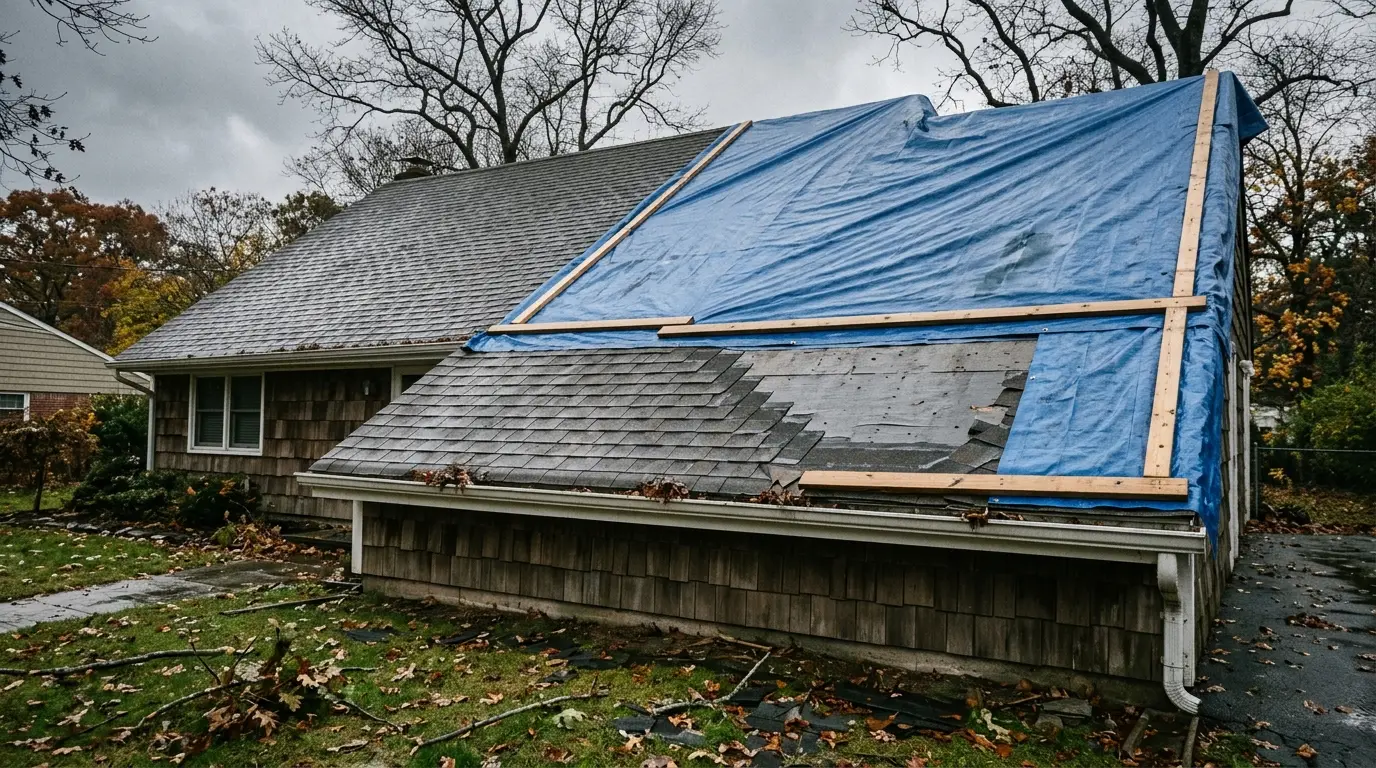
The wind was gusting past 60 miles an hour off the Great South Bay when your ridge cap let go. By morning you've got three tabs missing off the south slope, a soaked patch spreading across the guest room ceiling, and a claims number to call. You call it storm damage. The adjuster who shows up two weeks later, after the backlog clears, calls it "wear consistent with the age of the roof." That's not an accident. It's the standard move, and if you don't understand the difference between wind uplift and age denial before that adjuster gets on your roof, you're going to eat a repair that should have been a covered loss.
I've been doing this since 2018 across Nassau and Suffolk, and every nor'easter season I get the same call. Homeowner is deciding whether it's worth spending money before winter locks in, or whether to just patch it and hope. Here's the honest answer: what you do in the first 48 hours after the wind event decides whether that's your money or the insurance company's. Everything else is secondary.
Wind Uplift vs. "It Was Already Old"
Wind uplift is a specific mechanical failure. Wind doesn't just push on a roof, it creates negative pressure on the leeward side and at the edges and ridge, literally pulling shingles upward until the sealant strip lets go or the nails pull through. You can see it in the pattern: missing shingles cluster at the ridge, the rakes, and the corners, because that's where uplift force concentrates. Age-related failure looks completely different. Granule loss is uniform across the whole slope. Curling happens on shingles that have baked in sun for fifteen-plus years, not on a roof that lost tabs in one specific storm track.
Adjusters know this distinction. Some of them will still write "wear and tear" on a report because a homeowner didn't push back, or because there was no documentation showing the roof was intact before the storm and damaged after. Your job, and mine when we're on the claim with you, is to make the uplift pattern impossible to argue with. That means photos of the specific failure points, not just a wide shot of the hole.
The 48-Hour Window
Every policy on Long Island has some version of a mitigation clause. You're required to prevent further damage once you know about it, and if you don't, the insurer can deny the interior damage even if they accept the roof damage itself. That's the leverage point. Wait five days to get a tarp up because you're calling around for the cheapest bid, and now the water stain that spread across your bedroom ceiling isn't storm damage anymore, it's neglect.
Forty-eight hours is the practical window I work off. Inside that window you want three things done: the roof photographed from the ground and, where it's safe, up close before anything is covered, a temporary tarp installed correctly, not just draped and stapled, and the claim filed with a timestamp that shows you moved fast. Insurers read speed as credibility. A claim filed the same week as the storm with dated photos gets treated differently than one filed three weeks later after someone finally noticed the ceiling stain.
Why the Tarp Job Itself Matters
I see more claims damaged by a bad tarp than by the original storm. A tarp that's stapled straight into open decking creates new penetration points, and when the next system rolls through, water finds those holes and now you've got damage the adjuster can plausibly blame on the repair instead of the storm. A proper emergency tarp gets battened down over furring strips or through the shingle field itself, sealed at the ridge, and extended well past the damaged area on all sides, because wind-driven rain on Long Island doesn't fall straight down, it comes in sideways off the Sound or the Atlantic depending which way the storm tracked.
This is also where emergency roof repair work overlaps with the insurance process directly. We document the tarp installation itself, because a competent temporary repair is evidence you mitigated properly, and that protects the interior claim even if the permanent roof replacement takes weeks to schedule.
What Long Island Winters Actually Do to a Compromised Roof
If you skip the tarp and just hope the missing section holds until spring, understand what you're up against. This region runs 40 to 50 freeze-thaw cycles in a normal winter. Water gets into an exposed nail hole or a lifted shingle edge, freezes overnight, expands, and widens the gap. By February a problem that started as three missing tabs is a soft spot in the decking. Add salt air working the fasteners and flashing on any property within a few miles of the Sound, the bay, or the ocean, and metal components corrode faster than inland homes see, so a flashing detail that's marginal in October is failed by January.
Oak and pine leaf and needle load compounds it. Wet leaf mats sit in valleys and behind chimneys, holding moisture against the deck long after the storm passes, and that's usually where I find the rot when we finally open a roof up. If your chimney flashing is part of the picture, and on older Colonials and Capes across Suffolk it usually is, that joint is worth a separate look, because chimney flashing failures get blamed on the roof and roof leaks get blamed on the chimney, and nobody fixes the actual seam.
Documentation Before We Ever Show Up
Before you call anyone, and definitely before you call your insurer, get this on your phone:
- Wide shots of the whole roof from at least two angles, taken from the ground
- Close-ups of every missing or lifted shingle, with something in frame for scale
- Interior photos of any water intrusion, including the ceiling, walls, and attic if you can safely get up there
- A note of the date and approximate time the damage occurred, tied to the storm
That timeline is what turns a disputed claim into an approved one. Insurance restoration work lives and dies on documentation, and if you want help building a claim file that holds up, that's a core part of what our insurance restoration process does before a single shingle goes back on.
Permits, Towns, and the Repair vs. Replace Call
Once the immediate water intrusion is stopped, the real decision is whether you're patching a section or replacing the whole slope, and that decision runs through your town. Brookhaven, Islip, and Babylon generally treat like-for-like roof repair under a certain scope as exempt from separate permitting, but a full tear-off and re-roof needs a permit in every town I work in, Nassau or Suffolk. Smithtown and Huntington inspectors pay particular attention to ice and water shield coverage at eaves and valleys given how many older homes there were built without it. If your roof is old enough that the storm damage is really just the excuse the insurance company needed to deny a full claim, a full roofing replacement done to current code, with proper underlayment for our freeze-thaw cycle, is usually the better spend than chasing a patch that'll fail again next winter.
What We Do
We handle the whole sequence: emergency tarping within the 48-hour window, full photo and moisture documentation for your claim, direct coordination with your adjuster, and the permitted repair or replacement once the claim is settled. We've done this across Brookhaven, Islip, Smithtown, Huntington, Babylon, and Southampton long enough to know which adjusters push back and how each town's inspector wants the work documented.
Call (631) 312-7441 or book a free walkthrough before the next system rolls through.
Frequently Asked Questions
How can I tell if roof damage is from wind or just an old roof?
Wind uplift shows up in a pattern, missing shingles clustered at the ridge, rakes, and corners where negative pressure concentrates during a storm. Age-related wear looks uniform across the whole slope instead, with even granule loss and curling from years of sun exposure. If the damage lines up with the direction the storm hit, that's evidence for wind, not age.
What happens if I wait too long to tarp my roof after a nor'easter?
Most policies require you to prevent further damage once you know about it. If you wait days to get a temporary tarp up and water keeps getting in, the insurer can point to that delay and deny the interior damage even if they accept the roof damage itself. Moving inside the first 48 hours is what protects the rest of the claim.
Will insurance pay for a full roof replacement or just the damaged section?
That depends on your policy language, the age of the roof, and whether matching shingles are still available for a partial repair. An adjuster will often push for the smallest scope of repair that stops the leak, which is why documenting the actual extent of the uplift damage matters before that conversation happens.
Do I need a town permit for emergency tarping on Long Island?
No, a temporary tarp to stop active water intrusion is considered emergency mitigation and doesn't require a permit in any of the towns we work in. A permit comes into play once you move to the permanent repair or a full tear-off and re-roof.
Does salt air really make roof damage worse near the South Shore?
Yes. Homes within a few miles of the Sound, the bay, or the ocean see faster corrosion on nails, flashing, and any exposed metal, so a fastener or seam that would hold up inland can fail sooner here. Combined with our freeze-thaw cycle, that corrosion often shows up as a leak well before the shingles themselves look worn.
What should I photograph before the insurance adjuster shows up?
Get wide shots of the whole roof from the ground, close-ups of every missing or lifted shingle, and interior photos of any water staining or intrusion, all with a timestamp. That documentation, taken before the tarp goes up and before the adjuster's visit, is what supports a wind claim instead of an age denial.
Related Guides
- Emergency Roof Repair Long Island
- Chimney Flashing Leak Long Island
- Fall Home Maintenance Checklist Long Island
- Insurance Restoration
Get a Free Estimate from Alec's Construction
Licensed and insured, working across Nassau and Suffolk County since 2018. We come out, look at the actual job, and put a written number in your hand — no pressure, no obligation.
Book a Free WalkthroughOr call (631) 312-7441