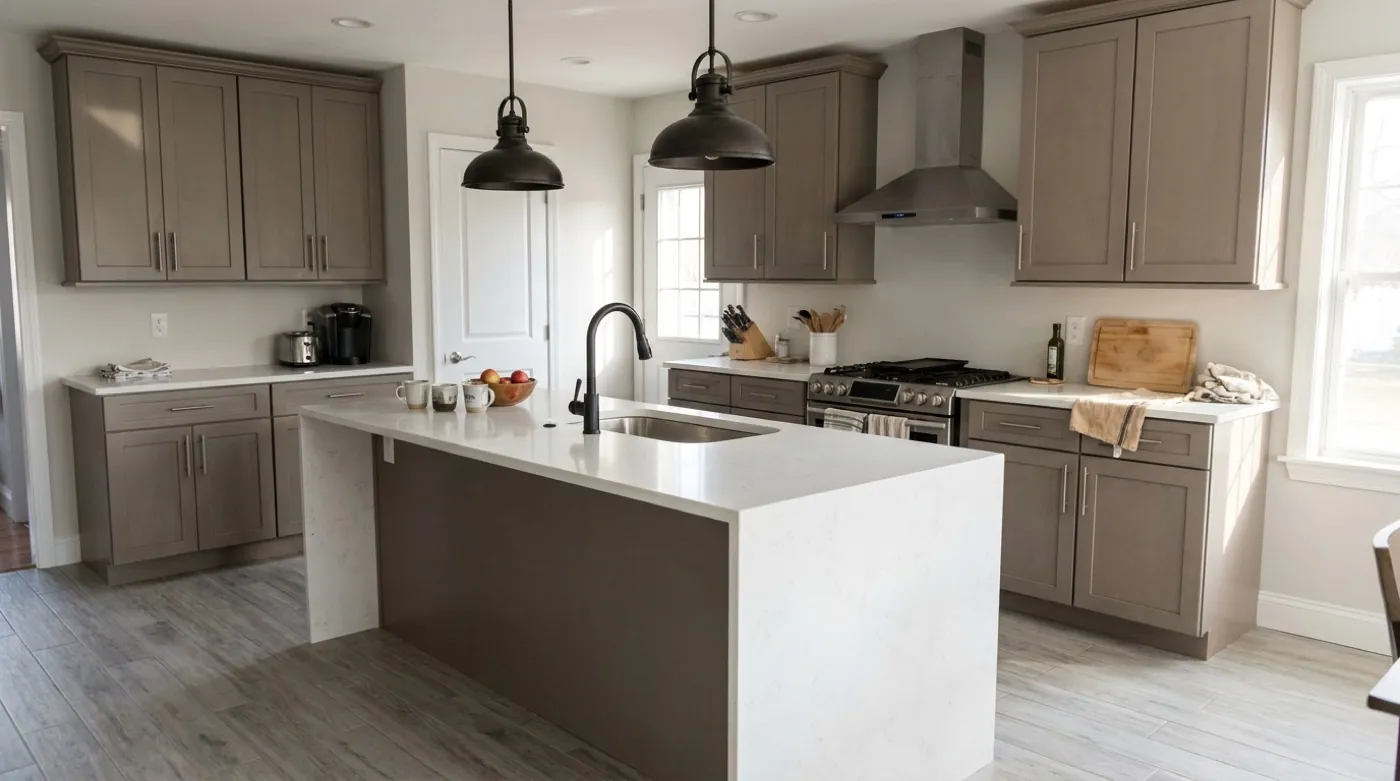
Short version: quartz costs a bit more up front and asks nothing of you afterwards. Granite costs a bit less and wants resealing. Everything else is preference, with one real exception around heat.
The numbers, installed, 2026
- Granite installed: $40 to $100 per square foot.
- Quartz installed: $50 to $120 per square foot.
- Mid-grade quartz: around $85 to $120 per square foot installed.
- Across tiers, granite typically runs $10 to $20 per square foot less than comparable quartz.
- The exception: rare and exotic granites — the dramatic blues and the metallics — can pass $100 per square foot and cost more than mid-range quartz. If you have fallen for an unusual slab, the price gap can invert entirely.
On a typical 45 square foot kitchen the difference between the two is often $500 to $1,000. That is real money, and it is smaller than most people expect — small enough that it should not be the deciding factor.
Quartz
Engineered: crushed quartz bound with resin. Non-porous, which is the whole argument for it.
- No sealing, ever. Nothing to remember, nothing to maintain.
- Non-porous, so red wine, oil and lemon juice do not stain and bacteria do not get in.
- Consistent pattern. What you see in the sample is what arrives. Good if you want predictability, a drawback if you want a slab with character.
- Weaker with heat. The resin is the vulnerability. A pan straight off the burner can mark it. Use a trivet, genuinely.
- Not for outdoor kitchens. UV degrades the resin and it will discolor.
Granite
Quarried stone. Every slab is different, which is either the appeal or the problem depending on the person.
- Handles heat better. Not indestructible, but far more forgiving of a hot pan than quartz.
- Every slab unique. Go to the yard and pick your actual slab — the sample is only an indication.
- Needs sealing, periodically, depending on the stone, the finish, how hard the kitchen is used and the sealer quality. It is a fifteen-minute job, but it is a job, and people forget.
- Porous if the seal lapses. Oil is the real enemy; it darkens the stone and does not come out.
- Fine outdoors, which quartz is not.
How to actually decide
- You cook seriously and put hot pans down without thinking: granite.
- You want to never think about the counter again: quartz.
- You want a specific consistent look, especially a clean white: quartz. A consistent white granite is expensive and hard to find.
- You want the counter to be the feature: granite, and go to the yard to choose the slab.
- Outdoor kitchen or a sunroom with heavy direct sun: granite.
- Rental or a house you are selling within two years: either — buyers on Long Island read both as an upgrade over laminate, and the cheaper of the two is the right answer.
What we use, and why
Our installed kitchens come with quartz. Not because it is better in every way — it is not, granite wins on heat — but because it needs nothing from the homeowner afterwards, and a counter that never gets sealed because life got busy is worse than either material chosen properly.
Our installed kitchens run $20,000 to $30,000 — cabinets, quartz counters, an island, a new sink and the plumbing, demo and haul-away, and labor. Not included: backsplash, appliances, flooring, and handles on most sets. The price works for a specific and finite reason: the cabinet sets came from projects that were cancelled after the cabinets had already been ordered, so they are paid for and sitting in our warehouse. When they are gone the price goes back to market.
Two things worth more than the material choice
The template. Counters cannot be templated until cabinets are installed and level. A rushed template produces gaps at the wall you will look at every day for fifteen years. Ask who templates and when.
The seam placement. On any run over about ten feet there will be a seam. Where it lands is a decision someone makes, and it should be you. Ask to be shown on the drawing before fabrication.
Want a real number on your kitchen?
We measure on site and price it in writing. Free, no obligation, no showroom.
Towns we do kitchens in
We are based in East Patchogue and most of our kitchen work is in Brookhaven and Islip, but we go where the job is. If you are inside an incorporated village, the village building department governs rather than the town.
- Brookhaven — Patchogue, East Patchogue, Medford, Holbrook, Farmingville, Coram, Selden, Bellport, Shirley, Mastic, Centereach
- Islip — Islip, Bay Shore, West Islip, East Islip, Sayville, Bohemia, Oakdale, Brentwood
- Smithtown — Smithtown, Nesconset, Commack, Kings Park, St James, Hauppauge
- Huntington — Huntington, Northport, Dix Hills, Melville, Greenlawn, Huntington Station
- Babylon — Babylon, West Babylon, North Babylon, Lindenhurst, Copiague, Deer Park
- Brookhaven villages — Port Jefferson, Patchogue village, Bellport and Lake Grove run their own building departments
If your town is not on the list, call anyway — the list is where we work most, not a boundary. Anything from Nassau through the Twin Forks is fair game; we tell you honestly if travel makes a small job uneconomical.
Frequently Asked Questions
Is quartz or granite cheaper?
Granite is usually cheaper. Installed granite runs $40 to $100 per square foot against $50 to $120 for quartz, and across tiers granite typically runs $10 to $20 per square foot less. Rare exotic granites are the exception and can cost more than mid-range quartz.
Does quartz need to be sealed?
No. Quartz is non-porous and requires no sealing. Granite is porous and needs resealing periodically depending on the stone, the finish, how heavily the kitchen is used and the quality of the sealer.
Can you put a hot pan on quartz?
You should not. Quartz is bound with resin and a pan straight off the burner can mark it. Granite handles heat considerably better, though neither is indestructible.
Which is better for an outdoor kitchen, quartz or granite?
Granite. UV light degrades the resin in quartz and will discolor it over time, so quartz is not suitable for outdoor use.
What matters more than choosing quartz or granite?
The template and the seam placement. Counters are templated after cabinets are installed and level, and a rushed template leaves gaps at the wall. Ask where the seams will fall and to see it on the drawing before fabrication.
Related Reading
- Kitchen remodel cost — where counters sit in the budget
- What $25,000 buys — quartz included
- What belongs in a quote — including edge profile and template
- Kitchen remodel timeline — the counter fabrication gap
- Kitchen islands — where the seams usually land
Ready to Get Started?
Choosing between quartz and granite? Call Alec's Construction at (631) 312-7441. Tell us how you cook and we will tell you which one you will be happier with in ten years.