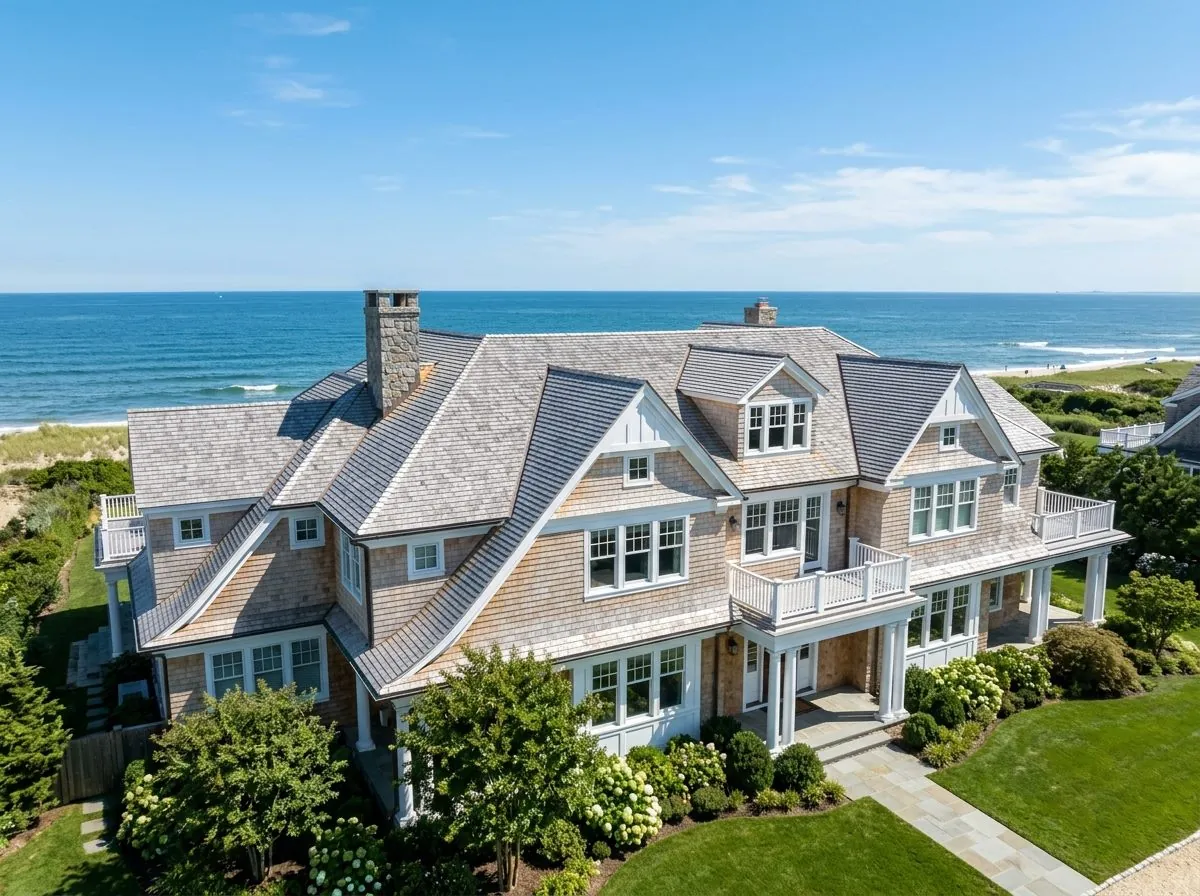
Wantagh is unincorporated Town of Hempstead, running from Sunrise Highway down to the bay and the Wantagh Parkway causeway out to Jones Beach. Everything files with the Town, which keeps the process simpler than the village-heavy parts of Nassau.
The exposure here is unusually direct
South Wantagh has very little between it and open water — the barrier island, then the bay, then your roof. There is no terrain, no elevation and, in the canal sections, not much built environment upwind to break the flow either.
That produces the sustained-wind damage pattern rather than the gust pattern. A nor'easter works the same windward edge for hours, and the failures are consistently at the edges: lifted shingles along the rake and the first course above the eave, ridge cap gone, flashing pulled at the chimney, and gutters torn at the fascia.
The damage you cannot see from the driveway
The one that catches people is a shingle that wind lifted, broke the seal on, and set back down. From the ground the roof looks untouched. The next driving rain goes straight under it.
That is why a post-storm inspection has to be on the roof, not from the lawn or from a drone photo alone. Seal failure is found by hand.
What we spec on an exposed south-shore roof
- Increased fastener count, particularly in the perimeter zones
- Upgraded starter strip, which is what holds the first course down
- Ridge cap rated for the wind speed, not standard three-tab cut into caps
- Ice-and-water shield at eaves, valleys and every penetration
- Balanced intake and exhaust ventilation, with both numbers on the proposal
- Corrosion-resistant hardware within a few blocks of the water
Salt takes the metal, not the shingle
Asphalt shingle is a petroleum product and salt does not degrade it. Drip edge, flashing, fasteners, vent collars and gutter hardware all corrode, and a corroded fastener streaks rust down a new roof before it loses its hold. Upgrading that hardware is a small line item on a job this exposed.
Original 1950s roofs and what is under them
Wantagh capes and ranches from the 1950s frequently have layers. Two, occasionally three, and the weight plus the trapped moisture is a problem in itself. A tear-off to deck is the only way to know what the sheathing is doing, and on a house that has taken sixty years of salt air the answer is worth knowing.
Frequently Asked Questions
My roof looks fine after the storm. Should I still have it checked?
Yes, and it needs to be checked on the roof rather than from the ground. The most common wind damage on an exposed south-shore roof is a shingle that lifted, broke its seal, and set back down — invisible from the driveway, and the next driving rain goes under it. Seal failure is found by hand.
Does salt air shorten my roof's life in Wantagh?
It shortens the metal's life, not the shingle's. Asphalt is unaffected by salt, but drip edge, flashing, fasteners, vent collars and gutter hardware all corrode faster near the water — and a corroded fastener streaks rust down a new roof before it loses its hold.
How long does a roof replacement take?
One to two days for a typical Long Island house. Tear-off and dry-in happen the same day — we never leave a roof open overnight.
Do you work in Nassau County?
Yes. We are based in East Patchogue and work across both Nassau and Suffolk. On Nassau jobs we confirm village versus town jurisdiction from the parcel before quoting, because Nassau has a far higher density of incorporated villages than Suffolk does.
Related Reading
- Storm Damage to Long Island Roofs — what wind actually does
- Roof Ventilation — the thing that quietly kills roofs early
- How Long a Roof Lasts Here — salt, wind and freeze-thaw
- Roofing in Nassau County — the county-wide guide
- Hiring a Roofing Contractor — the questions that separate bids
Also Serving Wantagh
- Storm Damage & Insurance Restoration in Wantagh — emergency tarping and the claim
- Masonry & Pavers in Wantagh — patios, walkways and retaining walls
Work With Alec's Construction
This guide is written by the crew that does the work. See Alec's Roofing service — tear-offs, repairs, flashing and storm damage across Suffolk and Nassau. Licensed and insured on Long Island, one crew start to finish, free walkthrough and a written estimate inside 48 hours.
Booking the cold months now: we also handle Seamless Gutters and Storm Damage & Insurance Restoration.
Filing something yourself? Our Long Island building department directory lists the address, phone and counter hours for all 23 permit offices in Nassau and Suffolk.
Ready to Get Started?
Free roof inspection with photos of what we find and a written scope listing underlayment, ice-and-water coverage and ventilation. Nassau and Suffolk County.