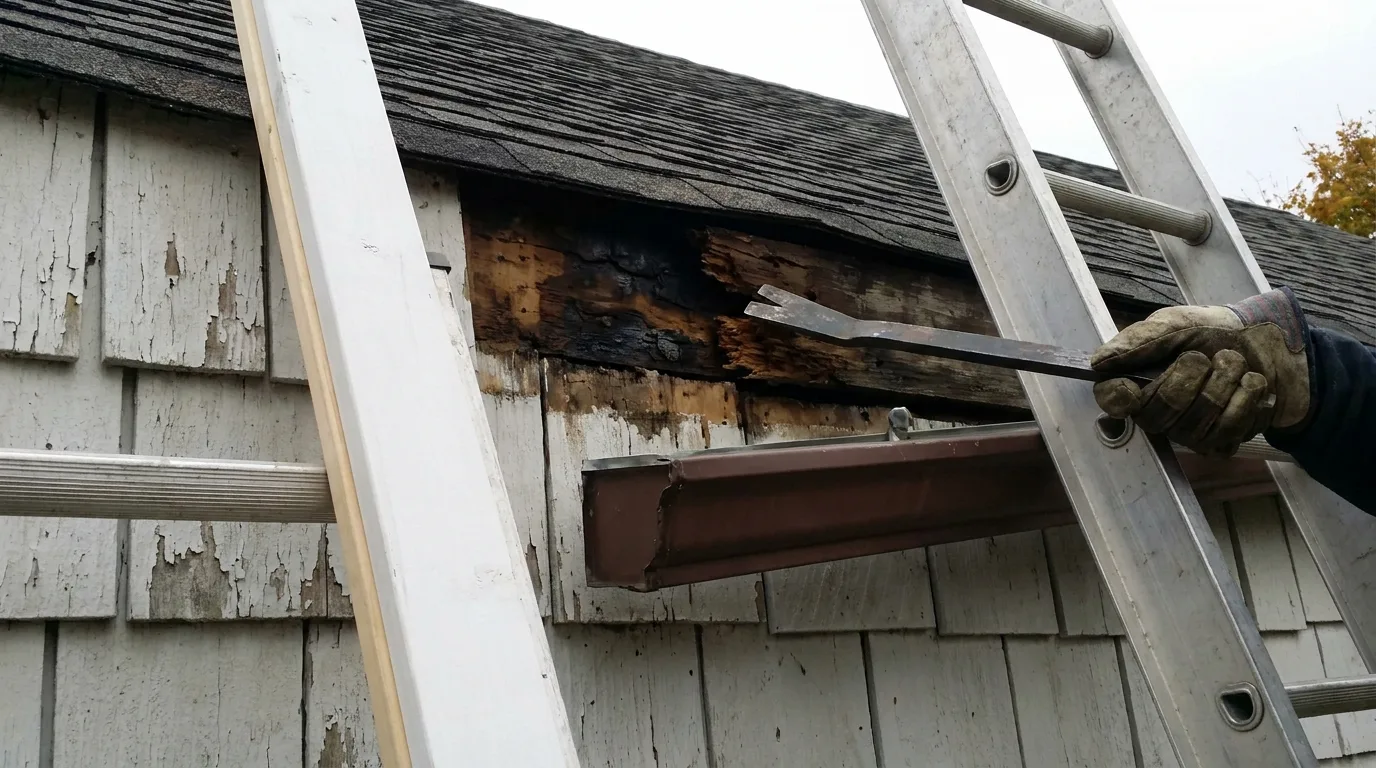
You walk the perimeter of the house before the first nor'easter and you find it. A soft spot on the rake board at the gable end. A corner board that gives when you press a thumb into it. Paint that's bubbled and cracked along the bottom edge of a window casing. This is rotted trim, and on Long Island it is not a cosmetic problem you can put off until spring.
I've pulled enough rotted rake boards off houses from Huntington to Southampton to know the pattern. Trim rot doesn't start as trim rot. It starts as a small gap where caulk failed, or a nail hole that opened up, or flashing that stopped shedding water two winters ago. Water gets behind the board, the board can't dry out between rains, and by the time you see paint failure on the outside, the wood underneath has usually been going soft for a year or more.
The reason this is a fall job and not a spring job is simple physics. Once softened wood takes on water and the temperature drops below freezing, the water inside the fibers expands and splits the wood along the grain. Do that 40 to 50 times in a Long Island winter and a board that was repairable in October is kindling by March. Fix it now and you're doing carpentry. Wait and you're doing demolition.
Why Trim Rots Faster Here Than Almost Anywhere Else
Long Island sits between two bodies of saltwater, so wherever you are, from Bay Shore to Port Jefferson, you're getting salt-laden air pushing corrosion into fasteners and pulling moisture into end grain. Add sandy soil that drains fast at ground level but does nothing for humidity in the air, a high water table on South Shore towns like Babylon and Islip, and oak and pine leaf litter that piles against foundation trim and holds moisture against the wood all fall. Then a nor'easter drives rain sideways into every seam in the siding. Trim on this island takes a beating that trim in a drier inland climate never sees.
Rake Boards Take the Worst of the Weather
The rake board, the trim running up the gable end following the roofline, is usually the first thing to go and the last thing homeowners notice, because you don't look up at it. It's exposed to wind-driven rain from every angle, it sits right under the roof edge where ice can back up, and on a lot of Long Island capes and colonials it butts directly against roof flashing that was never properly counter-flashed. If that flashing detail is bad, water runs behind the rake board every time it rains, no matter how many coats of paint go on the face. We check flashing tie-ins on every rake board repair, and if the roof edge is the actual source, patching the wood alone just buys you another year. Related read, chimney flashing leaks covers the same failure mode on a chimney, and it applies to any trim-to-roof transition.
Corner Boards and the Water Behind Them
Corner boards fail from the bottom up almost every time. Splash-back from grade, a downspout dumping right at the base, or a gutter overflowing during a heavy rain, all of it wicks up into the end grain at the bottom of the board. By the time you see paint lifting six inches up from the ground, the bottom foot of that corner board is often already spongy. If your gutters aren't moving water away from the foundation, you'll be back here in three years no matter what wood we put up. Worth reading, downspout drainage before you spend money on trim if your gutters have been an afterthought.
Window Casing: The One Homeowners Miss
Window casing rots quietly because it's usually caulked, painted, and looks fine from the driveway. The failure point is almost always the same, the bottom horizontal piece, the sill horn, or wherever the casing meets the brick mold at a butt joint. Caulk shrinks and cracks after a few Long Island winters, water gets into that joint, and it sits there because the joint doesn't drain. On older Cape and colonial-style homes from the 50s and 60s common in Smithtown and Huntington, we also find original casing that was never back-primed, so it's been rotting from the inside of the wood outward for decades, invisible until the paint finally can't hold it together.
What Actually Holds Up in a Repair
Not every piece of rot needs a full tear-out. If less than a third of the board's thickness is compromised, we dig out the soft material, let it dry, and consolidate and fill with a two-part epoxy system, then prime and paint. That repair holds for years if it's done right. Past that, we cut the section out and splice in new material, and for anything facing direct weather, we use cellular PVC or a well-primed cedar, not finger-jointed pine, which is what a lot of production-built Long Island houses got the first time around and why so much of this trim is failing at the same age across a neighborhood. If the rot is extensive enough that it's really a siding problem wearing a trim disguise, we'll say so before we start.
A few things that actually matter for longevity here: - Back-prime every cut end before it goes up, since end grain is where water gets in first - Use stainless or hot-dip galvanized fasteners, not electro-galvanized, because salt air eats the finish off cheap nails in a few seasons - Seal the top of every board, not just the face, since that's where water sits longest - Match the flashing detail to the actual water path, not just the old caulk line
Permits and Town Rules
Straight trim replacement, like-for-like, is generally maintenance and doesn't trigger a permit in most Suffolk and Nassau towns. Where it changes is if you're altering the profile, adding exterior foam behind new trim that changes wall thickness, or the repair is part of a larger siding job. Brookhaven, Islip, and Southampton each handle exterior alteration permits a little differently, and Southampton in particular has stricter review if you're anywhere near a historic district or the coastal zone. We pull the permit when the scope calls for one. We don't skip it to save you a step, because an open violation is a worse problem at closing than the rot ever was.
What We Do
We repair and replace rotted rake boards, corner boards, and window casing across Suffolk and Nassau County, matching material to exposure instead of defaulting to whatever's cheapest, and we check the flashing and drainage detail behind every board before we close it up, because trim that fails again in two years isn't a repair, it's a delay.
Call (631) 312-7441 or book a free walkthrough before the freeze sets in.
Frequently Asked Questions
How do I know if my trim is rotted or just needs paint?
Press a screwdriver or your thumb into the wood at the bottom edge and any seams. If it gives, feels spongy, or the screwdriver sinks in without much resistance, it's rot, not just peeling paint. Surface paint failure with solid wood underneath is a repaint. Soft wood underneath means the board itself is compromised.
Can rotted trim wait until spring?
Not on Long Island. Once wood is holding moisture, freeze-thaw cycles through the winter split the fibers and turn a patchable board into one that needs full replacement. Fall repair, before temperatures drop below freezing regularly, is almost always less work and less material than the same repair in April.
Do you match the original wood or use something different?
Depends on exposure. For trim facing direct weather, south and west-facing rakes and corner boards especially, we typically move to cellular PVC or a well-primed, back-primed cedar rather than replacing pine with pine. Areas more protected from direct rain can go back to properly primed wood to match the house.
Will you need to open up my siding to fix corner boards or window casing?
Sometimes, especially if the rot has traveled behind the board into the sheathing or house wrap. We check for that before quoting, because patching visible trim over hidden rot just hides the problem for another season. If the damage is contained to the trim piece itself, we can usually replace it without disturbing the siding around it.
Do I need a permit to replace rotted trim?
Straight like-for-like replacement is generally maintenance and doesn't require a permit in most Suffolk and Nassau towns. It changes if you're altering the trim profile, tying the repair into a larger siding job, or working in a district with stricter exterior review, like parts of Southampton. We'll tell you upfront if your job needs one.
What causes trim to rot in the same spot over and over?
Almost always a water source that was never fixed, bad flashing at a roof-to-wall transition, a gutter dumping at the base of a corner board, or a caulk joint that keeps failing. Replacing the wood without fixing that source just resets the clock on the same failure.
Related Guides
- Downspout Drainage on Long Island
- Chimney Flashing Leaks Explained
- Attic Air Sealing Before Winter
- Siding Services
Get a Free Estimate from Alec's Construction
Licensed and insured, working across Nassau and Suffolk County since 2018. We come out, look at the actual job, and put a written number in your hand — no pressure, no obligation.
Book a Free WalkthroughOr call (631) 312-7441