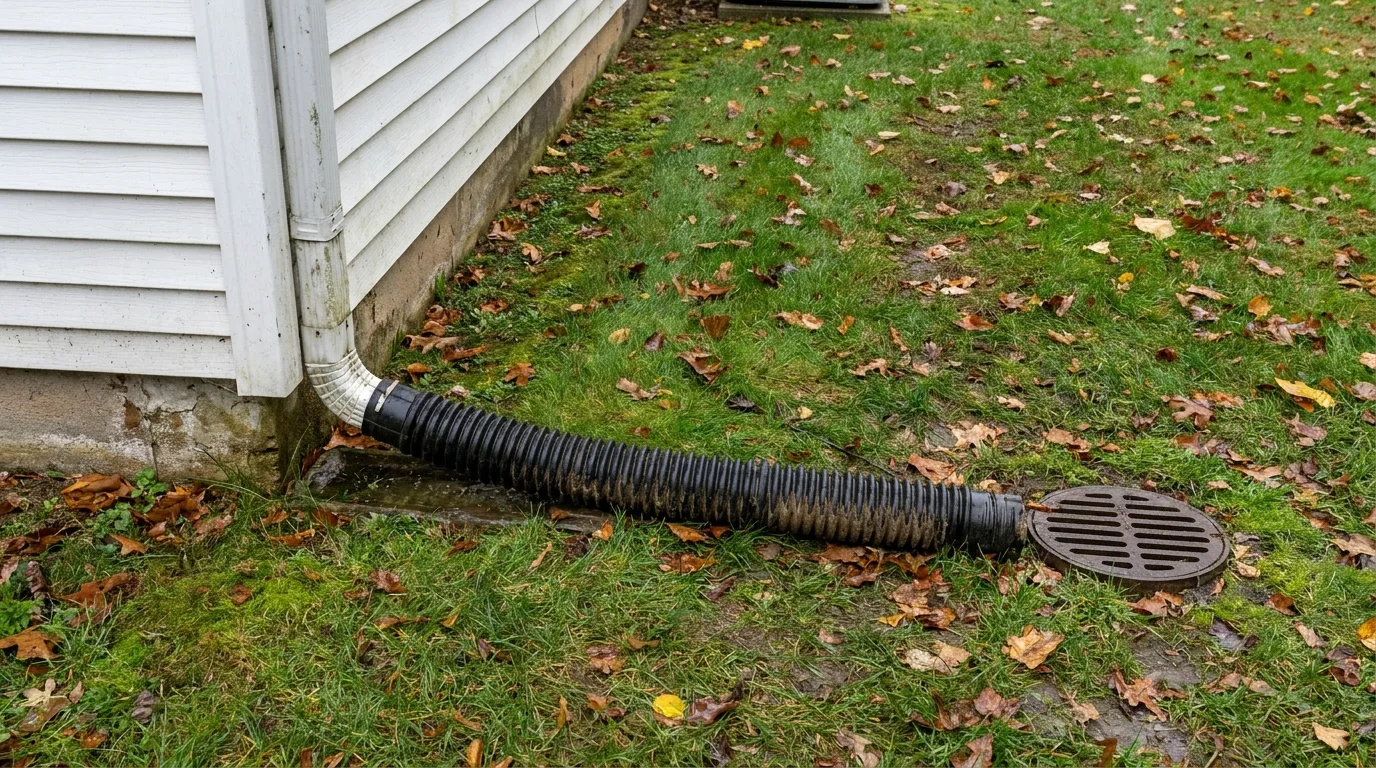
A gutter's job is not to catch water. It is to move water somewhere it cannot hurt the house. Most Long Island gutter systems do the first half of that correctly and the second half not at all.
Here is the number that makes the point. One inch of rain on a 2,000 square foot roof is about 1,250 gallons of water. A single decent Long Island nor'easter drops three inches. That is roughly 3,700 gallons, and if your downspouts end in splash blocks, all of it lands within three feet of your foundation over the course of a few hours.
That is the entire mechanism behind most wet Long Island basements. Not a foundation crack, not a high water table — the gutters, working correctly, delivering thousands of gallons directly to the wall.
The Splash Block Problem
A splash block spreads the discharge over about eighteen inches so it does not dig a hole in the mulch. That is all it does. The water still soaks into the ground directly against the foundation, saturates the backfill, and then finds the cold joint, the tie holes or the block cores.
The backfill soil around a foundation is looser than undisturbed ground — it was dug out and put back. Water follows the path of least resistance, which is straight down that loose ring and against the wall. Contractors call it the bathtub effect and it is why a house can have a perfectly sound foundation and a wet basement every spring.
Discharge needs to be a minimum of six feet from the foundation, and ten is better. On a low-slope lot it needs to go further than that or into something.
Your Four Real Options
1. Above-ground extensions. Corrugated flex pipe or rigid aluminum, six to ten feet from the house, sloped to fall. Cheapest real fix at $75 to $200 per downspout. Downsides: you have to move them to mow, they get kicked and disconnected, and they are visible. Still enormously better than a splash block.
2. Buried solid PVC to daylight. Four-inch solid PVC — not corrugated, which silts up and cannot be cleaned — buried on a slope and discharging at a low point of the property or into a curb outfall where allowed. This is the best answer on any lot with grade to work with, which covers most of the North Shore and anywhere with a real slope. Clean-outs at the elbows so it can be rodded if it ever blocks.
3. Drywells. A buried perforated chamber surrounded by stone that holds the surge and lets it percolate into the soil. This is the right answer on a flat lot with nowhere to daylight to, which describes a great deal of the South Shore. Long Island's sandy soil percolates well, which is exactly why drywells work here better than they do in most of the country. Sized to the roof area feeding them — a single 4-foot chamber does not handle a 2,000 square foot roof; that is the most common way a drywell "fails". Budget $900 to $2,500 installed.
4. Rain gardens and grading. A shallow planted depression that takes the discharge and lets it soak in over hours. Works on the right lot, looks better than a grate, and handles smaller roof areas well.
The Cesspool Mistake
This one is specific to Long Island and we find it constantly in Medford, Farmingville, Coram, Holbrook and Ronkonkoma.
Most of Suffolk County is on cesspools and septic systems rather than sewers. A downspout that discharges over the leach field or the cesspool ring is loading thousands of gallons of clean rainwater into a system sized only for household waste water. It saturates the field, destroys its ability to accept effluent, and can push a system into failure years early. A cesspool replacement is $5,000 to $15,000 and up.
Before routing any downspout, know where the system is. If you do not, the Suffolk County Department of Health Services has records for most properties, and any competent contractor will ask.
Where the Downspouts Should Be in the First Place
Drainage starts with the gutter, not the pipe. One downspout for every 30 to 35 feet of run. More on steep roofs, more on large drainage areas.
The recurring Long Island defect is the long back gutter — 45 or 50 feet of run on the rear of a colonial with a single 2x3 downspout at one end. That downspout is the bottleneck, so the gutter backs up and overflows in the middle of the run in any real storm, and no amount of cleaning or guarding fixes it. Adding a second outlet does.
Upsizing helps too. A 3x4 downspout carries a bit over twice what a 2x3 does and is far less likely to clog, because the shingle grit and pine needles that jam a 2x3 pass straight through it.
Where Water Goes on Different Long Island Lots
High-water-table South Shore — Lindenhurst, West Islip, South Merrick, Massapequa, Bellport, Shirley toward the bay. The water table is close to the surface and drywells have less depth to work with. Carrying discharge well out toward the street or a low corner usually beats trying to infiltrate near the house.
North Shore slopes — Huntington, Northport, Port Jefferson, Smithtown. Grade is your friend: buried PVC to daylight works well. The caution is not sending it onto a neighbour's property or into a slope you will then undermine.
Flat inland Suffolk — Medford, Farmingville, Coram, Holbrook, Ronkonkoma. Sandy soil percolates beautifully and drywells work as well here as anywhere in the country. Just keep them clear of the cesspool field.
Nassau village lots — Garden City, Merrick, Syosset. Tight lots, short distances to the property line, and drainage that has to be handled without pushing water at the neighbour. Drywells and buried runs to the street are the usual answer, and some villages have rules about discharge — worth a call before you dig.
Winter Detail Worth Knowing
Buried lines and extensions should have positive fall the whole way, because water standing in a line freezes, and a frozen line backs the whole downspout up. In a January thaw-and-refreeze cycle, that ice column can split a downspout seam. Clean-outs let you clear it; corrugated pipe buried flat with a low spot is where the trouble starts.
The Sequence That Works
- Size the gutter for the roof and the pitch
- Put in enough downspouts, 30 to 35 feet apart
- Upsize to 3x4 where the run or the roof demands it
- Get every discharge at least six feet from the foundation, ten if you can
- On a flat lot with no daylight, size a drywell to the roof area feeding it
- Keep everything clear of the cesspool or septic field
- Make sure the grade within six feet of the house falls away from it
Nothing on that list is exotic. It is just the half of the job that gets skipped.
Licensed, Insured, Local
Alec's Construction Inc., Barton Avenue, East Patchogue. Suffolk County Home Improvement License HI-68303. We do the excavation, the drywells and the buried lines as well as the gutters, which is the point — the water problem does not stop at the downspout elbow.
Call (631) 312-7441 or see the gutter service page.
Frequently Asked Questions
How far from the house should a downspout discharge?
Six feet minimum, ten is better, and further on a flat or low-slope lot. A splash block spreads the water over about eighteen inches and does nothing to move it away from the foundation.
How much water comes off a Long Island roof?
About 1,250 gallons per inch of rain on a 2,000 square foot roof. A three-inch nor'easter puts roughly 3,700 gallons through your gutters, and with splash blocks all of it lands within three feet of the foundation.
Do drywells work on Long Island?
Yes — sandy Long Island soil percolates well, so drywells work here better than in most of the country. The common failure is undersizing: a single small chamber cannot take the surge from a large roof. Size it to the roof area actually feeding it.
Can I run my downspouts into my cesspool or over the leach field?
No. It loads thousands of gallons of rainwater into a system sized only for household waste water, saturates the field and can cause early failure — a $5,000 to $15,000 replacement. We find this mistake regularly in Medford, Farmingville, Coram and Holbrook.
Should buried downspout lines be corrugated or solid PVC?
Solid four-inch PVC with clean-outs at the elbows. Corrugated pipe silts up in the valleys of the corrugation and cannot be cleaned out properly.
Why does my basement get wet even though my foundation looks fine?
Usually roof water. The backfill around a foundation is looser than undisturbed soil, so water discharged at the wall runs straight down that ring and finds the cold joint or the block cores. Moving the discharge away from the house fixes more wet basements on Long Island than waterproofing does.
How many downspouts does my house need?
One for every 30 to 35 feet of gutter run, and more on steep roofs or large drainage areas. A 45-foot back gutter with one downspout at the end will overflow in the middle of the run no matter how clean it is.
Related Guides
- Seamless Gutters on Long Island
- What Gutter Installation Costs on Long Island
- Are Gutter Guards Worth It on Long Island?
- Gutter Repair or Replacement
- Fascia and Soffit Repair on Long Island
Get a Free Estimate from Alec's Construction
Licensed and insured, working across Nassau and Suffolk County since 2018. We come out, look at the actual job, and put a written number in your hand — no pressure, no obligation.
Book a Free WalkthroughOr call (631) 312-7441