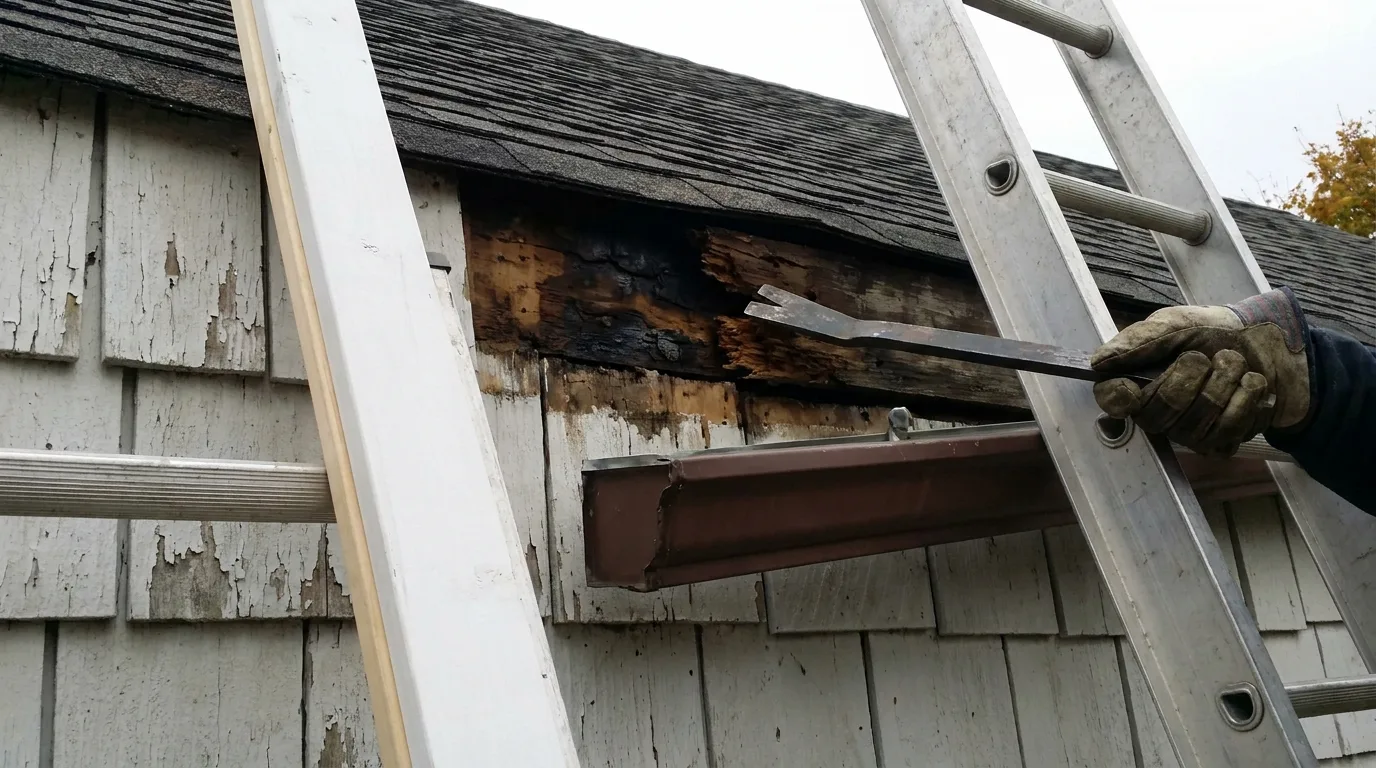
Walk the perimeter of your house this week and look up at the soffit, the flat panel that closes the gap under your roof overhang. If you see brown-black staining running down from behind the gutter, or a panel that flexes when you press it with a knuckle, that is not cosmetic. That is water that has been sitting there for at least one full season, probably two.
Here is the sequence I see on almost every soffit call on Long Island. The gutter clogs or pulls away from the fascia, water backs up instead of draining off the roof, and it starts wicking into the wood behind and above the gutter line. The soffit sits right there catching runoff every time it rains or the snow melts. By the time the paint is bubbling or the plywood has gone soft, the soffit did not fail on its own. The gutter failed first, and the soffit kept absorbing the overflow until it gave out.
Once that soffit rots or gets packed with wet leaf debris, the vent holes running through it close off too. Those holes are how your attic breathes in winter, pulling cold air in low and pushing warm, moist air out high. Block them with rot, old paint, or a squirrel nest, and you have set up the exact conditions that grow an ice dam along your eave the next time we get a real cold snap.
The Ice Dam Connection Nobody Explains Right
A properly vented attic stays close to outdoor temperature. Snow sits on the roof and melts slowly, from the sun, same as it does on the ground. A poorly vented attic runs warm because heat leaking up from the living space has nowhere to go. That warm roof deck melts the snow layer touching it, the meltwater runs down to the cold overhang past your exterior wall line, and it refreezes right at the eave. That ridge of ice is the dam. Every storm after that backs water up under your shingles instead of letting it run off, and it finds the nail holes, the soffit seams, and the top plate of your wall.
We get roughly 40 to 50 freeze-thaw cycles a winter out here, and every one of them is another chance for that trapped water to expand, contract, and work a gap wider. A house with blocked soffit venting and a marginal attic air seal will grow ice dams two or three times a season, not once. If you have not had your insulation and bypasses looked at, it is worth reading up on attic air sealing and attic ventilation balance alongside any soffit work, because fixing the soffit without fixing the intake-to-exhaust ratio just moves the problem.
What Rotted Soffit Actually Looks Like Up Close
On a ladder, rotted soffit rarely looks dramatic from the ground. Up close it is different. Aluminum panels look fine but the wood fascia behind them is spongy when you push a screwdriver into it. Wood tongue-and-groove soffit has swollen and separated at the joints, and the vent slots are caked with a black paste of pollen, pine needles, and mildew instead of open air. I have pulled soffit panels and found paper wasp nests built into the vent cavity and, on older Cape and colonial homes near wooded lots in Smithtown and Huntington, active squirrel access where the fascia rotted enough to give them a doorway into the attic. Once an animal gets in, the insulation underneath gets packed down and useless, on top of the ventilation problem.
Long Island Piles On Top of the Basic Problem
Three sides of this Island get salt air, and it does not skip your soffit. Aluminum fasteners and the drip edge behind the gutter corrode faster here than they would forty miles inland, which loosens the gutter's grip on the fascia and accelerates exactly the overflow-then-rot cycle described above. Oak and pine together mean two separate leaf seasons dumping into your gutters, oak holding on stubborn and wet into December, pine needles running year-round and packing into gutter screens tighter than broad leaves do. A nor'easter with sideways rain will drive water up and under a soffit that a straight-down rain would never reach, which is why houses that seemed fine after a normal storm show staining after the first real coastal blow. From Babylon and Islip through Brookhaven and out toward Southampton, and up into the Nassau towns, I see the same pattern on homes within a mile or two of water or heavy tree cover: gutter neglect first, soffit rot second, ice dam third.
Fixing It Right, Not Just Covering It
A real soffit repair is not snapping a new aluminum panel over rotted wood and calling it done. We pull the damaged material back to solid wood, check the fascia and the first foot of roof sheathing behind it for hidden rot, and replace anything soft. Then we reset the gutter with proper pitch and secure it to sound fascia, because a soffit repair that ignores the gutter that caused the damage just buys you a few more years before the same spot fails again. New soffit goes in vented, matched to your intake needs relative to your ridge or gable exhaust, not just whatever profile matches the old panel. On roofs where the whole eave assembly is compromised, we coordinate the soffit and fascia work with the roofing scope so flashing, drip edge, and venting get addressed together instead of three separate trips.
Permits and Inspections Across the Towns
Most straightforward soffit and fascia replacement on an existing single-family home does not trigger a separate building permit in Brookhaven, Islip, or Babylon when it is a like-for-like repair with no structural change. Smithtown and Huntington tend to ask more questions if the scope creeps into fascia framing or if it is bundled with a full re-roof, and Southampton, being coastal and often within FEMA flood zones near the water, can require documentation even for exterior work that looks minor elsewhere. Nassau towns vary building department to building department. We pull the permit ourselves when the job needs one and tell you upfront if it does not, rather than guessing after the fact.
What We Do
We inspect the soffit, the fascia behind it, the gutter causing the damage, and your attic venting as one system, then give you a straight repair scope instead of a panel swap that ignores why it failed.
Call (631) 312-7441 or book a free walkthrough.
Frequently Asked Questions
How do I know if my soffit problem is causing ice dams, or the other way around?
Blocked soffit vents choke off the fresh air your attic needs to stay cold in winter, which grows ice dams. Rotted soffit is usually a symptom of a gutter that has been overflowing onto it for a season or more. Both problems feed each other, so we check the vent path and the gutter condition on the same visit rather than treating them separately.
Can I just replace the soffit panels myself without touching the gutter?
You can, but if the gutter is still pitched wrong or pulling away from the fascia, the new soffit will start staining again within a season or two. The gutter is almost always the source, not the soffit itself.
Do squirrels or wasps getting into rotted soffit mean I have bigger problems?
Usually yes. If an animal found a way in through soft wood, the insulation directly behind that spot is likely compressed or contaminated, and there may be more rot along the same run than what is visible from the ground. We check further than just the entry point.
Will new vented soffit fix an ice dam by itself?
Not on its own. Vented soffit only helps if the attic actually has a clear path for that air to reach ridge or gable exhaust vents, and if the attic floor is properly air sealed so heat from the house is not warming the roof deck from underneath. We look at intake, exhaust, and air sealing together.
Does salt air really make a difference for soffit and gutter fasteners?
On homes within a few miles of the Sound or the South Shore, yes, noticeably. Aluminum fasteners and gutter hangers corrode faster there than on inland Long Island homes, which loosens gutters sooner and accelerates the overflow-and-rot cycle at the soffit.
When is the latest I can get this done before winter really sets in?
Soffit and fascia repair is exterior carpentry, so we need dry, above-freezing conditions to do it properly. Late fall is workable most years, but once we are into a stretch of hard freezes the wood and caulking will not perform, so earlier is better than later if you are already seeing staining.
Related Guides
Get a Free Estimate from Alec's Construction
Licensed and insured, working across Nassau and Suffolk County since 2018. We come out, look at the actual job, and put a written number in your hand — no pressure, no obligation.
Book a Free WalkthroughOr call (631) 312-7441