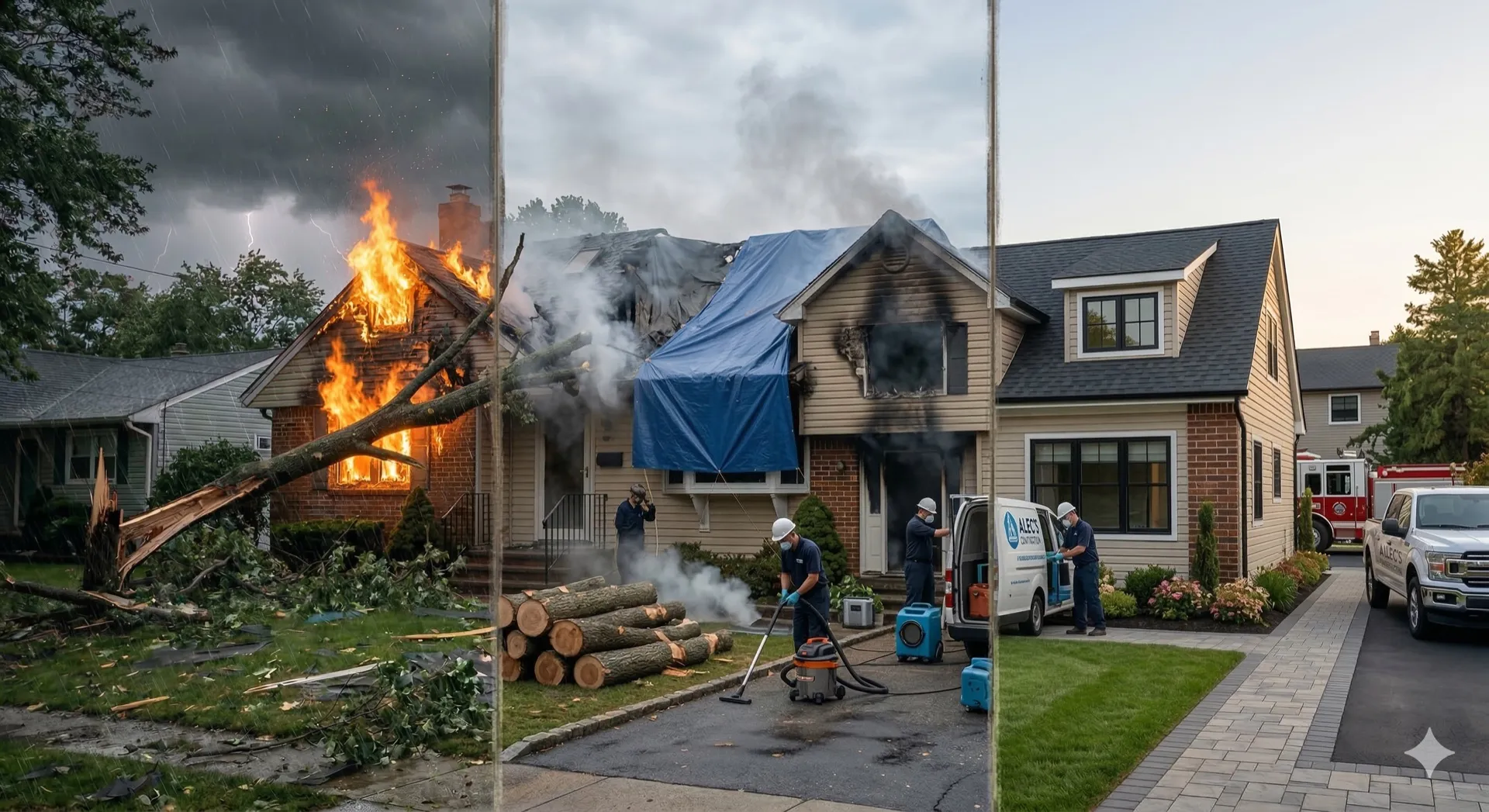
Every fall I get calls from homeowners in Bellport, Sayville, and Islip who watched a nor'easter strip shingles off a slope and figure the insurance company will just cut a check. It doesn't work that way. Adjusters here handle a stack of claims after every big storm, and on Long Island that stack is thick. We run roughly 40 to 50 freeze-thaw cycles a season on top of nor'easters that come in off the Atlantic with sideways rain, and salt air working on three sides of every roof, not just the ocean-facing side. An adjuster who has looked at five hundred roofs this month is not going to climb up and study yours for twenty minutes.
What actually happens is the adjuster walks the perimeter, or more often stands on the ground with binoculars or flies a drone, takes a set of reference photos, and checks what they see against a wind and hail damage checklist. If your own documentation doesn't already show what they're not looking hard for, that money is gone, not on appeal, not on a supplement later, gone. I've stood on roofs I built and roofs I didn't during these walkthroughs, and the pattern holds every time: the claim gets paid based on what's visible and provable in the first fifteen minutes on site.
Here's what I tell every homeowner deciding whether it's worth documenting damage before winter locks in: what the adjuster is actually scoring, what to photograph before anyone touches the roof, and where the supplement conversation falls apart.
What the Adjuster Is Actually Looking For
Every insurer works off a version of the same checklist for wind and hail claims: creased or lifted shingle tabs, missing tabs, granule loss in a random hail pattern versus a straight wind-line tear, exposed nail heads, torn ridge cap, and bent or bruised soft metal like flashing and gutter caps. The adjuster's job on site is to separate storm damage from ordinary wear, because insurers deny wear-and-tear claims outright. On Long Island that line gets blurry fast. Salt air corrodes fasteners and degrades shingle sealant strips years before a roof would show that wear inland, so an adjuster who doesn't work this coast regularly can mistake corrosion-driven granule loss for age and write the claim down low. Oak and pine litter is another factor, a roof that's been holding wet leaf mat in the valleys all fall already has soft, discolored decking before the storm even hits, and that gets used against you as a pre-existing condition.
Photograph Before You Touch Anything
Do this the morning after the storm, before you tarp anything, before a contractor climbs up, before you rake debris off the lawn. Use your phone, shoot in daylight, and let the date stamp save.
- Wide shots of every slope from the ground, all four sides of the house, so the adjuster sees the full field of damage and not one cherry-picked angle
- Close-up shots of every crease, torn tab, and bald spot with something for scale, a tape measure or a quarter laid next to it
- The valleys, ridge line, and rake edges, where wind uplift on a nor'easter starts and where adjusters check first
- Chimney flashing, counter-flashing, step flashing, and any crickets before they get bent back into place
- Gutters and downspouts, including any granule buildup inside the gutter, which proves recent shingle damage rather than old wear
- Debris on the ground, broken branches, shingle pieces, ridge cap fragments, dated and left in place until photographed
- The attic underside, especially rafters and sheathing near any spot where you see daylight or staining, shot with a flashlight the same day
How Wind and Hail Get Scored on a Long Island Roof
Nor'easters don't hit like a straight-line derecho. The wind rotates over hours, so it works an eave from one direction in the morning and the opposite rake by afternoon, and that's why adjusters check both rake edges and the ridge before anything else, uplift there tells them the storm had real force on your specific roof and not just heavy rain. A roof under fifteen years old with architectural shingles reads differently than an older three-tab roof, the older roof's sealant strips are already brittle from UV and salt exposure, so wind separates tabs more easily and adjusters know it. That's not automatically bad for your claim, but it means the estimate written on site tends to lowball material grade, assuming a patch job instead of a full match. If your roof is more than ten years old, say so and get it on the record, because match-ability affects the whole scope.
The Supplement Fight, Where Homeowners Leave Money on the Table
The first insurance estimate is written from what's visible without opening the roof. The supplement is the second claim you file once a contractor tears off the damaged section and finds what was underneath, usually saturated insulation, rotted decking, or a code requirement the original estimate never priced. On Long Island, the single biggest supplement fight is ice and water shield. Current code in most Suffolk and Nassau towns requires ice and water membrane extended well past the exterior wall line to handle our freeze-thaw ice damming, and a lot of older roofs were built before that requirement existed. When you replace storm-damaged sections, code says you bring that area up to current code, and insurers know this and often leave it off the first check. That gap has to be filed as a supplement citing the specific code section, with photos of the exposed decking showing the water damage pattern. The other common miss is decking replacement percentage, adjusters approve spot replacement of a few sheets, a contractor pulling shingles finds soft plywood across a wider field, and that difference has to be documented sheet by sheet, not estimated after the fact.
Flashing, Chimneys, and the Damage Adjusters Miss
Flashing is the number one item that gets under-scored on a ground-level or drone inspection, because you cannot see corrosion or a hairline separation in step flashing from thirty feet. Salt air here eats galvanized flashing faster than almost anywhere inland, and a storm that peels back a shingle course will also flex flashing that was already thinning. If your chimney has any history of moisture, get it looked at as part of this claim, not after, because a chimney flashing leak that goes unclaimed now becomes an out-of-pocket repair in February when the ice dam finds it. I'd rather write it into the same claim while the storm date is still the documented cause.
Gutters and the Secondary Damage Claim
A storm that damages your roof usually damages your gutters and fascia the same afternoon, torn hangers, dented runs, and fascia boards exposed to water once a gutter pulls away. That's a legitimate part of the same claim if you photograph it before repairs. On the South Shore towns, Babylon, Islip, and parts of Southampton, the high water table means a compromised downspout doesn't just overflow, it pushes water back toward the foundation, so get your downspout and drainage system checked at the same time you're documenting roof damage. If the storm exposed soffit or fascia rot that had been building for a season under oak and pine leaf load, say so in the same claim rather than letting it sit as a separate homeowner expense.
Timing It Before Winter
Every week you wait after a storm, freeze-thaw cycles work against your documentation. Water gets into a crease today, freezes tonight, expands, and by the third or fourth cycle that crease looks like older wear, which gives the adjuster room to argue pre-existing damage. Permitting adds real time too, Brookhaven, Islip, Smithtown, Huntington, Babylon, and the Nassau towns all require a permit for a reroof or any structural repair, and that review queue gets long once everyone's calling contractors after the same storm. File the claim and start photographing immediately, then let the permit and scheduling timeline run in parallel instead of waiting to start it after approval comes through.
What We Do
We walk the roof with you, document what the adjuster's photos missed, and handle the supplement paperwork directly with your insurer so you're not negotiating code requirements against an adjuster alone. That's the whole job on an insurance restoration claim, get you paid for what the storm actually did, not what a fifteen-minute inspection caught.
Call (631) 312-7441 or book a free walkthrough before the next nor'easter finds what this one missed.
Frequently Asked Questions
How long do I have to file a storm damage claim on Long Island?
Check your policy's declarations page, most carriers give a set window after the date of loss, often measured in months, not weeks. File as soon as you've photographed the damage rather than waiting, since freeze-thaw cycles change how the roof looks within days. Waiting also pushes you into the busiest permit and scheduling season if everyone in your town filed after the same storm.
Will my insurance rates go up if I file a storm claim?
Weather-related claims are generally underwritten differently than at-fault claims like a car accident, but this varies by carrier and by how many claims you've filed recently. Ask your agent directly before you decide not to file, because eating storm damage out of pocket to protect a rate that may not move is often the wrong trade. A licensed contractor helping you document the claim doesn't change how the insurer classifies it.
What is a supplement claim and when do I need one?
A supplement is a follow-up claim filed after your contractor opens the roof and finds damage or code requirements the original adjuster's estimate didn't account for, like rotted decking under a shingle course or an ice and water shield extension required by current code. It has to be documented with photos and, where relevant, the specific code citation. Most storm claims on older Long Island roofs end up needing at least one supplement.
Do I need a permit for storm damage roof repair in Suffolk or Nassau County?
Yes, Brookhaven, Islip, Smithtown, Huntington, Babylon, Southampton, and the Nassau towns all require a permit for a reroof or any structural repair beyond a small patch. Permit review time varies by town and gets longer right after a widespread storm event. Filing your claim and starting the permit process at the same time keeps the project moving instead of adding the permit wait after approval.
Can I choose my own contractor instead of the insurer's preferred vendor?
Yes, the choice of contractor is yours, insurers cannot require you to use a specific vendor from their preferred list. A local contractor who knows how adjusters here read storm damage and who understands town-specific permit requirements is usually better positioned to fight for a fair supplement. Get a second opinion if a preferred vendor's estimate looks thin compared to what you're seeing on the roof.
What if the adjuster's estimate doesn't match what my roof actually needs?
That gap is exactly what the supplement process exists for, an initial estimate is written from a ground-level or drone inspection and isn't the final word. Document the discrepancy with photos, tie any code-required upgrades to the specific local code section, and submit it as a supplement rather than accepting the first number. Most adjusters expect a supplement on an older roof and won't push back if the documentation is solid.
Related Guides
- Chimney Flashing Leak Repair on Long Island
- Fascia and Soffit Repair on Long Island
- Downspout and Drainage Systems on Long Island
- Insurance Restoration Services
Get a Free Estimate from Alec's Construction
Licensed and insured, working across Nassau and Suffolk County since 2018. We come out, look at the actual job, and put a written number in your hand — no pressure, no obligation.
Book a Free WalkthroughOr call (631) 312-7441