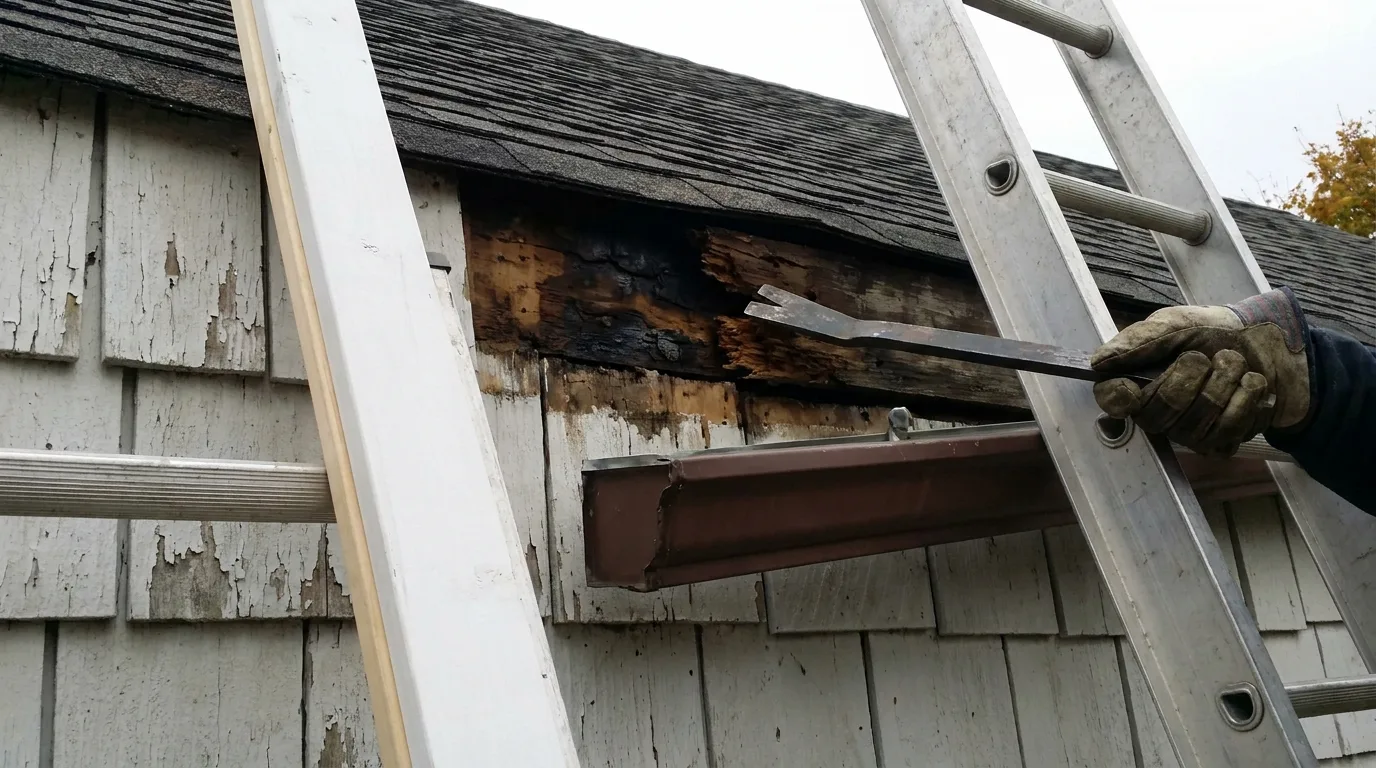
Fascia is the flat board at the roof edge that the gutter hangs on. Soffit is the underside of the overhang, running from the fascia back to the wall. Together they close the roof edge, carry the gutter, and — through the soffit vents — feed the entire attic ventilation system.
They are also the first thing on a Long Island house to rot, because they are the first thing that overflowing gutters touch.
How It Starts
The chain is always the same:
Gutters clog or are undersized, water backs up and spills over the back edge of the gutter instead of the front, and lands directly on the fascia. Or there is no drip edge at the roof edge, so water wicks backward under the shingle and runs down the face of the fascia behind the gutter, where nobody ever sees it.
Either way the board stays wet. Paint fails, the wood absorbs, and on Long Island it then goes through freeze-thaw about sixty times a winter. Within a few seasons the fascia is soft, and once the fascia goes, the soffit and eventually the rafter tails follow.
By the time it is visible from the ground, it has usually been going on for three or four years.
The Aluminum Wrapping Problem
Somewhere on Long Island right now, someone is being sold aluminum capping over rotted fascia.
Wrapping is legitimate work — a coil-stock aluminum cap bent to the fascia profile, over sound wood, eliminates painting forever. Done correctly it is a good product.
Done over soft wood it is a disaster, and it is common. The rot continues underneath, invisible, and it accelerates, because the aluminum traps moisture against the wood and stops it drying. The gutter hangers are screwed through the cap into wood that no longer holds a screw. Two or three years later the gutter starts pulling off a house that looks perfect from the street, and when the cap comes off there is nothing behind it.
Anything being wrapped has to be probed first. If a contractor is quoting wrapping without checking the wood, that is the whole review of that contractor.
What Replacement Actually Involves
- Gutter comes down
- Fascia probed along the full run; every soft section marked
- Rotted sections cut back to sound wood at a rafter tail, not mid-span
- Rafter tails inspected — if the tail itself is soft, it gets sistered before anything is fastened to it
- New fascia let in, primed on all six sides including the cut ends before it goes up
- Drip edge / gutter apron installed or corrected so water cannot get behind the new board
- Soffit repaired and venting confirmed clear
- Gutter re-hung on hidden hangers into solid wood
Priming the back and the cut ends matters more than it sounds. Most replacement fascia on Long Island is installed primed on the face only, and it starts absorbing from the back within a year.
Cost runs roughly $18 to $40 per linear foot including paint, more on a two or three-story elevation where staging is needed.
Material Choices
Primed pine is the traditional and cheapest option and it is fine, if it is fully primed and kept painted. On Long Island that means repainting the roof edge every seven to ten years and sooner near the water.
PVC trim boards — Azek and similar — do not rot, ever. They cost more, they expand and contract more than wood so they need correct fastening and spacing, and they hold paint well but do not need it. On a house that has already rotted its fascia once, on the north elevation, or anywhere near salt water, PVC is usually the right decision.
Cedar is appropriate on North Shore and East End houses where the trim is cedar, and it has real rot resistance, but it is not immune and it still wants paint or stain.
Soffit Venting: The Part That Connects to Everything Else
This is where fascia and soffit stop being carpentry and become building science.
Attic ventilation on Long Island works on intake at the soffit and exhaust at the ridge. Cold air enters low through the soffit vents, runs up the underside of the roof deck, and leaves at the ridge, carrying heat and moisture with it. That airflow keeps the roof deck cold in winter and vents summer heat.
Break the intake and the whole system stops. Three ways it gets broken on Long Island houses, all of them common:
- Insulation stuffed into the eave, blocking the vent channel — happens on nearly every attic that has ever been re-insulated without baffles
- Solid aluminum soffit installed over the old vented soffit during a siding job, with no perforated panel
- Soffit vents painted over so many times the perforations have closed
The consequences are exactly the two problems Long Island homeowners complain about every winter. Without intake air, warm attic air melts snow on the roof deck; the meltwater runs to the cold eave and refreezes into an ice dam. And without airflow, moisture from the house condenses on the underside of the sheathing, which is the frost you see on rafters in January and the black mould some people find in March.
So when we open a soffit to repair rot, we check the venting, because it is free to check and expensive to ignore.
Why This Is a Gutter Article
Because fascia is what your gutters hang on, and there is no useful way to separate the two. A gutter quote that does not mention the condition of the fascia is a quote to hang new aluminum on unknown wood.
We are a licensed general contractor, so cutting out rot, sistering a rafter tail, correcting drip edge and re-vending a soffit are all in scope — and then the gutter goes on last, onto something solid.
Suffolk County Home Improvement License HI-68303, general liability and workers compensation, certificates on request. Alec's Construction Inc., Barton Avenue, East Patchogue.
Call (631) 312-7441, or see the gutter service page and our roofing service.
Frequently Asked Questions
How much does fascia replacement cost on Long Island?
Roughly $18 to $40 per linear foot including paint, and more on two and three-story elevations where staging is required. The range depends on height, how much of the run is soft, and whether rafter tails also need sistering.
Can you wrap fascia in aluminum instead of replacing it?
Only over sound wood. Capping rotted fascia traps moisture against it and accelerates the rot invisibly, and the gutter hangers end up screwed into wood that cannot hold them. Anything being wrapped should be probed first.
What causes fascia to rot on Long Island houses?
Overflowing or clogged gutters spilling over the back edge onto the board, or a missing drip edge letting water wick backward under the shingle and run down the fascia behind the gutter. Then sixty freeze-thaw cycles a winter finish it.
Should I use PVC or wood fascia?
PVC trim does not rot and is usually the right choice on a house that has already rotted its fascia once, on north elevations, and near salt water. Primed pine is fine if it is primed on all six sides and repainted every seven to ten years.
Why does blocked soffit venting matter?
Attic ventilation depends on intake at the soffit and exhaust at the ridge. Block the intake — with insulation, solid aluminum soffit or painted-over vents — and you get ice dams in winter and condensation on the underside of the roof sheathing.
Do rafter tails need to be replaced if the fascia is rotted?
Sometimes. If the rot reached back into the tail, it gets sistered before anything is fastened to it. Fastening new fascia to a soft tail just moves the failure a few inches back.
Related Guides
- Seamless Gutters on Long Island
- What Gutter Installation Costs on Long Island
- Are Gutter Guards Worth It on Long Island?
- Gutter Repair or Replacement
- Downspouts and Drainage on Long Island
Get a Free Estimate from Alec's Construction
Licensed and insured, working across Nassau and Suffolk County since 2018. We come out, look at the actual job, and put a written number in your hand — no pressure, no obligation.
Book a Free WalkthroughOr call (631) 312-7441