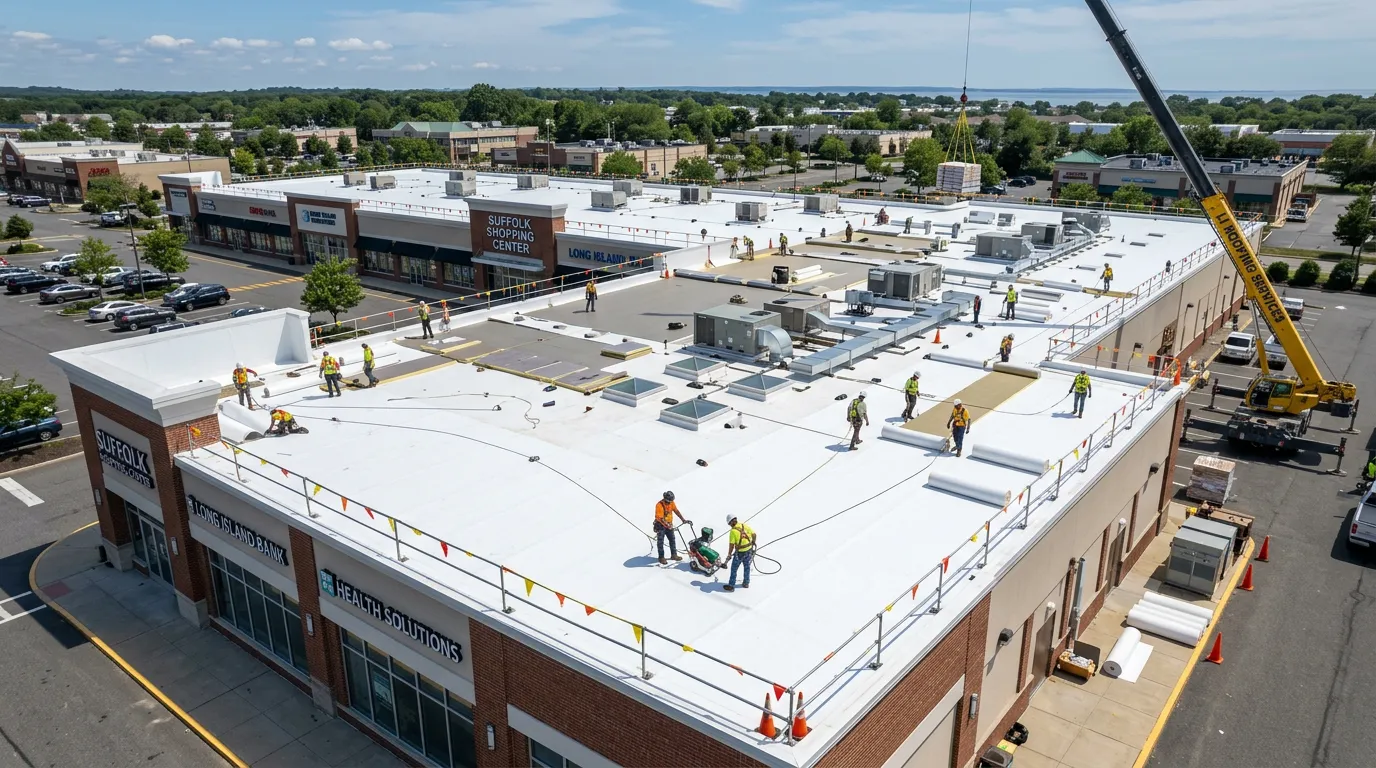
A flat commercial roof on Long Island doesn't usually fail in one dramatic storm. It fails the way most things fail out here, slowly, through forty to fifty freeze-thaw cycles a season while nobody's looking at the roof deck. Water sits in a low spot after a fall rain, freezes overnight, expands, and works a seam open by a sixteenth of an inch. Nobody notices until February, when that sixteenth of an inch is a running leak over the sales floor.
I've pulled apart enough TPO and modified bitumen roofs on strip plazas in Bay Shore and warehouses in Ronkonkoma to know the pattern. It's never the membrane in the middle of the field that goes first. It's the drain that's half full of oak leaves from October, the scupper nobody cleared after the last nor'easter, or the seam at a parapet wall where the flashing was cut a half-inch short twenty years ago and never touched since.
The real cost isn't the roof repair. It's the shutdown. A commercial leak in January doesn't wait for a convenient Tuesday. It drops water on inventory, on server racks, on a tenant's ceiling tile, and now you're calling your insurance carrier and explaining why the drain wasn't cleared in November. Every contractor who's worked this island through a winter has watched a business close for a few days over a problem a fall inspection would have caught.
Why Ponding Water Is the Real Enemy
Code allows a flat roof to hold some water temporarily, but the design intent is drainage within about forty-eight hours. On a lot of the commercial buildings I get called to, that clock never starts. Decades of rooftop unit changes, patch repairs, and minor deck settling leave low spots the original drainage plan never accounted for. Water collects, sits through a cold snap, and freezes solid. Ice doesn't just sit there, it expands under the membrane at every lap and seam, lifting adhesive and separating seams that were watertight in October. By the time it thaws, you've got a path straight into the deck that only shows itself as a stain on a ceiling tile weeks later.
The Freeze-Thaw Math on a Flat Roof
Long Island runs somewhere around forty to fifty freeze-thaw cycles in a normal winter, and every one of those cycles works a compromised seam a little further open. Add salt air coming off three sides of the island and you're corroding metal flashing, coping caps, and drain bowls faster than an inland roof ever would. Then a nor'easter comes through with sixty-mile-an-hour gusts and the wind gets under a seam that ice already loosened. None of these forces are dramatic on their own. Stacked together over a season, they're what turns a five-year-old roof into a liability.
Drains, Scuppers, and the Leaf Load Nobody Budgets For
Oak leaves mat down over a drain strainer and hold water like a sponge. Pine needles pack into scupper throats and are nearly impossible to see from the roof surface until you're on your knees with a flashlight. I check every drain, scupper, and internal leader on a commercial roof before December, because a clogged drain doesn't just cause ponding on the roof, it backs water up onto a loading dock or parking lot on properties with a high water table, which is most of the South Shore. If your site already fights standing water at grade, a rooftop drainage failure makes it worse, not separate. It's worth reading our downspout and drainage guide if your gutters and site drainage were already stressed this fall.
Seam and Flashing Inspection Before the First Freeze
A proper fall inspection isn't a walk across the field looking for obvious tears. It's a check of every transition point, because that's where flat roofs actually fail.
- Field seams and laps, checked for adhesion and any lifting at the edges
- Parapet wall flashing and coping caps, where salt air corrosion shows up first
- Curb flashing around every rooftop HVAC unit and exhaust fan
- Pitch pans around pipe penetrations, which dry out and crack faster than people expect
- Drain bowls and clamping rings, checked for a tight seal, not just clear of debris
- Pipe boots and vent flashing, a common source of slow leaks that get blamed on the membrane
On buildings in Huntington and Smithtown where the roof backs up to mature trees, I'll also check for branch scrape damage on the membrane itself, because a scraped seam is a weak point before winter even starts.
What a Winter Leak Actually Shuts Down
A residential leak is an inconvenience. A commercial leak is a business problem. It's inventory damage, it's a tenant lease dispute over who's responsible for interior repairs, it's a health inspector shutting down a kitchen because water hit a ceiling near food prep. And once water's been sitting in insulation for more than a couple of days, you're not just fixing a roof, you're dealing with a mold remediation timeline on top of it. If a leak does get ahead of you, our insurance restoration team handles the claim documentation while the roofing crew stops the source, so you're not managing two separate contractors during a shutdown.
Permits, Towns, and What Inspectors Actually Check
Commercial roof work triggers permits differently than a residential reroof almost everywhere on the island. Brookhaven, Islip, Smithtown, Huntington, Babylon, and Southampton all require a permit once you're replacing roofing over a certain percentage of the roof area, and several of these towns want an engineer's drainage calculation on file for flat and low-slope commercial roofs, not just a contractor's word that it drains. The Nassau towns run similar reviews, and inspectors are specifically looking for positive drainage and documented structural capacity anytime new rooftop equipment or additional insulation layers get added. Skip the permit and you're the one explaining it to your insurance carrier if a claim ever gets filed on that roof. Our commercial roofing crews pull the permit and handle the town inspection as part of the job, not as an afterthought.
What We Do
We inspect drains, scuppers, and every seam and flashing point on your commercial roof before the first hard freeze, clear what's clogged, repair what's failing, and document it for your insurance file. If a leak already got ahead of you this season, we handle that too.
Call (631) 312-7441 or book a free walkthrough.
Frequently Asked Questions
How often should a commercial flat roof be inspected before winter?
Once a year in the fall is the minimum, before the first hard freeze locks in whatever debris and ponding built up over summer and fall. Buildings near mature oak or pine trees, or with a history of ponding, benefit from a second check in early winter after the leaves are fully down.
Is ponding water on a flat roof always a problem?
Some ponding after a rain is normal on flat and low-slope roofs, but it should drain within about two days. Water that's still sitting after that, especially in the same spot every time, means a low area or clogged drain that will freeze and stress the seams underneath it.
Can a small roof leak really shut down a business?
Yes, and it's one of the more common calls we get in January. Water hitting inventory, electrical panels, server equipment, or a food prep area can force a temporary closure while repairs and cleanup happen, which is a bigger cost than the roof fix itself.
Do I need a permit to repair a commercial roof in Suffolk or Nassau County?
It depends on the scope. Most towns require a permit once repairs cover a significant percentage of the roof area, and several want a drainage or structural review on file for flat roofs. We handle the permit application and town inspection as part of the job.
What's the difference between a roof repair and a roof restoration?
A repair addresses specific failure points, like a seam, a drain, or a section of flashing. A restoration typically involves recoating or re-membraning larger sections of the roof and is usually recommended when multiple areas are showing age at the same time rather than one isolated problem.
How does salt air affect a commercial roof differently than an inland building?
Salt air accelerates corrosion on any exposed metal, coping caps, drain bowls, flashing fasteners, faster than it would inland. On a building close to the shoreline, metal components often need attention years before the membrane itself would otherwise be a concern.
Related Guides
- Downspout and Drainage Systems for Long Island Properties
- Chimney Flashing Leaks on Long Island Roofs
- Attic Ventilation Balance for Long Island Homes
- Roof Snow Load Considerations for Long Island Buildings
Get a Free Estimate from Alec's Construction
Licensed and insured, working across Nassau and Suffolk County since 2018. We come out, look at the actual job, and put a written number in your hand — no pressure, no obligation.
Book a Free WalkthroughOr call (631) 312-7441