A house on a quarter acre in Medford and a house three blocks from the water in Bay Shore see different snow, wind, and salt exposure, but they're both built to the same ground snow load number on paper. That number sits around 30 pounds per square foot for most of Nassau and Suffolk under the code we build to, and homeowners assume that's what their roof has to carry. It isn't quite that simple. Ground snow load gets adjusted down for roof slope, wind exposure, and how much heat is leaking out of your attic, so the open field of most Long Island roofs is actually designed around 20 to 25 pounds per square foot.
Where I actually get called out in January isn't for a roof that failed under a flat, even blanket of snow. It's for a roof that failed where the snow stopped being flat, a valley behind a dormer, the low slope where an addition meets the main house, a porch roof tucked under a taller wall. Wind scours snow off the open roof and dumps it into those pockets, and a drift three or four feet deep can weigh more per square foot than the code ever assumed for that spot. Add 40 to 50 freeze-thaw cycles a season, salt air off the Sound or the Atlantic working on fasteners and flashing, and oak and pine debris that clogged your gutters back in November, and you've got a roof section carrying more than it was ever built for while it's also weaker than it was ten years ago.
This article is about telling the difference between a roof that's fine under snow and one you need to deal with now, before a nor'easter puts three feet of wind-driven snow against your dormers.
What "Ground Snow Load" Actually Means for Your Roof The 30 psf ground snow load you'll see referenced on a Suffolk or Nassau permit is a starting number, not what's sitting on your shingles. Engineers apply an exposure factor for how much wind can scour snow off your roof, a slope factor because snow slides off an 8/12 pitch faster than it sits on a 3/12, and a thermal factor tied to how much heat your attic loses into the roof deck. A well-insulated, well-ventilated roof holds more snow longer because it isn't melting it from underneath. A roof over an under-insulated attic sheds snow faster in the field, which sounds good until that meltwater refreezes at the eave and starts an ice dam instead. If you're not sure which one describes your house, that's an attic problem before it's a roof problem, and it's worth reading about attic air sealing before you spend money up top.
Where the Real Weight Piles Up: Drift at Dormers and Additions Flat, uniform snow load almost never collapses a residential roof out here. Drift load does. Wind coming off the water picks up snow from an open roof plane and drops it against any vertical obstruction, a dormer cheek wall, a chimney, the wall where a two-story addition meets a one-story ranch. I've measured drifts against dormers in Smithtown and Huntington that were four times deeper than the snow sitting six feet away on open roof. Code accounts for this with a drift surcharge calculation, but that calculation assumes the framing under it was actually built to spec. On additions built by a prior owner, or a porch enclosed without an engineer, that framing is the first thing I check, because it's often undersized for the roof it's now tied into, before you ever add a drift load on top of it.
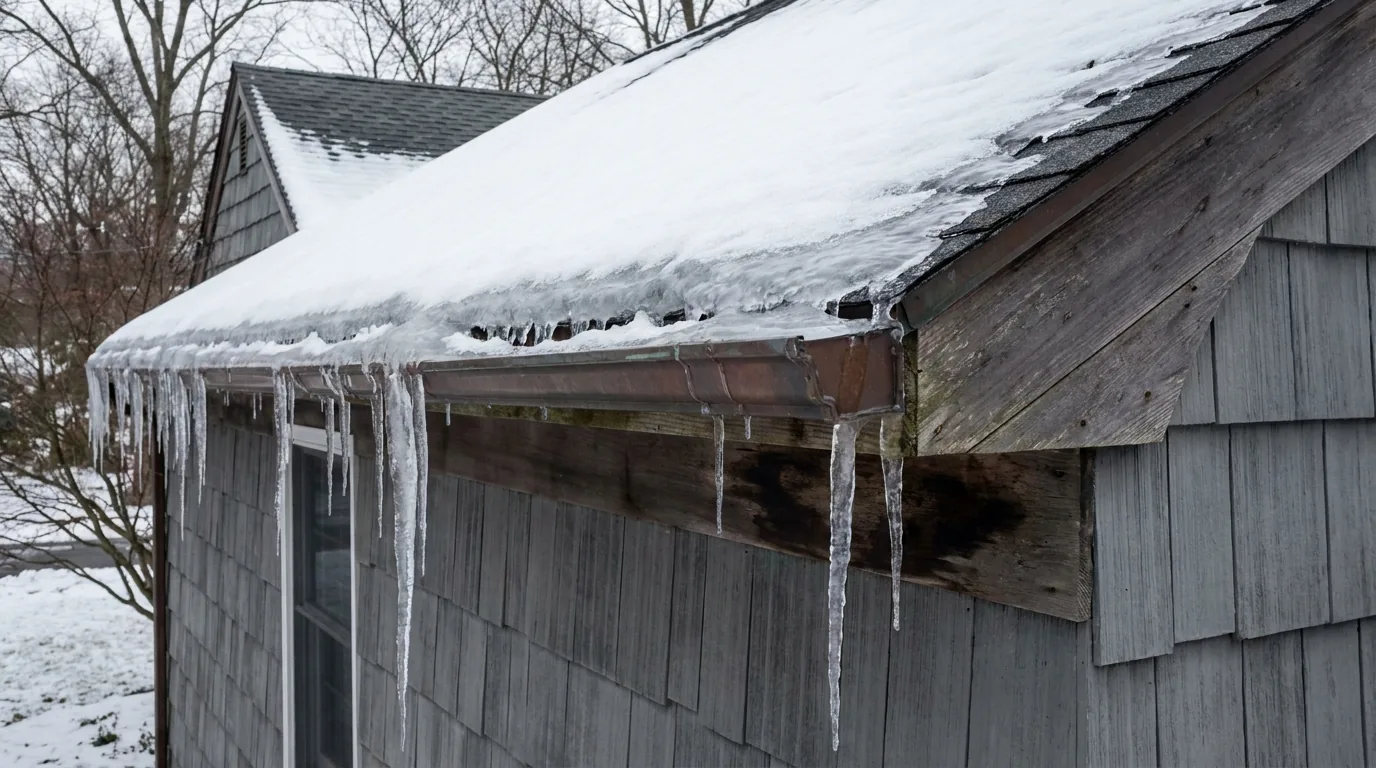
The Freeze-Thaw Cycle Nobody Budgets For Long Island runs somewhere around 40 to 50 freeze-thaw cycles a season, more on the North Shore where moisture off the Sound adds extra melt-refreeze events. Every cycle works water into any crack in your shingles, flashing, or sheathing, then expands it. A roof deck that was marginal in November is measurably weaker by February, right when snow load peaks. This is also how ice dams form at the eaves and back water up under your shingles, which has nothing to do with total snow weight and everything to do with a warm attic melting snow that refreezes the second it crosses over unheated soffit. If your gutters were packed with oak and pine debris going into winter, that ice dam problem gets worse, because trapped water has nowhere to drain. Clean gutters and working downspout drainage matter more in January than most homeowners think.
Signs Your Roof Is Actually in Trouble You don't need to guess. Walk your property after a snowfall and look for: - Doors that stick or a roofline that looks like it's sagging between rafters, not just buried under snow - Cracking or popping sounds from the attic during or after a storm - Water stains spreading on ceilings near a chimney or dormer wall, which usually means flashing failure, not structural risk - Snow that's visibly deeper in one section, a valley, a dormer, or where two roof planes meet, than everywhere else - Gutters pulling away from the fascia under ice weight None of these mean your roof is about to come down. Most of them mean you have a localized problem that gets worse if you ignore it through March.
When You Should Actually Clear a Roof Most Long Island homeowners who call me in a panic during a snowstorm don't need the roof cleared. A single storm, even a heavy one, is well within what a code-built roof holds. I tell people to get a roof rake out, or call for it, when you're looking at back-to-back storms without a thaw in between, when you can see a drift against a dormer or addition wall that's clearly deeper than the rest of the roof, or when you already know that section had a repair or a soft spot before winter. Clearing the open field of a roof after every snow isn't just unnecessary, it's how people put a ladder through their own gutters or punch a rake through shingles that have gone brittle in the cold. If you're worried about a specific section, that's a five-minute look I'll do rather than you guessing with a rake from the ground.
Flat and Low-Slope Sections Carry Different Rules Porch roofs, additions, and anything built at a low slope don't shed snow the way your main roof does, and they're the sections most likely to be under-built in the first place, especially if they were added after the house was originally permitted in Brookhaven, Islip, or Babylon. These are also the roofs most exposed to ponding, where meltwater sits instead of draining, adding weight the framing was never sized for. If you've got a low-slope roof over a porch or an add-on room and it's never been looked at structurally, that's worth doing before a season with back-to-back nor'easters, not after you notice a sag.
What We Do We inspect roof framing at dormers, additions, and low-slope tie-ins before winter, clear drift-prone sections when it's actually warranted, and handle the flashing, gutter, and roofing work that turns a bad snow season into a manageable one.
Call (631) 312-7441 or book a free walkthrough.
Frequently Asked Questions
How much snow load is my roof actually built for on Long Island?
Most homes here are engineered around 20 to 25 pounds per square foot on the open roof field once slope, exposure, and attic heat loss are factored in, even though the base ground snow load code references is closer to 30. Drifted areas against dormers, chimneys, and additions can carry far more than that field number.
Why does snow pile up so much deeper near my dormer than the rest of the roof?
Wind scours snow off open roof planes and drops it against the first vertical obstruction it hits, which is usually a dormer wall, a chimney, or the tie-in wall of an addition. That drifted snow can end up several times deeper than what's sitting on the open roof a few feet away.
Do I need to clear my roof after every snowstorm?
No. A single storm, even a heavy one, is normally well within what a code-built roof was designed to hold. Clearing is worth doing when storms stack up without a thaw between them, or when you can see a drift building against a dormer or addition wall.
How do freeze-thaw cycles affect roof snow load over a whole winter?
Each freeze-thaw cycle works water further into small cracks in shingles, flashing, and sheathing, weakening the deck over the course of the season. That means a roof section that was fine in November can be measurably weaker by February, exactly when snow load is at its highest.
Is a sagging porch roof after a snowstorm an emergency?
Any visible sag, cracking sound, or door that suddenly sticks after a storm is worth a same-week inspection rather than a wait-and-see approach. Porch roofs and additions are more often under-built for load than the main roof, so they're the first place I check.
Can ice dams cause the same damage as heavy snow load?
They cause different damage but they're related. Ice dams form when attic heat melts snow that refreezes at the unheated eave, and the backed-up water gets under shingles and into the deck rather than adding structural weight, which is why clean gutters and attic insulation matter as much as the snow itself.
Related Guides
- Downspout Drainage Before Winter
- Chimney Flashing Leak Repair
- Attic Air Sealing Guide
- Chimney Inspection Guide
Get a Free Estimate from Alec's Construction
Licensed and insured, working across Nassau and Suffolk County since 2018. We come out, look at the actual job, and put a written number in your hand — no pressure, no obligation.
Book a Free WalkthroughOr call (631) 312-7441