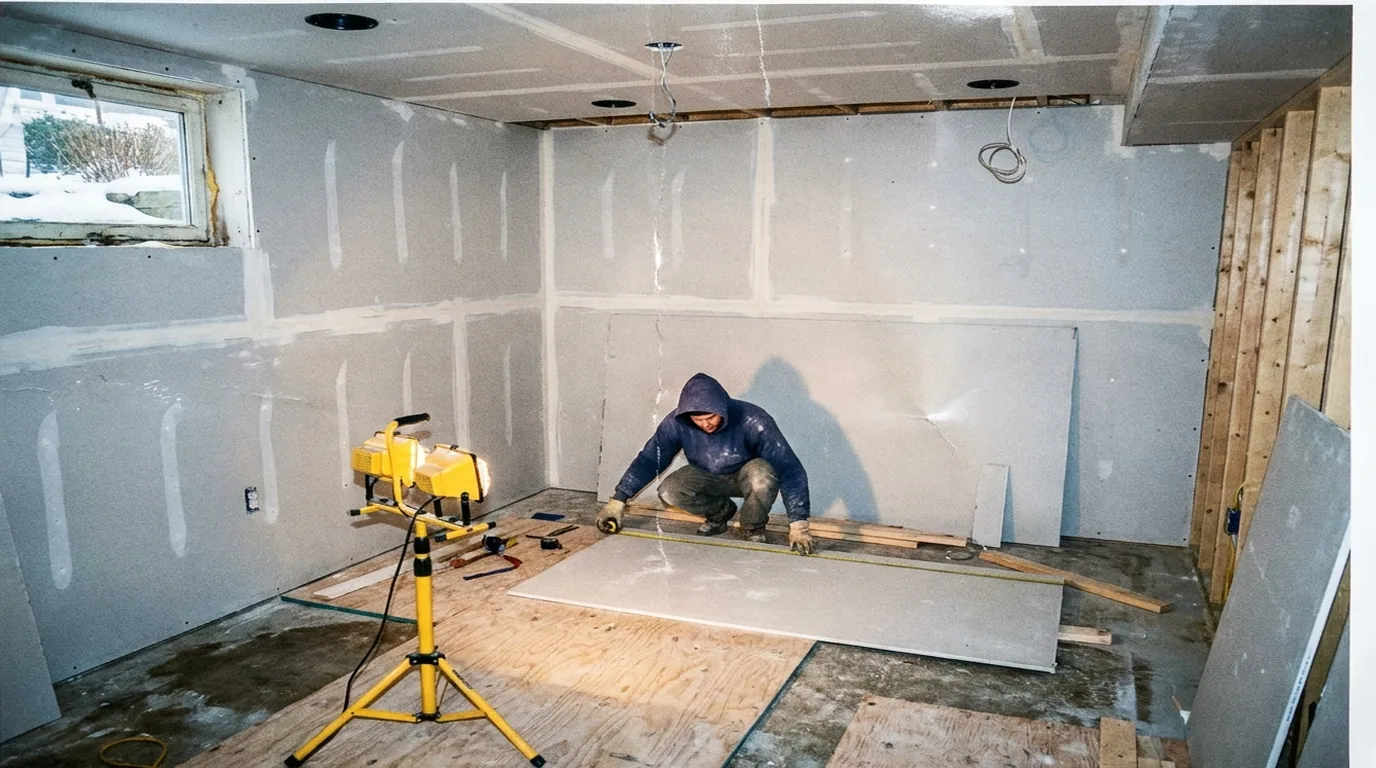
Plenty of Long Island houses sit on a crawl space rather than a full basement — ranches and capes through Holbrook, Medford, Shirley and the older waterfront stock, plus additions built onto houses that do have basements. It is the part of the house nobody goes into, and it is frequently where a cold floor, a musty smell and a heating bill all come from at once.
The Two Approaches
Vented. Foundation vents let outside air move through the crawl. The insulation goes in the floor above it, between the joists, and the crawl space is treated as outdoors. This is how most of these houses were built.
Sealed. The vents are closed, a heavy vapour retarder covers the ground and runs up the walls, the insulation moves from the floor to the foundation walls, and the crawl becomes part of the conditioned building — usually with either a small supply of conditioned air or a dedicated dehumidifier keeping it dry. The residential code recognises unvented crawl spaces and sets out what is required: a continuous ground vapour retarder, sealed and lapped, with either mechanically supplied air or continuous operation of a dehumidifier.
Why Venting Often Does Not Work Here
The theory of a vented crawl is that outdoor air carries moisture out. That works when the outdoor air is drier than the crawl. On Long Island in July it is not. Warm, humid summer air comes in through the vents, hits a foundation wall and a floor system that are sitting at ground temperature, and condenses on them. The vents that were supposed to dry the crawl are what is wetting it.
That is the mechanism behind the classic Long Island crawl space: damp joists, rusty duct straps, a musty smell that shows up in the house in August, and fibreglass batt that has fallen out of the joist bays and is lying on the ground.
The batt falling is not a coincidence. Face-stapled batt in a floor over a crawl gets damp, gains weight, and lets go. Once it is on the ground it is doing nothing, and half the crawl spaces we open have at least some of it down there.
When Vented Is Still the Right Call
- The crawl is genuinely dry, well drained and stays that way
- There is no ductwork or plumbing in it that matters
- The floor insulation is properly installed — in full contact with the subfloor, supported so it cannot fall, with the rim joist sealed and insulated
- Budget makes the sealed approach unrealistic right now
If you insulate the floor, the detail that matters is contact. An insulated floor with a two-inch air gap between the batt and the subfloor is not insulating the floor; it is insulating a ventilated cavity underneath it.
When Sealing Is Clearly Better
- Ductwork or an air handler is down there. Anything in a vented crawl is in an unconditioned, humid space, and duct losses in that space are losses to the outdoors.
- Plumbing runs through it. A sealed, conditioned crawl does not freeze pipes. A vented one on the South Shore in January absolutely can.
- The crawl smells, or the house does. Air moves upward through a house, and a meaningful share of the air you breathe on the ground floor came up out of the crawl.
- The floors are cold and the batt is on the ground. At that point you are paying for the sealed job either way; one version fixes it.
What a Sealed Crawl Actually Involves
1. Water first. Standing water, a high water table or drainage coming toward the house gets solved before anything is sealed. Sealing a wet crawl makes a sealed wet crawl. 2. Ground vapour retarder. A heavy liner over the whole floor, seams lapped and taped, carried up the foundation walls and sealed to them. 3. Wall insulation. Rigid foam or closed-cell foam on the foundation wall rather than in the floor above, carried up to and across the rim joist. 4. Rim joist. The band of framing on top of the foundation wall, sealed and insulated. It is the leakiest part of the assembly and it is easy to reach while the crew is in there. 5. Close the vents. Sealed, not just covered. 6. Moisture control. Either a small supply of conditioned air or a crawl-rated dehumidifier, per the code path being followed. 7. Combustion safety. If there is an atmospherically vented appliance in the crawl, that gets addressed as part of the design, not discovered afterwards.
The Flood-Zone Exception
On the canal streets of West Islip and Lindenhurst, the bay side of Shirley, and anywhere else inside a mapped flood zone, this is not a free choice. Flood-resistant construction requirements govern what can be installed below the design flood elevation, and enclosed areas below that elevation generally require flood openings that are not allowed to be sealed. The answer there is a different assembly and it is an address-level question for the building department before anything gets specified.
We are a general contractor, not an insulation-only outfit. That matters at the attic hatch more than anywhere else in the house, because the work that makes insulation perform is carpentry and roofing work — blocking, baffles, duct terminations, hatch covers and fascia. Alex and the crew walk the attic, photograph what is actually there, and put a written scope in your hand. Free walkthrough, no obligation, across Suffolk County.
Frequently Asked Questions
Should a Long Island crawl space be vented or sealed?
For most houses with ductwork, plumbing or a moisture problem down there, sealed performs better. The reason venting underperforms here is summer air: warm humid outdoor air entering a cool crawl condenses on the joists and the walls, so the vents that were supposed to dry the crawl are what wets it. A genuinely dry crawl with nothing in it can stay vented if the floor insulation is installed properly.
Why does my crawl space insulation keep falling down?
Face-stapled fibreglass batt in a floor over a damp crawl absorbs moisture, gains weight and pulls off its staples. Once it is lying on the ground it insulates nothing. It is one of the most reliable signs that the crawl has a moisture problem the floor insulation was never going to solve.
Do I insulate the floor or the walls of a crawl space?
One or the other, not both. If the crawl is vented and stays outdoors, the insulation belongs in the floor above, in full contact with the subfloor and mechanically supported. If the crawl is sealed and brought inside the envelope, the insulation belongs on the foundation walls and the rim joist and the floor is left open.
Can a crawl space be sealed in a flood zone?
Not freely. Inside a mapped flood zone, flood-resistant construction requirements govern what may be installed below the design flood elevation, and enclosed areas below it generally require flood openings that cannot be sealed shut. On the canal streets of West Islip and Lindenhurst and the bay side of Shirley this is the first question, and it is answered by the building department against the actual address.
Related Guides
- Attic Insulation on Long Island
- Blown-In vs Batt Insulation
- Spray Foam Insulation on Long Island
- Cape Cod Knee Wall Insulation
- Attic Air Sealing on Long Island
Work With Alec's Construction
This guide is written by the crew that does the work. See Alec's Attic Insulation service — air sealing, baffles and R-49 depth in the order that makes it work. One crew start to finish, free walkthrough and a written estimate inside 48 hours.
Booking the cold months now: we also handle Roofing and Windows & Doors.
Get a Free Estimate from Alec's Construction
Working across Suffolk County since 2018, one crew from start to finish. We come out, look at the actual job, and put a written number in your hand — no pressure, no obligation.
Or call (631) 312-7441