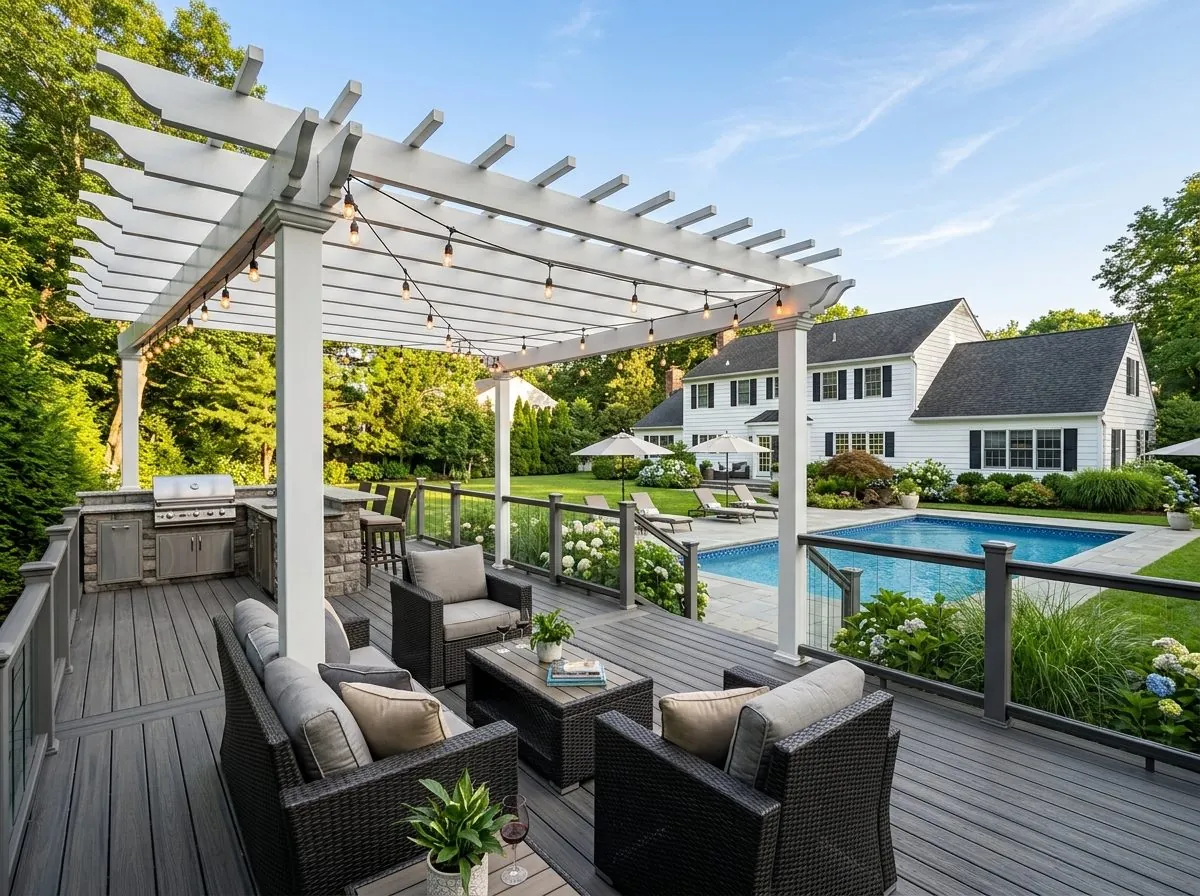
Huntington's moraine lots rarely offer a flat place to put a deck, and the single large platform the catalogs assume becomes, on a slope, a stilted shelf hovering over a hillside. The design that works here steps with the grade: a series of levels, each modest, connected by short stair runs, landing where the hill lands.
Why multi-level beats one big platform on grade
- Each level sits closer to its ground, so the structure stays honest — shorter posts, less bracing theater, guards where guards are needed and open edges where the drop is a step
- Levels zone themselves: cooking on the house level, dining a step down, a fire or spa terrace at grade — circulation the hill designs for you
- The lowest level often stops being deck at all and becomes patio — the deck-to-hardscape handoff on the downhill side is the signature north-shore move, and we build both sides of it
- Cost scales honestly: three modest levels usually price near one tall platform, because height is expensive and steps are not
Building around oaks, not through them
Huntington's mature oaks are worth more than any deck, and a slope lot's best trees are frequently exactly where the deck wants to go. Framing around a trunk — a generous well, not a snug collar, sized for decades of growth and trunk flex — keeps the tree and gains the shade. What matters underneath: footings placed off the critical root zone, hand-dug where the roots run, because pier holes through structural roots kill oaks on a five-year delay nobody connects.
The jurisdictions, as always
Huntington Bay, Lloyd Harbor and Asharoken run their own desks, and visible structures on harbor-side parcels get reviewed accordingly. Parcel check first; drawings to the right authority; the slope survey that the multi-level design needs anyway doubles as the permit exhibit.
Frequently Asked Questions
My back yard slopes away hard. Can I still have a deck?
Yes — but the design that works steps with the grade instead of fighting it: a series of modest levels connected by short stairs, each close to its own ground, often ending in a patio at the bottom. It zones itself naturally, the structure stays honest, and three stepped levels usually price near one tall stilted platform because height is expensive and steps are not.
Can you build a deck around my oak tree?
Yes, and on a Huntington lot it is often the right call — the tree is worth more than the deck. The framing gets a generous well sized for decades of trunk growth and flex, and the footings go off the critical root zone, hand-dug where roots run. Pier holes cut through structural roots kill oaks on a five-year delay; we plan the foundation around the root map first.
How long does a deck take to build?
Five to eight days on site for a typical 300 to 500 square foot composite deck, after permit approval. The permit is the calendar driver — most Suffolk towns require one for any attached or elevated deck, and lead times vary by town.
Do I need a permit for a deck on Long Island?
Almost always, for anything attached to the house or elevated. Incorporated villages run their own desks with their own timelines. We handle the drawings and filing as part of the job, and we confirm which authority governs your parcel before quoting.
Related Reading
- Deck Cost on Long Island — the honest number ranges
- Best Deck Materials — wood, composite and PVC compared
- Deck vs. Patio — which one your yard actually wants
- Deck Permits on Long Island — what triggers one and what it takes
- Hiring a Deck Builder — the questions that separate bids
- Deck repair and builders in Stony Brook — costs, permits and timelines
- Garage conversion in Huntington — the $125K grant, explained
Also Serving Huntington
- ADUs in Huntington — accessory apartments and grants
- Attic Insulation in Huntington — air sealing, baffles and R-49 depth
- Basement Finishing in Huntington — egress, ceiling height and moisture
- Bathroom Remodeling in Huntington — full gut renovations
- Chimney Repair in Huntington — repointing, crowns, caps and flashing
- Emergency Roof Repair in Huntington — tarping, leaks and storm response
- Fallen Tree Removal & Roof Repair in Huntington — tree off the house, roof supported and repaired
- Flood & Water Damage Cleanup in Huntington — wet material out, drying metered
- Front Steps & Stoops in Huntington — rebuilds, treads and railings
- Garage Conversion in Huntington — turning the garage into living space
- Gutter Installation in Huntington — seamless gutters, fascia and drainage
- House Painters in Huntington — exteriors while the fall window holds
- Hurricane & Storm Damage Repair in Huntington — trees, flooding, cleanup and repairs
- Storm Damage & Insurance Restoration in Huntington — emergency tarping and the claim
- Interior Painting in Huntington — the right work for the cold months
- Kitchen Remodeling in Huntington — cabinets, counters and layout
- Masonry & Pavers in Huntington — patios, walkways and retaining walls
- Roofing in Huntington — tear-offs, repairs and storm damage
- Siding in Huntington — James Hardie, vinyl and cedar
- Storm Debris Removal & Cleanup in Huntington — trees, building debris and hauling
- Storm Roof & Siding Repair in Huntington — wind damage, tarped and rebuilt
- Windows & Doors in Huntington — insert and full-frame replacement
Work With Alec's Construction
This guide is written by the crew that does the work. See Alec's Decks service — framing, composite and pressure-treated builds and repairs. Licensed and insured on Long Island, one crew start to finish, free walkthrough and a written estimate inside 48 hours.
Booking the cold months now: we also handle Roofing and Painting.
Every town here has villages inside it running their own building department. Our directory sorts out which counter your address actually files at.
Ready to Get Started?
Free deck design consultation with a written scope covering framing, footings, flashing and code guards. Nassau and Suffolk County.