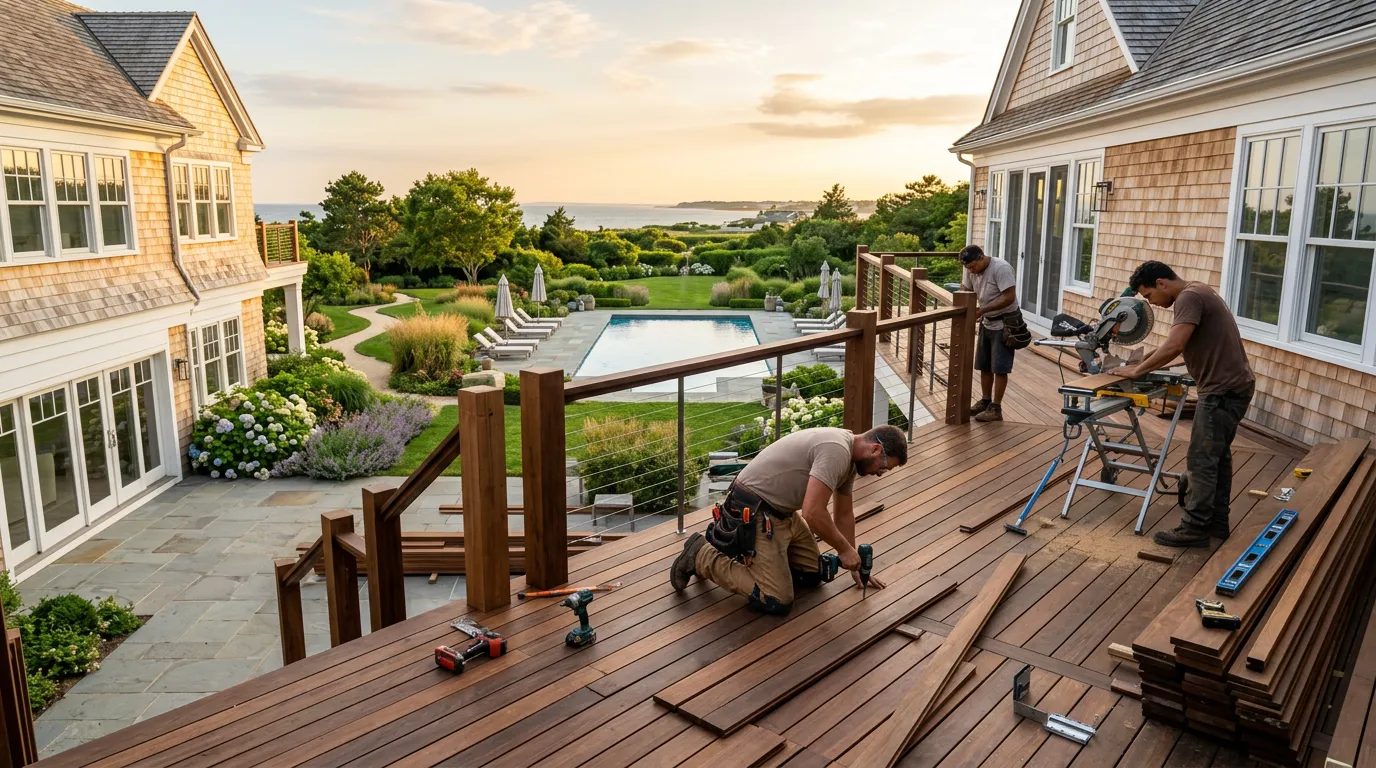
Decks are the project homeowners most often assume is simple. Most are not — Long Island's frost depth, coastal exposure and permit requirements all shape what gets built and what it costs.
Here are the questions we are asked most often before a deck goes in. Alec's Construction is a licensed Suffolk County general contractor serving Babylon, Islip, Brookhaven, Smithtown, Huntington, Riverhead and the East End.
How much does a deck cost per square foot?
Pressure-treated decks generally run $45 to $70 per square foot installed. Composite runs roughly $70 to $110, and hardwoods like ipe higher still. A typical 400-square-foot composite deck therefore lands somewhere around $28,000 to $44,000. Elevation drives cost as much as material — a deck more than a few feet off grade needs deeper footings, taller posts, guardrails and often stairs with landings.
Do I need a permit for a deck not attached to the house?
In nearly all cases, yes. Long Island towns generally require a building permit for decks above a modest height or size threshold, and attached decks almost always require one because they affect the structure of the house. Building without a permit risks a stop-work order and fines, and unpermitted structures surface during title work when you sell.
Composite vs wood deck: pros and cons
Composite costs roughly 50 to 80 percent more upfront and effectively eliminates sanding, staining and sealing. Pressure-treated costs less and needs cleaning and resealing every two to three years to stay sound. Over a fifteen-year horizon on Long Island — with salt air, humidity and freeze-thaw cycling — composite usually wins on total cost of ownership. Over five years, wood is cheaper.
How long does a deck last?
A well-built pressure-treated deck lasts roughly 15 to 20 years with consistent maintenance. Composite decking commonly carries 25-year or longer warranties on the boards. The limiting factor is rarely the surface — it is the framing, the ledger connection and the footings. Those are what fail, and they fail invisibly.
How deep do deck footings need to be?
Below the frost line, which on Long Island is generally taken as 36 inches. Footings that stop short will heave with freeze-thaw cycling and the deck will rack and separate from the house within a few seasons. This is the most common defect we find on decks built without permits or by unlicensed crews.
What is a ledger board and why does it matter?
The ledger is the board that fastens the deck to the house. It is the single most safety-critical connection in the entire structure, and improper ledger attachment is the leading cause of deck collapses nationally. It must be through-bolted or fastened with approved structural screws into solid framing, and it must be flashed so water cannot get behind it and rot the rim joist.
Can I build a deck over my existing patio?
Usually yes, and it is often a good solution when the patio has settled or cracked. Footings still need to go below frost depth, which means cutting through the slab at each footing location. Drainage under the new deck has to be considered so you are not trapping water against the foundation.
How long does it take to build a deck?
Permitting typically takes two to six weeks depending on the town. Construction on a straightforward deck runs one to two weeks. Multi-level decks, built-in seating, integrated lighting or curved framing extend that. Weather is the usual variable — footing inspections cannot happen in saturated ground.
Does a deck add value to my home?
Generally yes, and decks have historically been among the better-returning outdoor improvements. On Long Island, where outdoor living season is real but finite, a well-designed deck that connects properly to the kitchen or living space is more valuable than a large deck that is awkward to reach.
What maintenance does a deck need?
Wood decks need annual cleaning and resealing every two to three years. Composite needs periodic washing to prevent mold in shaded areas, which is common under Long Island tree cover. Regardless of material, the annual check that matters is structural: ledger flashing, fastener corrosion, post bases and any softness at the framing.
Do I need railings?
Code generally requires guardrails once the walking surface is more than 30 inches above grade, with specific height and baluster spacing requirements. Even below that threshold, railings are worth considering around stairs and near drop-offs. Baluster spacing exists to stop a small child passing through and is not a place to improvise.
When is the best time to build a deck?
Spring and fall are ideal for construction. The strategic move is to permit over winter so you are building the moment the ground is workable — that is how you get a finished deck for the start of the season rather than the end of it.
Composite vs wood deck: which holds resale value better?
Composite generally holds up better on resale, largely because buyers read it as low-maintenance and because it still looks presentable after a decade. A neglected wood deck reads as deferred maintenance and can actively cost you at inspection. That said, a well-maintained wood deck with sound framing shows well, and buyers on Long Island care more about whether the structure is safe and permitted than about the decking material.
Does composite decking get hot in the sun?
Yes, noticeably more than wood in direct sun, and it is worth planning around on a south or west-facing deck. Lighter colors run cooler than dark ones, and capped composites from the major manufacturers have improved. If the deck gets full afternoon exposure and will be used barefoot around a pool, factor color choice and shade into the design rather than discovering it in July.
Related Guides
- Best deck materials
- Deck permits on Long Island
- Composite decking guide
- Deck cost breakdown
- Deck maintenance
Work With Alec's Construction
This guide is written by the crew that does the work. See Alec's Decks service — framing, composite and pressure-treated builds and repairs. Licensed and insured on Long Island, one crew start to finish, free walkthrough and a written estimate inside 48 hours.
Booking the cold months now: we also handle Roofing and Painting.
Not sure whether the town or village files your permit? That question trips up more Long Island projects than any other — the directory sorts it out.
Have a Question We Did Not Answer?
Alec's Construction is a licensed Suffolk County general contractor. Tell us about your project and we will walk you through what is possible on your property, what it costs, and how long it takes.
Get a Free Consultation