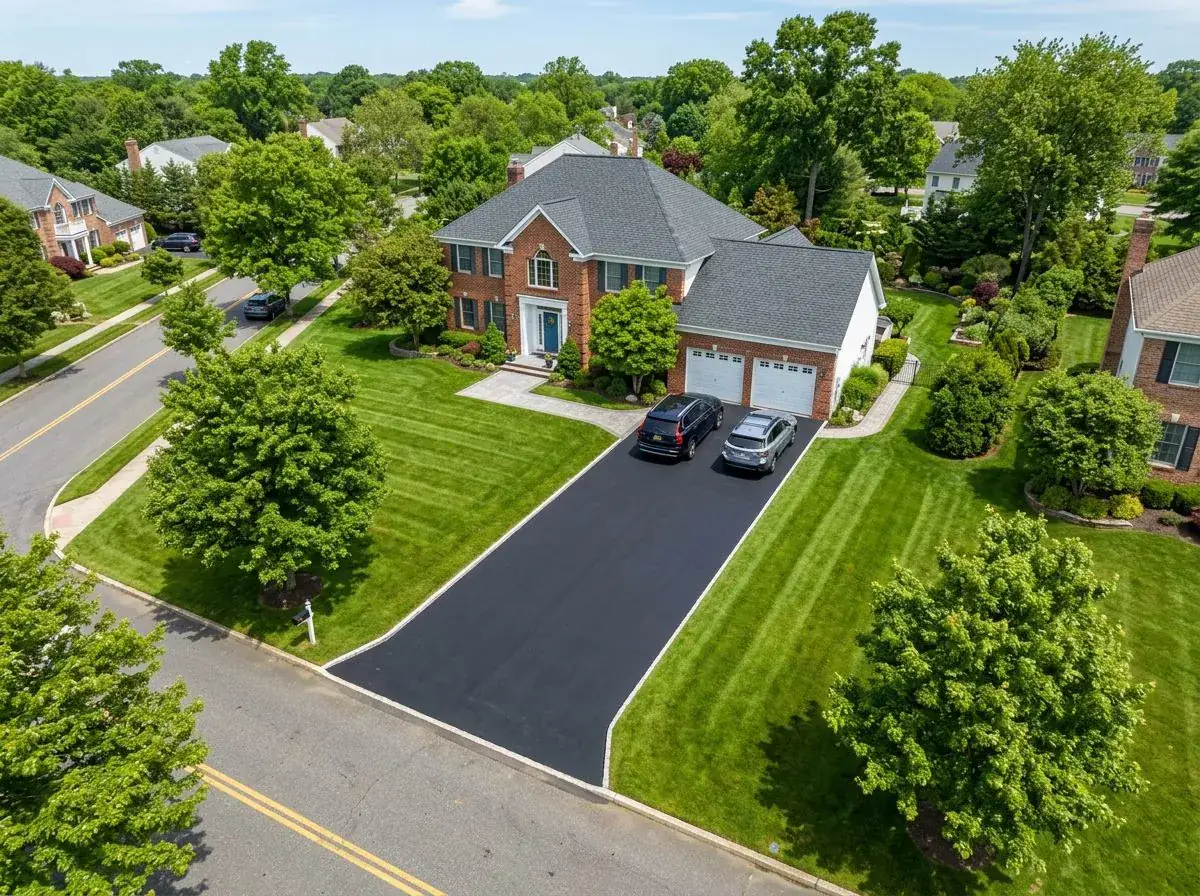
Holtsville's subdivision grid, threaded between the LIE and Waverly Avenue's corridor, deals corner lots by the score — and a corner lot holds a card mid-block owners never get: two street frontages, and the option to put the driveway on either one. Half the corner-lot paving jobs we quote here end up moving the curb cut, because the original builder put it on the wrong street.
When moving the driveway wins
- Off the busier street: a drive backing onto the collector road trades stress for safety twice a day — the side-street cut ends it
- With the garage, not against it: corner houses often present the garage to the side street anyway, and the wrapped front-street drive wastes thirty feet of asphalt reaching it
- For the yard: relocating the drive can consolidate the lot's open space into one usable yard instead of two margins
- For the slope: two frontages mean two grades, and the flatter approach wins the winter argument
What a relocation involves
A new curb cut and apron on the side street (Brookhaven Highway's desk), corner sight-line rules that keep the new cut clear of the intersection, closing the old cut honestly — curb restored, apron removed, the abandoned drive excavated and returned to lawn rather than left as a phantom parking pad — and the coverage math, which usually improves: the replacement drive is typically shorter than the one it retires, and shorter is cheaper forever.
The corridor households
Holtsville shares the airport-belt economy of its neighbors, and the work-vehicle question from our Bohemia page applies: box trucks, trailers and equipment parked at home want a deeper section and a reinforced pad where the point loads land, specified before the pour rather than discovered as alligatoring after. Tell us what parks there; the corner-lot relocation is frequently the moment the work vehicle finally gets a pad sized for it.
Otherwise, home-turf paving
Holtsville is ten minutes from our yard, on the same sandy outwash as East Patchogue — standard base depths, honest one-day installs, and the multi-neighbor mobilization discount wherever the same-age blocks are replacing together.
Frequently Asked Questions
Can I move my driveway to the side street on my corner lot?
Usually yes, and it is often the better driveway: off the busy frontage, aligned with the garage instead of wrapping to it, shorter, and frequently flatter. The moves are a new curb cut and apron on the side street through Brookhaven Highway, sight-line clearance at the corner, and closing the old cut honestly — curb restored, old drive excavated back to lawn. Coverage math usually improves because the new drive is shorter.
What happens to the old driveway when the new one moves?
It gets retired properly: apron removed, curb restored, and the abandoned drive excavated and returned to lawn — not left as a phantom parking pad that still counts against your lot coverage and still sheds water. Reclaiming that coverage is often what funds the better geometry of the new drive.
How long does a driveway take?
One day for a resurface on a typical residential driveway, one to two days for a full rip-out and repave. Park on it in 48 to 72 hours; full cure takes about 30 days.
Related Reading
- Driveway Curb Appeal — what buyers notice from the street
- Driveway Widening — the seam, the coverage math and the apron
- Blacktop Driveway Cost on Long Island — real per-square-foot numbers
- How Thick a Driveway Should Be — the spec that decides lifespan
- Driveway Paving on Long Island — the full homeowner guide
Work With Alec's Construction
This guide is written by the crew that does the work. See Alec's Driveways & Blacktop service — asphalt paving, resurfacing and sealcoating. Licensed and insured on Long Island, one crew start to finish, free walkthrough and a written estimate inside 48 hours.
Booking the cold months now: we also handle Masonry & Pavers and Roofing.
Every town here has villages inside it running their own building department. Our directory sorts out which counter your address actually files at.
Ready to Get Started?
Free on-site measure and a written price that lists base depth, asphalt thickness and compaction lifts. Most residential driveways are a one-day install.