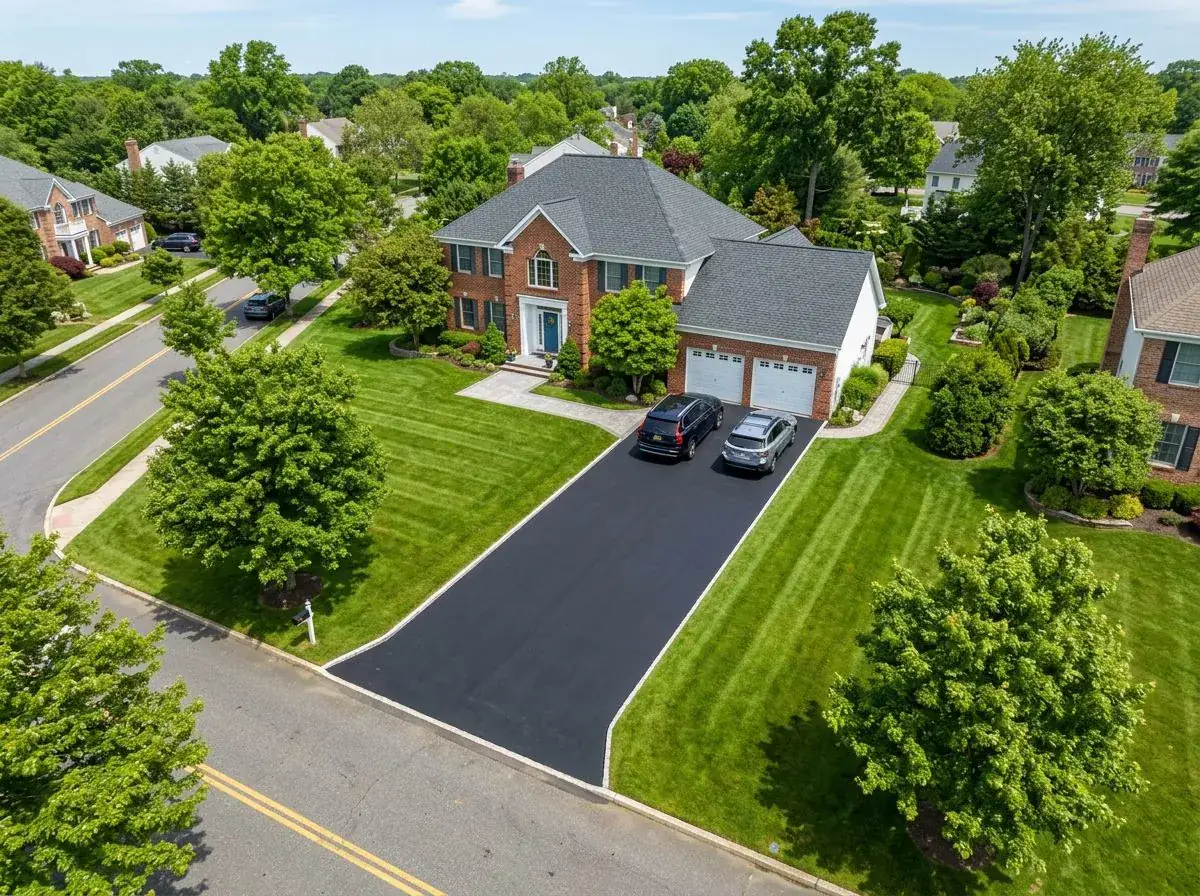
Shirley's streets have been opened more than most — post-Sandy utility rebuilds, service upgrades and new connections ran trenches under and across these blocks for a decade — and the signature driveway failure here is the result: a straight depression running across the drive, exactly the width of a trench, sinking a little more each year.
Why trench patches sink
- A utility trench is backfilled fast and compacted in one or two heavy lifts — nothing like the three-to-four-inch compacted lifts a driveway base gets — and loose backfill consolidates for years
- The asphalt patch over it is usually a cold-patch or a thin hot patch with no base rebuild, so it rides the settlement down
- Water follows the depression, gets into the seam around the patch, and freeze-thaw turns the stripe into a rut and then a pothole line
- Topping it up annually is maintenance theater: new asphalt over still-consolidating backfill sinks on the same schedule
The actual fix
Cut the failed zone back to sound pavement, excavate the trench line down to firm material, rebuild the base in proper compacted lifts — with flowable fill where the trench is deep, because it does not consolidate — and pave the lane as a bonded section, seams sealed. On a driveway due for replacement anyway, the rip-and-repave handles it wholesale: the trench line gets its base rebuilt as part of the excavation, and the new mat crosses it without a seam at all.
Who pays is worth ten minutes
If the trench was cut by a utility and the patch failed inside its warranty window, the restoration is arguably theirs — worth a call with photos before you spend your own money. We document the trench line and the patch condition as part of the estimate; sometimes that photo set is worth more than the paving.
The sandy base is on your side
Away from the trench lines, Shirley's outwash sand is honest driveway ground — fast-draining, standard base depths, predictable one-day installs. The trench stripe is the local complication; the rest of the job is as straightforward as paving gets on the Island.
Frequently Asked Questions
There is a sunken stripe across my driveway. What is it?
Almost certainly a utility trench — Shirley's streets have been opened repeatedly over the past decade, and trench backfill compacted in one heavy lift keeps consolidating for years under the thin patch that covered it. Topping it up annually just rides the settlement down. The fix is excavating the trench line to firm material and rebuilding the base in proper lifts — flowable fill where it runs deep.
The utility company patched my driveway and the patch failed. Do I have to pay to fix it?
Maybe not — if the patch failed inside the utility's restoration warranty window, the repair is arguably theirs. Call with photos before spending your own money. We document the trench line and patch condition as part of every estimate here; that photo set is sometimes worth more than the paving.
How long does a driveway take?
One day for a resurface on a typical residential driveway, one to two days for a full rip-out and repave. Park on it in 48 to 72 hours; full cure takes about 30 days.
Related Reading
- Repair or Replace — how to tell which you need
- How Thick a Driveway Should Be — the spec that decides lifespan
- Blacktop Driveway Cost on Long Island — real per-square-foot numbers
- When to Pave on Long Island — the thermometer that runs the calendar
- Driveway Paving on Long Island — the full homeowner guide
Also Serving Shirley
- ADUs in Shirley — accessory apartments and grants
- Attic Insulation in Shirley — air sealing, baffles and R-49 depth
- Basement Finishing in Shirley — egress, ceiling height and moisture
- Bathroom Remodeling in Shirley — full gut renovations
- Chimney Repair in Shirley — repointing, crowns, caps and flashing
- Emergency Roof Repair in Shirley — tarping, leaks and storm response
- Fallen Tree Removal & Roof Repair in Shirley — tree off the house, roof supported and repaired
- Flood & Water Damage Cleanup in Shirley — wet material out, drying metered
- Garage Conversion in Shirley — turning the garage into living space
- Gutter Installation in Shirley — seamless gutters, fascia and drainage
- House Painters in Shirley — exteriors while the fall window holds
- Hurricane & Storm Damage Repair in Shirley — trees, flooding, cleanup and repairs
- Storm Damage & Insurance Restoration in Shirley — emergency tarping and the claim
- Interior Painting in Shirley — the right work for the cold months
- Kitchen Remodeling in Shirley — cabinets, counters and layout
- Masonry & Pavers in Shirley — patios, walkways and retaining walls
- Roofing in Shirley — tear-offs, repairs and storm damage
- Siding in Shirley — James Hardie, vinyl and cedar
- Storm Debris Removal & Cleanup in Shirley — trees, building debris and hauling
- Storm Roof & Siding Repair in Shirley — wind damage, tarped and rebuilt
- Windows & Doors in Shirley — insert and full-frame replacement
Work With Alec's Construction
This guide is written by the crew that does the work. See Alec's Driveways & Blacktop service — asphalt paving, resurfacing and sealcoating. Licensed and insured on Long Island, one crew start to finish, free walkthrough and a written estimate inside 48 hours.
Booking the cold months now: we also handle Masonry & Pavers and Roofing.
We pull the permits on our own jobs — if you need the building department for your town, we keep a current directory of all 23 Long Island permit offices.
Ready to Get Started?
Free on-site measure and a written price that lists base depth, asphalt thickness and compaction lifts. Most residential driveways are a one-day install.