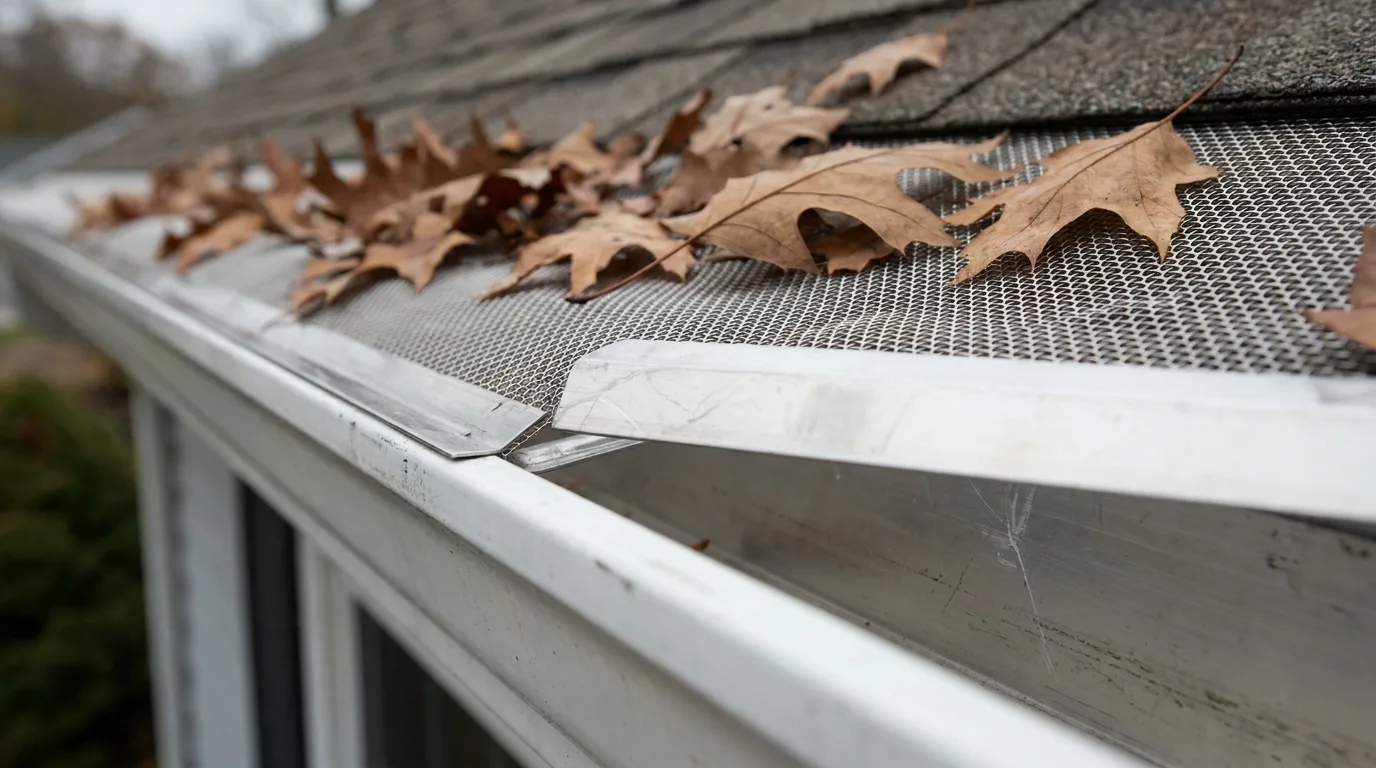
You call at 8pm on a Tuesday in November because water is running down your fascia and freezing into a sheet over your walkway. That's not a gutter that's failing, that's a gutter that never had a chance, buried under two feet of wet oak and pine debris since the first hard nor'easter blew through in October. I've pulled gallons of black sludge and pine needles out of gutters on capes in East Patchogue that hadn't been cleaned since the previous owner sold the house.
Long Island runs oak on the north side of most towns and pine stands wherever the soil gets sandy, which is most of Suffolk. Put a house under both and you get two totally different clog patterns hitting the same gutter system, one that mats and rots, one that needles through and jams. Add 40 to 50 freeze-thaw cycles a season and salt air working three sides of the house, and a clogged gutter doesn't just overflow, it becomes an ice dam that tears the gutter off the fascia by February.
Guards can fix this, but only the right guard for your tree cover, and only if the gutter and fascia underneath are sound before you put a guard on top of them. That's what actually decides whether the install is money well spent or a warranty claim waiting to happen.
The Two Trees That Wreck Long Island Gutters
Oak drops broad, flat leaves late, often after Thanksgiving on a mild year, and they arrive wet. Wet oak leaves mat together like paper mache and sit on top of most guard styles instead of sliding off. On a low-pitch ranch roof with a long, gentle slope, that mat doesn't get flushed by rain, it dries into a compost layer that holds moisture against the gutter face and starts the aluminum corroding from the outside in.
Pine is the opposite problem. Needles are thin enough to slip through anything but true micro-mesh, and even micro-mesh gets felted over with a needle mat that looks fine from the ground but blocks water like a coffee filter clogged with grounds. I see this constantly toward the pine barrens edge of Brookhaven, homeowners who installed a screen-style guard, watched it work great for two years, then found out their gutters were bone dry inside during a downpour because the needle mat on top was shedding water straight onto the lawn instead of into the trough.
Guard Styles and How They Actually Hold Up
- Micro-mesh, stainless frame - best all-around for mixed oak and pine. Blocks needles, sheds most oak leaf mats in wind, but needs an annual brush-off or soft wash, it is not a zero-maintenance product no matter what the salesman says.
- Reverse-curve (surface tension) helmet guards - work well on steep pitches where water has momentum, but on Long Island's flatter capes and ranches, heavy nor'easter rain rates overshoot the curve and dump water straight down the siding instead of into the gutter.
- Perforated screen - the cheapest option and the one I replace most often. Pine needles thread through the holes and pile up inside the gutter where you can't see them until the downspout backs up.
- Foam inserts - I don't install these anymore. They soak up water, freeze solid in a January cold snap, and hold that ice against the gutter metal all winter. I've pulled out foam that had turned to black mush inside gutters that were maybe five years old.
- Brush inserts - fine for light debris, useless against oak mat, and pine needles tangle in the bristles until the brush is doing more clogging than the gutter would on its own.
If your lot has real oak and pine cover, micro-mesh is the only style I'll warranty. Everything else is a compromise I'll walk you through, but I won't sell you a foam insert and call it a system.
What Drives the Cost of an Install
The guard itself is a small piece of this. What actually moves the number is the condition of what's underneath it. If your fascia board is soft or the gutter is already pulling away from the house from last winter's ice load, that gets fixed first, guards don't hold on to rotten wood any better than gutters do. Roof pitch and story count change access and labor time, a two-story colonial with a steep dormer roofline takes longer and needs different ladder work than a single-story ranch. Total linear footage matters obviously, but so does the number of corners, valleys, and downspout transitions, because guards have to be custom-cut and fitted at every seam, not just rolled out straight.
Fall is also the busiest season for this work on Long Island, every homeowner wants it done before the leaves finish dropping and before the first freeze, so scheduling itself becomes part of the equation. Book in September and you get more flexibility than calling in mid-November when every crew on the Island is booked through New Year's.
Salt Air, Freeze-Thaw, and the South Shore
Houses within a few miles of the Great South Bay or the Sound take salt air on top of the freeze-thaw cycle, and that combination eats through cheap aluminum guard fasteners faster than people expect. I use stainless hardware on anything within a couple miles of saltwater, full stop, coastal towns like Babylon, Bay Shore, and Southampton chew through galvanized screws in a few seasons. Inland toward Smithtown and Huntington you get more freeze-thaw stress and less salt, so the failure mode shifts from corrosion to guards popping loose under ice weight instead.
South Shore towns with a high water table add a separate problem that guards don't touch. If your downspouts dump water four feet from the foundation on sandy soil that's already saturated, a clean gutter just moves the flooding problem from your roof to your crawlspace. Guards keep the gutter itself flowing, but they don't fix where that water goes once it hits the ground, that's a downspout and drainage question, and I'd rather solve both at once than have you call me back in the spring about a wet basement.
Permits and Town Rules
Gutter guard installation itself doesn't trigger a building permit in Suffolk or Nassau in the vast majority of cases, it's not a structural change. Where it gets complicated is if the fascia or roof edge needs repair alongside the guard install, some townships want that portion inspected if it touches the roofline assembly, and HOA-governed developments in parts of Smithtown and Huntington have their own material and color approval process for anything visible from the street. I check the specific township and any HOA rules before I quote the job so there are no surprises once the crew is on the roof.
When Guards Don't Make Sense
If your fascia and soffit are already failing, fix those first, a guard on a rotten fascia board is wasted money, and that's a fascia and soffit repair job, not a guard job. If you're on a tight budget and your tree cover is light, sometimes twice-a-year cleanings cost less over five years than a full guard system, and I'll tell you that straight if it's true for your house. If you're doing a full fall maintenance pass anyway, it's worth bundling gutter work into that same visit instead of scheduling it separately.
What We Do
We install and warranty micro-mesh gutter guard systems built for oak and pine load, with stainless hardware on coastal jobs and a full fascia inspection before anything goes up, matched to your specific roofline and tree cover across Nassau and Suffolk. Learn more about our gutter services.
Call (631) 312-7441 or book a free walkthrough.
Frequently Asked Questions
Will gutter guards stop me from ever cleaning my gutters again on Long Island?
No system is maintenance-free with oak and pine mixed on the same roof. Micro-mesh guards cut cleanings down to roughly once a year instead of two or three, but pine needle felting still needs a brush-off. Anyone who tells you zero maintenance forever is selling, not installing.
Do gutter guards help prevent ice dams?
They help by keeping the gutter channel clear so meltwater has somewhere to go instead of backing up under the shingles. They don't fix an ice dam caused by poor attic insulation or ventilation, that's a separate problem tied to how the attic itself is sealed.
Can I put gutter guards on an older gutter system that already has some rust?
If the rust is surface level, yes, but I inspect the seams and hangers first because a guard adds weight and wind load the old gutter has to carry. If the gutter is pitting through or pulling away from the fascia, that gets repaired or replaced before any guard goes on.
Why do pine needles cause more problems than oak leaves?
Oak leaves are broad enough that most guards shed them in wind and rain. Pine needles are thin enough to slip through cheaper screens and mesh, then mat together on top of even good micro-mesh guards, quietly cutting off water flow while looking fine from the ground.
Do I need a permit for gutter guard installation on Long Island?
Typically no, since it's not a structural change to the house. If the job includes fascia or roofline repair, some townships want that portion inspected, and HOA communities may have their own approval process for visible exterior work.
Should coastal homes near the Great South Bay or the Sound use different hardware?
Yes. Salt air corrodes galvanized fasteners fast, so I use stainless steel hardware on anything within a couple miles of saltwater. Skipping that on a coastal install is the most common reason I get called back within a few years.
Related Guides
- Downspout and Drainage Guide
- Fascia and Soffit Repair Guide
- Fall Home Maintenance Checklist
- Gutter Services
Get a Free Estimate from Alec's Construction
Licensed and insured, working across Nassau and Suffolk County since 2018. We come out, look at the actual job, and put a written number in your hand — no pressure, no obligation.
Book a Free WalkthroughOr call (631) 312-7441