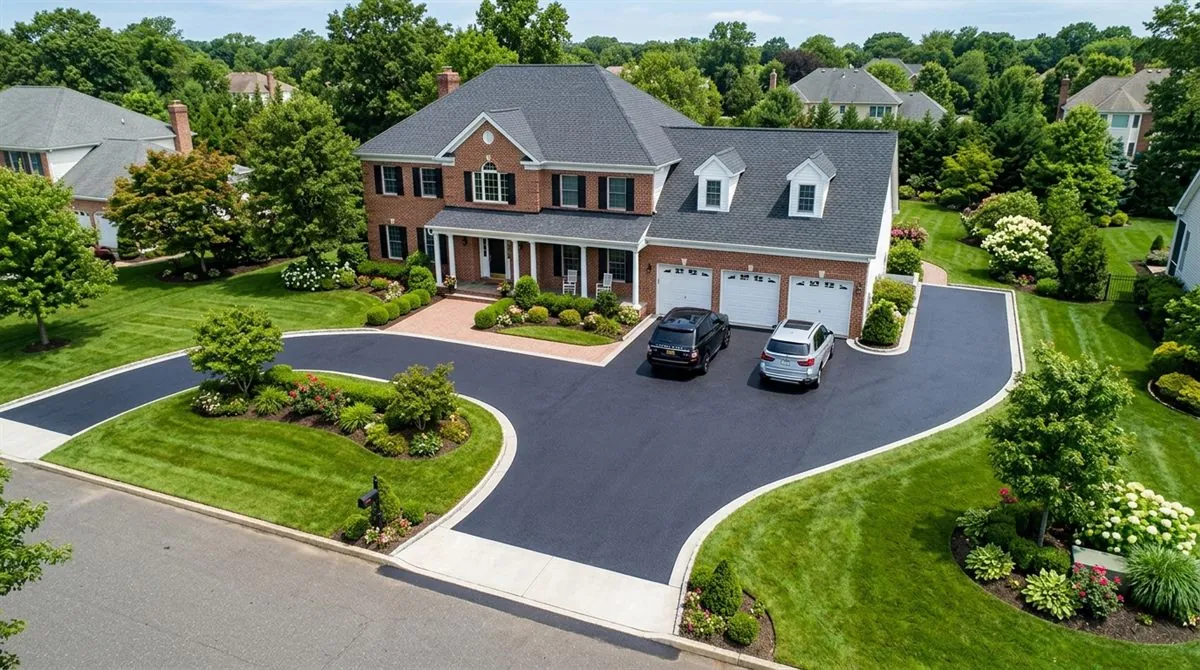
A well-installed blacktop driveway on Long Island will last between 15 and 25 years, depending on the quality of installation, how the driveway is maintained, and how aggressively Long Island's climate works against it. That is a wide range — and the difference between a 15-year driveway and a 25-year driveway almost always comes down to the decisions made at installation and in the first five years of ownership. At Alec's Construction, we have laid hundreds of driveways across Suffolk County and we know exactly what separates a driveway that holds up from one that falls apart in a decade.
Why Long Island Is Hard on Blacktop
Long Island's climate is one of the most demanding environments for asphalt in the northeastern United States. Here is what you are up against:
Freeze-thaw cycles. Suffolk County averages 25 to 35 freeze-thaw cycles per winter — days where temperatures rise above freezing during the day and drop below at night. Water seeps into small surface cracks, freezes, expands, and widens those cracks with each cycle. By spring, what started as hairline cracking can become potholing and alligator cracking that reaches deep into the base. This is the single biggest enemy of Long Island blacktop.
Salt damage from coastal air and road treatment. Properties near the coast — Bay Shore, Sayville, Patchogue, the Hamptons, the North Shore — are exposed to salt-laden air year-round. Sodium chloride, the primary ingredient in road salt, draws moisture into asphalt and accelerates oxidation of the binder that holds aggregate particles together. Oxidized asphalt turns gray, becomes brittle, and loses its flexibility — exactly the flexibility it needs to flex under freeze-thaw stress without cracking.
Heavy vehicle loads. Long Island driveways frequently absorb loads they were not designed for: delivery trucks, oil company tankers, garbage trucks turning around in the driveway. Repeated heavy loads on asphalt that is not adequately thick or properly based will cause premature rutting and edge cracking.
Tree root intrusion. Many Long Island properties have mature trees close to driveways. Oak, maple, and locust root systems will find their way under asphalt and push up through the surface. If trees are within 15 feet of your driveway, root intrusion should be planned for at installation.
Need a blacktop estimate?
Free walkthrough — no obligation, no pressure.
What Makes Blacktop Last Longer
The lifespan of your driveway is largely determined at the moment of installation. Here are the factors that separate a 25-year driveway from a 12-year one:
- Base depth. A Long Island driveway needs a minimum of 6 inches of compacted gravel base (8 inches is better on soft or clay-heavy soils). Contractors who cut corners and lay asphalt directly on a 3-inch base are setting you up for failure within a few years.
- Asphalt thickness. Residential driveways should be installed at 3 inches of compacted asphalt, minimum. Commercial driveways and areas that regularly see heavy vehicles need 4 to 6 inches. Anything under 2.5 inches will crack and fail under normal use.
- Proper drainage slope. Water that pools on the surface or does not drain away from the edges will saturate the base and undermine the entire structure. A proper crown or cross-slope of at least 1–2% is essential.
- Quality of mix. Not all asphalt is the same. A dense-graded mix with the right aggregate-to-binder ratio handles freeze-thaw cycles significantly better than cheap hot-mix that is heavy on fines.
- Edge support. Unsupported edges are the first thing to crack. Compacted shoulder material or concrete edging on driveway perimeters extends life by years.
The Maintenance Schedule That Doubles Driveway Life
Even the best-installed blacktop needs attention to hit that 25-year mark. Here is the maintenance timeline we recommend to every homeowner in Suffolk County:
- Year 1: Do nothing. New asphalt needs 6 to 12 months to cure. Sealcoating too early can trap oils and cause soft spots.
- Year 2–3: Apply the first sealcoat. Use a coal-tar or acrylic sealer (asphalt emulsion is the minimum acceptable quality). This fills surface voids, protects against UV oxidation, and restores the surface's water-resistance. Cost for a typical Long Island driveway: $200–$500 professionally applied.
- Every 3–5 years: Reapply sealcoat. Avoid over-sealing — building up too many layers creates a surface that peels. One thin, even coat every 3 to 5 years is the right cadence.
- Annually (spring): Inspect for cracks. Any crack wider than 1/4 inch should be filled with hot- or cold-pour crack filler before water penetrates. Left untreated, cracks become potholes in 1 to 3 winters.
- Year 10–15: Consider an overlay or milling/resurfacing assessment. If the base is still sound and cracking is limited to the surface layer, a 1.5-inch overlay can extend driveway life by another 10 to 15 years for a fraction of full replacement cost.
Signs Your Blacktop Needs Replacement (Not Just Repair)
Knowing when to repair versus replace saves money. Here are the indicators that repair is no longer cost-effective:
- Alligator cracking across more than 25% of the surface. This pattern of interconnected cracks indicates base failure. Crack filling and sealcoating will not address the underlying problem.
- Multiple potholes. Potholes in multiple locations indicate the base has been compromised by water infiltration and freeze-thaw damage throughout.
- Significant rutting or depressions. Low spots that collect water will continue to deteriorate faster than the rest of the driveway.
- Driveway is 20+ years old. At this age, the asphalt binder has typically oxidized to the point where the surface is too brittle to hold repair materials. Full replacement delivers better value.
Licensed & Insured
Full coverage on every project
48-Hour Estimates
Fast, no-obligation quotes
Crack-Free Guarantee
We stand behind our work
Blacktop Costs on Long Island in 2026
A full blacktop driveway installation in Suffolk County currently runs between $4 and $8 per square foot for residential work, depending on the depth of base required, whether old material needs to be removed and hauled, and the complexity of the layout. A typical two-car driveway (roughly 600 square feet) costs $2,400 to $4,800 installed. Overlays on sound existing base run $2 to $4 per square foot. These numbers move with asphalt commodity prices, which fluctuate with oil — the primary input in asphalt binder.
For a free on-site estimate, call (631) 312-7441 or visit our blacktop and paving service page. We serve all of Suffolk County, from Bay Shore and Patchogue to Smithtown and the Hamptons.
Frequently Asked Questions
When should I sealcoat a new driveway?+
Can I repair cracks myself?+
Does blacktop last longer than concrete?+
Related Articles
Work With Alec's Construction
This guide is written by the crew that does the work. See Alec's Driveways & Blacktop service — asphalt paving, resurfacing and sealcoating. Licensed and insured on Long Island, one crew start to finish, free walkthrough and a written estimate inside 48 hours.
Booking the cold months now: we also handle Masonry & Pavers and Roofing.
We keep a permit office directory for Nassau and Suffolk, checked against each jurisdiction's own site, because we file in these counters constantly.
Get a Free Blacktop Estimate
Licensed, insured, and paving driveways across Suffolk County. Contact Alec's Construction for a no-obligation quote.
Request Your Free Walkthrough